

First Impressions and Platform Overview
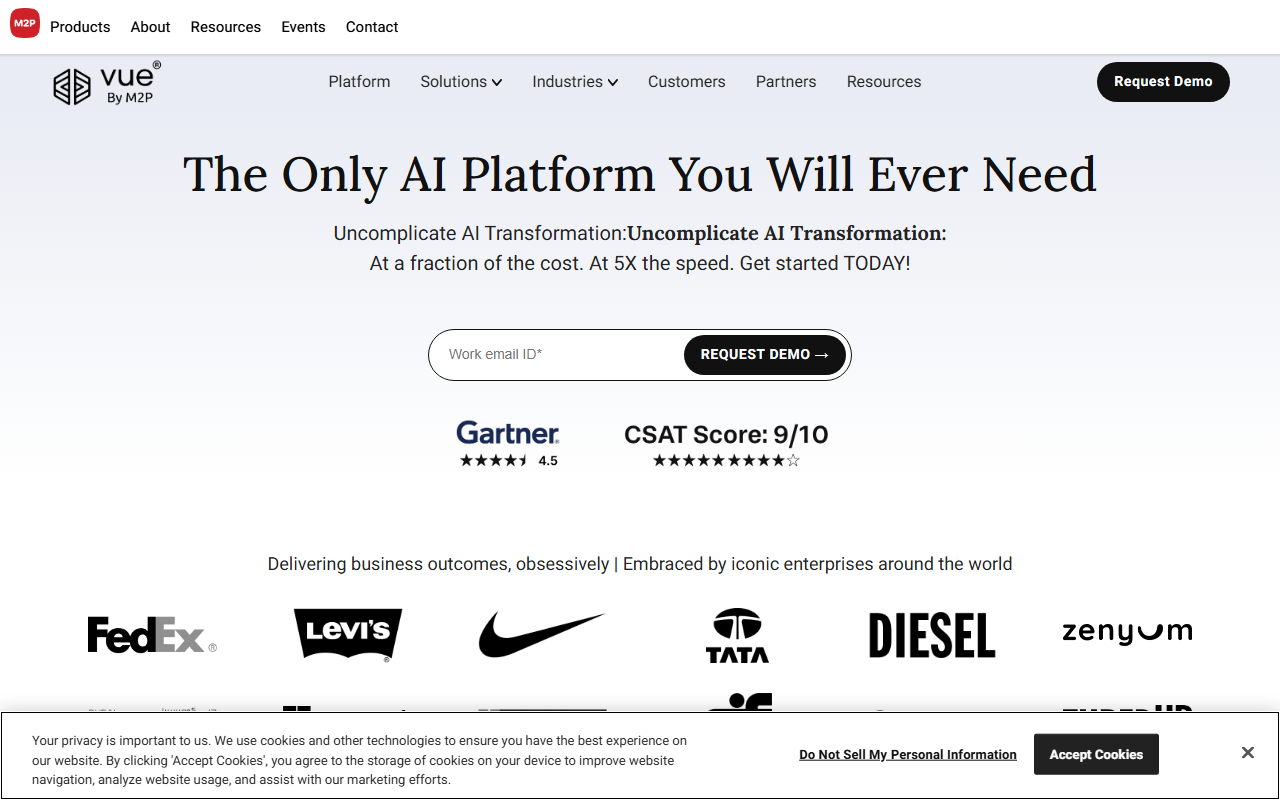
Upon visiting Vue.ai's website, I was immediately struck by the bold promise: 'The Only AI Platform You Will Ever Need.' The homepage emphasizes rapid deployment—'go-live today' and a 30:60:90 framework for pilot, proof, and scale. The dashboard-like navigation reveals four core hubs: Data Hub, Customer Hub, Automation Hub, and Optimization Hub. Each hub houses specific tools like product tagging, audience building, intelligent document processing, and lead generation. The design is enterprise-centric, with clean modules and a prominent 'Request Demo' form. I tested the demo request flow and found a straightforward form asking for contact details and agreeing to communication—a standard enterprise SaaS gate. The site also showcases several industry verticals: eCommerce, financial services, insurance, logistics, and healthcare. Notably, the tag 'Image AI > AI Design' from the review prompt suggests visual applications, but the platform is much broader, covering data cleanup, personalization, workflow automation, and optimization. When evaluating the free tier, I discovered none exists; this is purely a custom-priced enterprise solution.
Core Capabilities and Technical Architecture
Vue.ai positions itself as an 'AI orchestration' platform rather than a collection of isolated models. The platform's architecture is composable and modular, built with an AI-native approach. Key technical features include Data Self-Prep AI for ingesting and cleaning messy data, Adaptive Automation for machine-first guided processing, and Composable Workflows via a drag-and-drop low-code interface. Self-learning AI with active learning and federated models allows the system to adapt to context shifts. A standout is the 'Quick Bootstrap with Little Data' capability—training models with small data samples for fast time-to-value. The High Dimensional Graphs component provides rich customer and product relationship maps. Unlike many AI vendors that focus solely on model performance (e.g., DataRobot), Vue.ai emphasizes a data-centric approach: clean and organize data first, then apply AI across multiple use cases. This contrasts with point solutions like Salesforce Einstein, which are more CRM-tied. Vue.ai's promise is a single platform that replaces multiple single-purpose apps, reducing integration complexity. The 30:60:90 accelerator guarantees a pilot in 30 days, ROI proof by day 60, and scaling by day 90—an aggressive timeline that large enterprises may find appealing.
Use Cases and Industry Focus
Vue.ai targets complex workflows across industries, with detailed tables for each vertical. For eCommerce, use cases include product tagging, content moderation, automated on-model imagery, virtual dressing rooms, and personalized marketing journeys. For financial services, the platform offers document data extraction, customer taxonomy creation, and fraud detection snippets. The Automation Hub handles intelligent document processing and workflow automation, while the Optimization Hub tackles sales efficiency and lead generation. The website features case studies and resources (blogs, podcasts, reports), indicating a rich content backend. I examined the 'How 125 enterprises across 10 industries use AI' report, which suggests real-world traction. However, the site lacks transparent pricing or a self-serve trial, meaning potential buyers must engage with sales for a demo. This makes detailed feature verification difficult without direct access. The platform appears best suited for large organizations already investing in AI transformation projects, especially those in retail, finance, and insurance. It is less appropriate for small businesses or individual users who need quick, low-cost AI tools.
Pricing, Limitations, and Verdict
Pricing is not publicly listed on the website. Vue.ai uses a demo-only model typical for enterprise platforms, quoting based on custom requirements. This opacity can frustrate smaller evaluators. Strengths include the comprehensive all-in-one approach—data management, customer engagement, automation, and optimization under one roof—and the aggressive deployment timeline. The 30:60:90 framework with accountability (walk-away clauses) builds trust. However, limitations are clear: no free tier, no transparent pricing, and a heavy enterprise focus that may overwhelm teams without dedicated AI resources. The platform's breadth could also lead to complexity during initial implementation, despite claims of speed. Compared to competitors like H2O.ai (more open-source and model-centric) or Adobe Experience Cloud (stronger in marketing analytics but narrower), Vue.ai targets a holistic transformation. My honest recommendation: Vue.ai is a powerful choice for large enterprises seeking to consolidate AI initiatives into a single orchestrated platform with fast time-to-value. If you are a mid-sized business or an individual, consider lighter alternatives like Zapier for workflow automation or a specialized image AI tool. Visit Vue.ai at https://vue.ai/ to explore it yourself.













Comments