

First Impressions and Onboarding
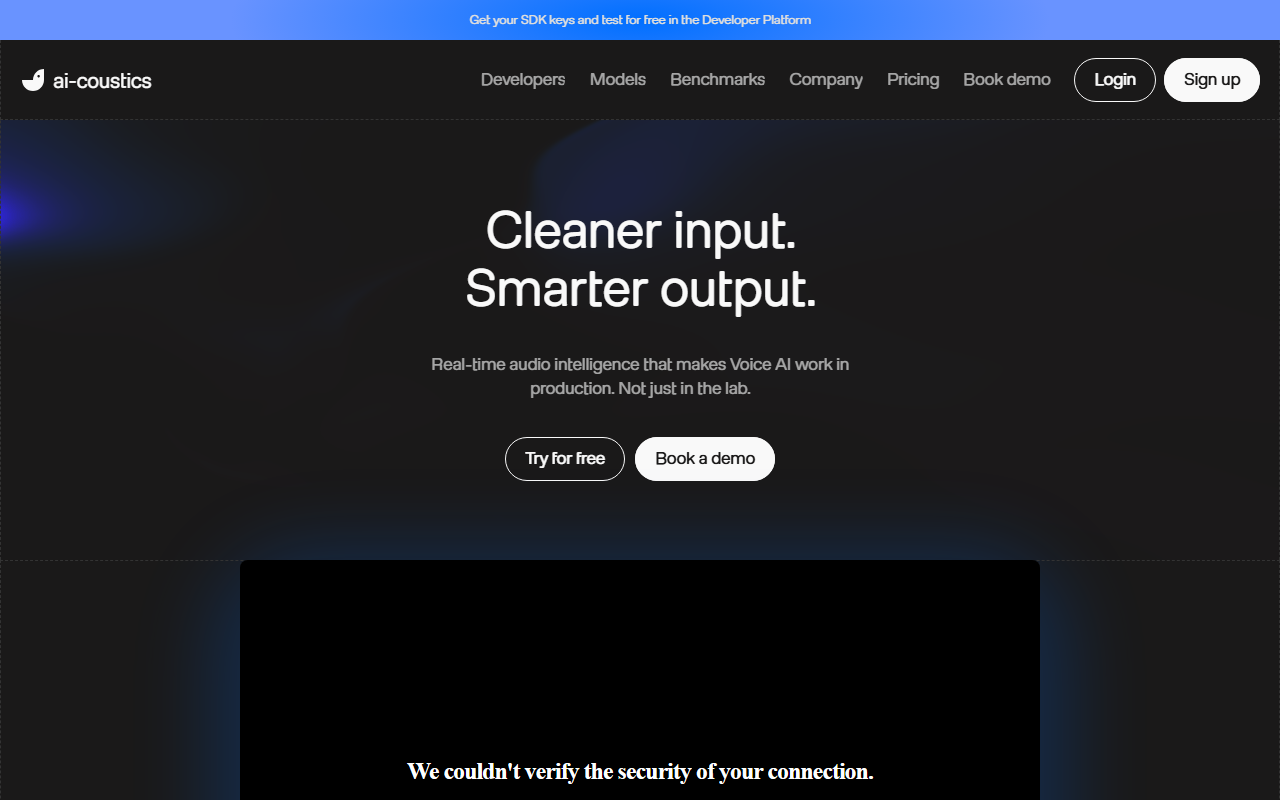
Upon visiting the ai-coustics website, the messaging is immediately clear: this is a developer-first audio intelligence layer. The tagline “Cleaner input. Smarter output.” succinctly frames the core problem — Voice AI pipelines degrade when fed unpredictable, real-world audio. The page leads with a “Try for free” call-to-action that directs you to a Developer Platform where you can test models and generate SDK keys. I explored the dashboard briefly; it offers a drop-in sandbox to upload or stream audio samples and returns enhanced output within seconds. The onboarding flow is minimal — sign up, get an API key, and integrate via a lightweight SDK that claims to work without a GPU or ONNX dependency. For teams already building with Python, C++, or Unity, the setup seems straightforward.
Core Capabilities and Technical Edge
ai-coustics addresses a critical pain point in production Voice AI: “bad audio breaks voice agents.” The tool provides three specialized models under the Quail brand. Quail is a speech-to-text primer that reduces Word Error Rate by up to 43% in noisy conditions. Quail VAD offers voice activity detection that outperforms Silero VAD in accuracy and reliability. Quail Voice Focus isolates the foreground speaker, suppressing competing voices — essential for call-center agents or multi-party conferencing. The technology runs in under 30ms latency at 8 and 16 kHz PCM, making it suitable for real-time voice pipelines. The team trained on over 500 types of noise and more than a million acoustic environments, covering stationary, non-stationary, impulsive interference, and reverberant spaces. This depth of training data gives the models a robustness that standard denoisers lack. Unlike many competitors that require separate noise reduction and VAD tools, ai-coustics bundles these capabilities into one SDK, simplifying the stack.
Integration and Real-World Performance
The SDK is designed to drop into existing voice stacks with “native integrations for every major framework.” Testimonials from engineers at Elgato, Synthesia, and HiDesk reinforce its production readiness. One reviewer noted “major performance improvements in turn-taking as well as audio understanding” across Voice Agents. Another highlighted how cleaning audio upstream for voice cloning tasks keeps speaker identity stable. The platform processes millions of minutes weekly across 187 countries and 150+ languages — a strong indicator of scalability. In terms of market positioning, ai-coustics competes broadly with generic audio enhancement APIs (e.g., Krisp) and specialized speech enhancement models like NVIDIA Riva. But ai-coustics differentiates by focusing exclusively on the Voice AI pipeline — ASR, VAD, TTS — rather than general-purpose noise cancellation. The emphasis on real-time, low-latency processing without GPU requirements makes it particularly attractive for edge deployments or cloud-based voice agents.
Pricing and Target Audience
Pricing is not publicly listed on the website. The only option shown is a “Book a demo” for enterprise inquiries and a free trial tier through the Developer Platform. This suggests a usage-based or subscription model, likely tiered by minutes processed or number of API calls. The absence of transparent pricing is a limitation for small teams or indie developers who need to budget upfront. For larger voice AI teams with production-scale needs, ai-coustics appears to offer significant value — improving ASR accuracy, reducing mis-dialogues, and lowering compute costs from retries. However, casual users or those building simple voice apps may find the complexity and lack of a clear free tier off-putting. The tool is best suited for engineering teams at companies building voice assistants, call center automation, or real-time transcription services. If you are already using an ASR model like Whisper or Deepgram and struggle with noisy input, ai-coustics could be the missing audio reliability layer. For those seeking a budget-friendly, open-source alternative, tools like Silero VAD combined with RNNoise exist, but they lack the integrated, production-tested ecosystem ai-coustics provides.
Verdict: ai-coustics is a polished, developer-centric solution that demonstrably cleans audio in real time for Voice AI. Its strengths — low latency, no GPU dependency, multi-model suite — outweigh the lack of public pricing. I recommend requesting a demo if you are architecting a voice-first product and consistently battling audio quality issues.
Visit ai-coustics at https://ai-coustics.com/ to explore it yourself.












Comments