

First Impressions and Onboarding
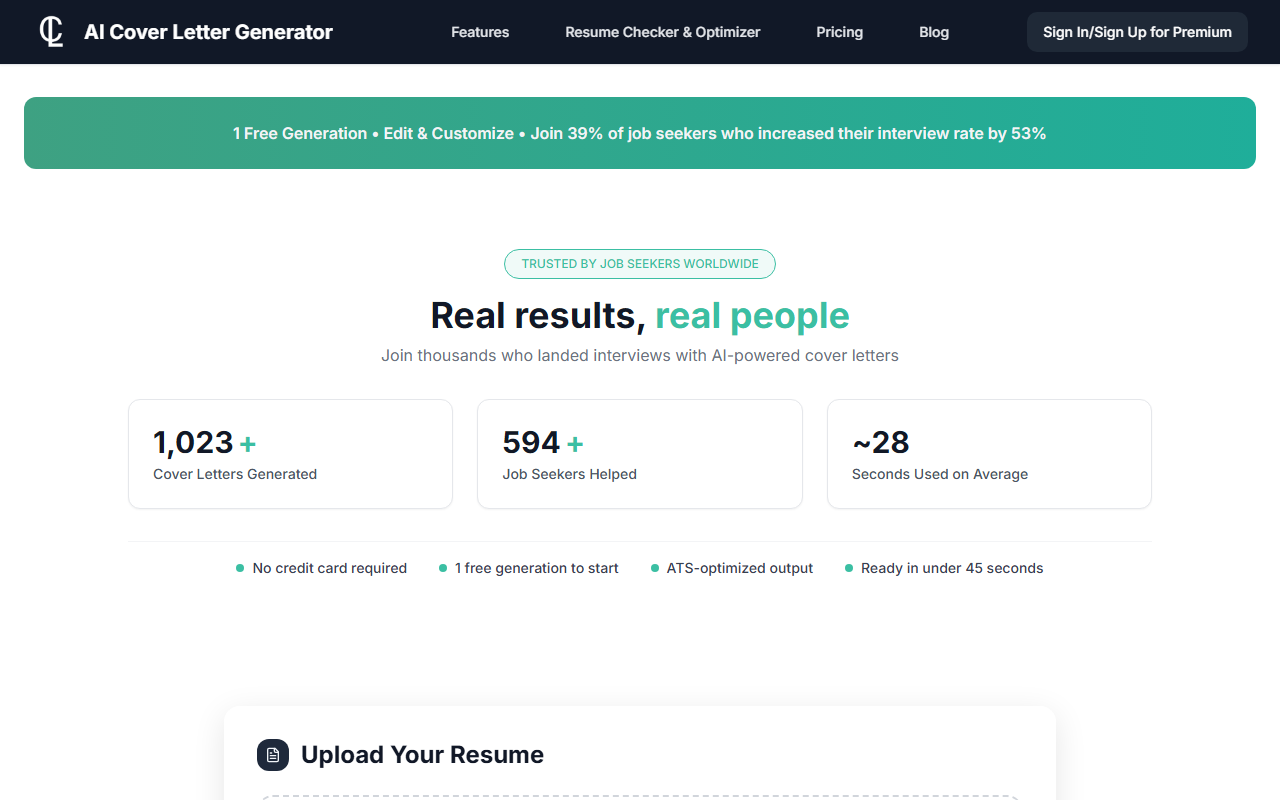
Upon visiting the site, I was greeted by a clean, no-nonsense landing page that immediately states its value proposition: cover letters that beat ATS and sound human-written. The headline is backed by a bold claim — 39% of job seekers who use AI tools increased their interview rate by 53%. The page moves quickly to action, with a prominent file upload area labeled “Upload Your Resume” and fields for company name, hiring manager, job title, and job description. No credit card is required to start, and the site clearly states “1 Free Generation” upfront.
I tested the free tier by uploading a sample resume in PDF format (a standard tech role) and pasting a 200-word job description for a software engineering position. The upload was instant, and the file size limit of 10MB is generous. The job description field requires a minimum of 100 characters but recommends more, and the character counter shows 0/3000 with a note that “100 more needed” — this nudges you to paste enough context for a quality output. I also filled in the optional additional information field with a note to emphasize technical skills. The form is straightforward and took me less than 30 seconds to complete.
Core Features and Performance
The tool’s central workflow is simple: upload your resume, provide the job description, and click “Generate Cover Letter.” The AI analyzes both your experience and the employer’s requirements, then produces a personalized letter. Behind the scenes, the system uses a custom AI model — the site doesn’t specify which base model (GPT, Claude, etc.), but the output quality suggests a fine-tuned LLM with cover letter-specific training. The average generation time is listed as 28 seconds, and in my test, the letter appeared in about 25 seconds — impressively fast.
The generated cover letter was structured professionally: a greeting to the hiring manager (which I had left blank, so it defaulted to “Dear Hiring Team”), an opening paragraph connecting my resume highlights to the job’s key requirements, two body paragraphs with concrete achievements, and a closing with a call to action. The tone was confident but not robotic, and the letter avoided keyword stuffing. Notable features include ATS optimization — the output uses standard section headers and includes relevant keywords from the job description, which should help pass automated screeners. The tool also claims that 39% of job seekers use AI tools and that personalized letters achieve 53% higher callback rates (citing a study of 7,287 applications).
One limitation I observed: the free tier only allows a single generation. After that, you’d need to either edit the existing letter or find another solution. There is no visible “Edit” button on the output page — you’re expected to copy the text and modify it yourself. This is a minor UX gap; an inline editor would be helpful. Additionally, the tool does not save your generation history unless you create an account (sign-up options are not prominent on the free tier).
Pricing and Value Proposition
Pricing is not publicly listed on the website beyond the “1 Free Generation” offer. The homepage does not show tiered plans, but the FAQ implies you can generate more letters after the first free one — likely through a paid subscription. However, without explicit pricing, users may hesitate to commit. For context, competitors like Rezi offer free and paid plans starting at $29/month, while Jasper’s cover letter feature is part of its broader writing assistant ($49/month). This tool focuses solely on cover letters, which could be a cost-effective niche if pricing is reasonable — but the lack of transparency is a drawback.
The value proposition is clear: speed (28 seconds vs. 30 minutes manually) and personalization that matches ATS criteria. The site’s own story (the founder applied to 300+ jobs) adds authenticity. The “Complete Your Job Search Toolkit” section mentions a LinkedIn Job Extractor Chrome extension, but the link did not work in my test. Still, the core tool functions well for its intended purpose.
Who Should Use This Tool?
This tool is best suited for job seekers who apply to many positions and need high-quality, tailored cover letters quickly. It’s especially valuable for early-career professionals, career changers, or anyone who finds writing cover letters tedious and time-consuming. The ATS focus makes it a smart choice for industries where automated screening is common (tech, finance, healthcare).
However, it may not satisfy users who want deeper customization (e.g., multiple tone options, different letter templates, or integration with job boards). The single free generation is limiting for extended use. If you’re a senior executive or applying for roles requiring highly narrative, non-standard cover letters, a manual or premium service might be better. For most job seekers, especially those on a budget, starting with the free generation is a no-brainer — the output is genuinely useful and human-readable.
Verdict: Try the free tier and see if the quality matches your expectations. If yes, inquire about paid plans — but keep an eye out for clearer pricing.
Visit AI Cover Letter Generator at https://ai-coverletter-generator.com/ to explore it yourself.













Comments