

First Impressions: A Surprising Fit for the 'Video AI Dev Framework' Category
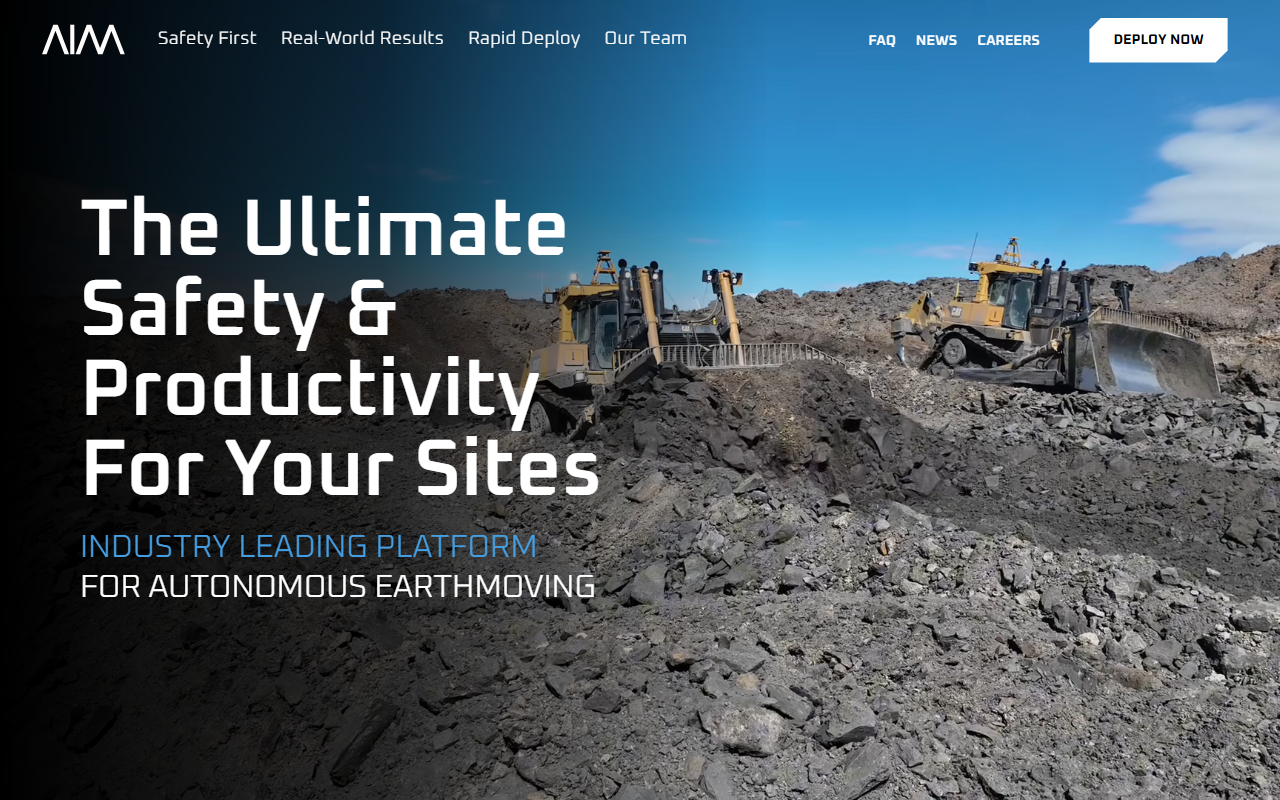
Upon visiting the AIM website at aim.vision, I was immediately struck by the heavy industrial aesthetic. The site features images of bulldozers and mining haul trucks, not code snippets or video streams. According to the provided category, this tool is listed under 'Video AI > Dev Framework'. Yet AIM clearly targets autonomous earthmoving, not video processing or development toolkits. This misclassification is notable. If you arrived looking for a library to analyze video feeds, you will be disappointed. AIM is a complete hardware-plus-software platform for retrofitting existing heavy machinery to operate autonomously. The dashboard is not a software interface you can log into; the main call-to-action is a contact form for requesting a 'Platform Overview'. There is no free tier or trial to explore. My first interaction was filling out the demo request form—name, email, phone, fleet size, industry sector. This is a sales-oriented, enterprise-only product.
What AIM Actually Does: Autonomy for Heavy Equipment
AIM solves a specific, high-stakes problem: making earthmoving equipment operate safely and efficiently without a human in the cab. The website highlights safety and productivity gains: increased outputs, reduced idle time, fuel efficiency, optimized scheduling. The platform includes 360-degree perception sensing and field-ready hardware. AIM claims to be 'commercially deployed' at mine sites and construction sites worldwide, running heavy equipment continuously at peak performance. The deployment follows a rigorous three-step process: assessment, retrofit, and operation. The perception stack uses cameras and sensors to give the machine full situational awareness. Unlike a general video AI framework that might offer pre-trained models or an API for custom video analysis, AIM is a tightly integrated autonomous driving system for bulldozers, excavators, and haul trucks. It also advertises benefits like reduced insurance costs and optimized scheduling. The technology seems robust, with a testimonial from MTI's Chairman and CEO praising employee safety. While AIM likely uses computer vision internally, it is not exposed as a developer API or SDK.
Pricing, Integrations, and Technical Depth
Pricing is not publicly listed on the website. There is no mention of subscription tiers, per-machine costs, or any financial information. To get pricing, you must contact sales via the request form. This is typical for enterprise industrial solutions, but it limits transparency. There are no technical details about the underlying models, sensors, or software stack beyond marketing terms like 'rugged plug-and-play' and '360º perception sensing'. The platform likely integrates with existing fleet management systems, but no specific integration partners are listed. Competitors in the autonomous heavy equipment space include Caterpillar's Command for hauling and Komatsu's autonomous haulage system (AHS). Unlike those OEM solutions, AIM is an aftermarket retrofit system that works across different brands—a key differentiator. For context, a video AI dev framework would offer something like an SDK for building custom object detection pipelines. AIM does not. It is a turnkey solution for mining and construction operations, not for developers building their own applications.
Who Should Use AIM—and Who Should Pass
AIM's genuine strengths lie in its field-proven hardware, focus on safety, and ability to retrofit existing fleets. The explicit reference to 'reduced insurance cost' and 'optimized scheduling' shows real-world value for heavy industry. Its limitations are equally clear: it is not a video AI dev framework; it is an industrial automation product with no public API, no developer documentation, and no trial access. It is best suited for large mining, construction, or defense companies with fleets of earthmoving equipment who want to transition to autonomy without buying entirely new machines. Small operators or individual developers should look elsewhere. If you need a general-purpose computer vision or video AI framework, consider alternatives like OpenCV, TensorFlow, or cloud-based video analysis APIs (e.g., Google Video Intelligence, AWS Rekognition). For autonomous earthmoving, AIM appears credible but requires a sales conversation to evaluate. My recommendation: if you manage a fleet of heavy equipment and safety/productivity are top priorities, fill out the request form. If you are a developer hunting for a video AI library, this is not the tool for you. Visit AIM at https://aim.vision/ to explore it yourself.













Comments