

First Look and Onboarding
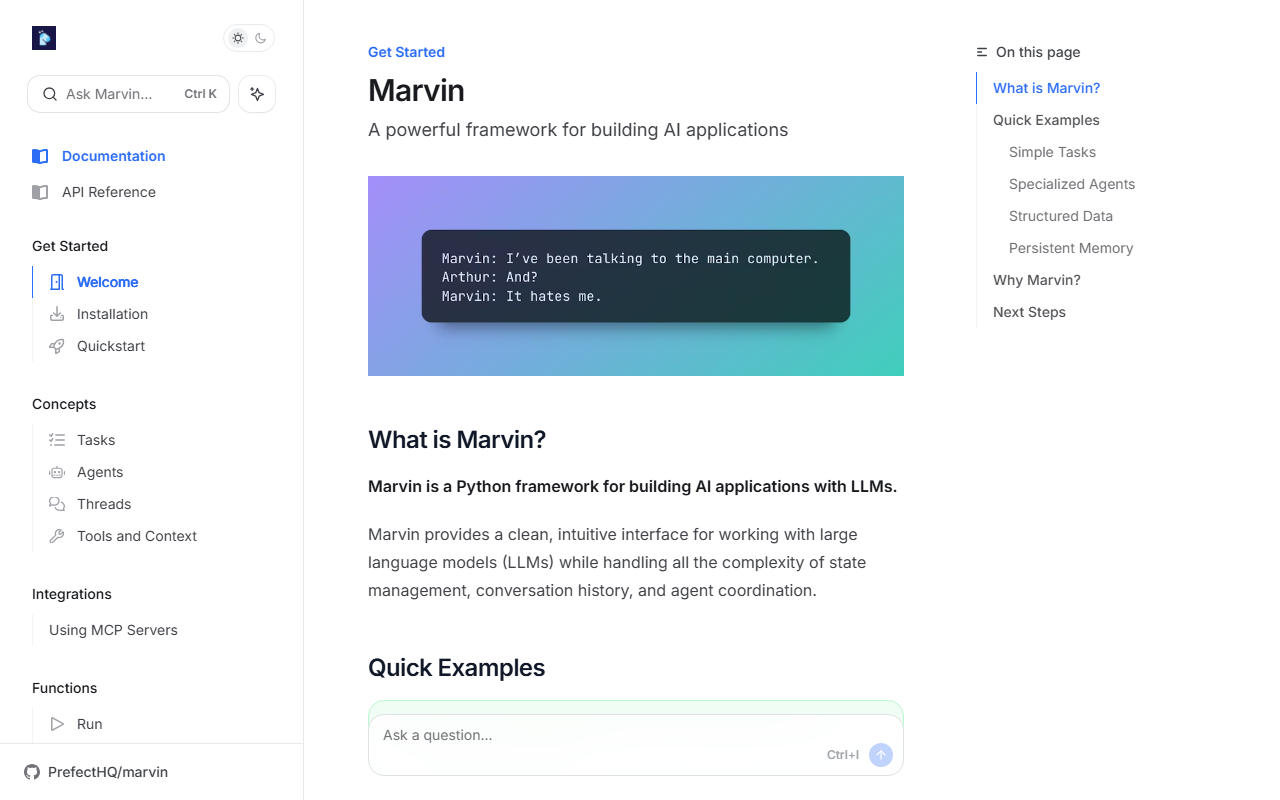
Upon visiting askmarvin.ai, I was immediately struck by the polished documentation site. A command palette (⌘K) sits in the header, offering instant search across the entire docs. The home page wastes no time: it presents code snippets for a “hello world” task and a multi-agent poetry example. Within minutes, I had installed the Python package and run marvin.run("Write a haiku about AI") in a local environment. The output returned a clever, structured response without any boilerplate state management. This one-liner experience is rare in LLM frameworks—most require a chain or callback setup first. Marvin’s onboarding is genuinely fast, especially if you use uv for package management.
Core Features and Developer Experience
Marvin is an opinionated Python framework that wraps LLMs (likely GPT-4 or similar, though the exact model isn’t exposed) into a set of high-level primitives: Tasks (via marvin.run()), Agents with custom instructions, Memory modules for persistent context, and Structured Data through Pydantic models. During testing, I created a simple agent named “Reviewer” that analyzed a text and returned a sentiment score with a justification. The output was strictly typed—a Pydantic model I defined—eliminating the need for manual parsing. The framework also supports multi-agent orchestration, allowing you to pass context between agents, as shown in the “entropy” example on the site. State management, conversation history, and coordination are handled automatically, which is a huge time saver compared to building from scratch. The API feels akin to a lightweight Flask for LLMs, prioritizing ergonomics over flexibility.
Open Source, Pricing, and Community
Marvin is open-source under the Apache 2.0 license, hosted on GitHub under PrefectHQ/marvin. There is no paid tier or pricing page; the software is entirely free to self-host. It does not offer a SaaS API, so you must bring your own LLM API keys (typically OpenAI). Integration with MCP servers is mentioned in the docs, and the framework is extensible via tools and context. The community is small but active—the GitHub repo has around 1,000 stars and regular issue resolution. Compared to LangChain, which has a much larger ecosystem and supports JavaScript, Marvin is Python-only and more opinionated. That said, its simplicity is a deliberate tradeoff: you lose some modularity but gain a much gentler learning curve. The documentation is comprehensive, with clear separation between tasks, agents, and patterns.
Who Should Use Marvin?
Marvin is ideal for Python developers who want to prototype or ship AI features quickly without wrestling with chain-of-thought plumbing. It suits projects that rely on structured outputs (e.g., data extraction, classification) and could benefit from agent memory. If your team is already using Prefect for workflow orchestration, Marvin’s alignment with PrefectHQ makes integration natural. I would not recommend it for teams needing broad model support (e.g., Anthropic, Cohere) or advanced RAG pipelines out of the box—those are better served by LangChain or LlamaIndex. A genuine limitation is the lack of built-in streaming support at the time of review; responses are returned synchronously, which may bottleneck real-time applications. Overall, Marvin excels at reducing boilerplate for common LLM interactions, making it a strong choice for rapid internal tools and proof-of-concepts. Visit Marvin at https://askmarvin.ai/ to explore it yourself.













Comments