
First Impressions and Interface
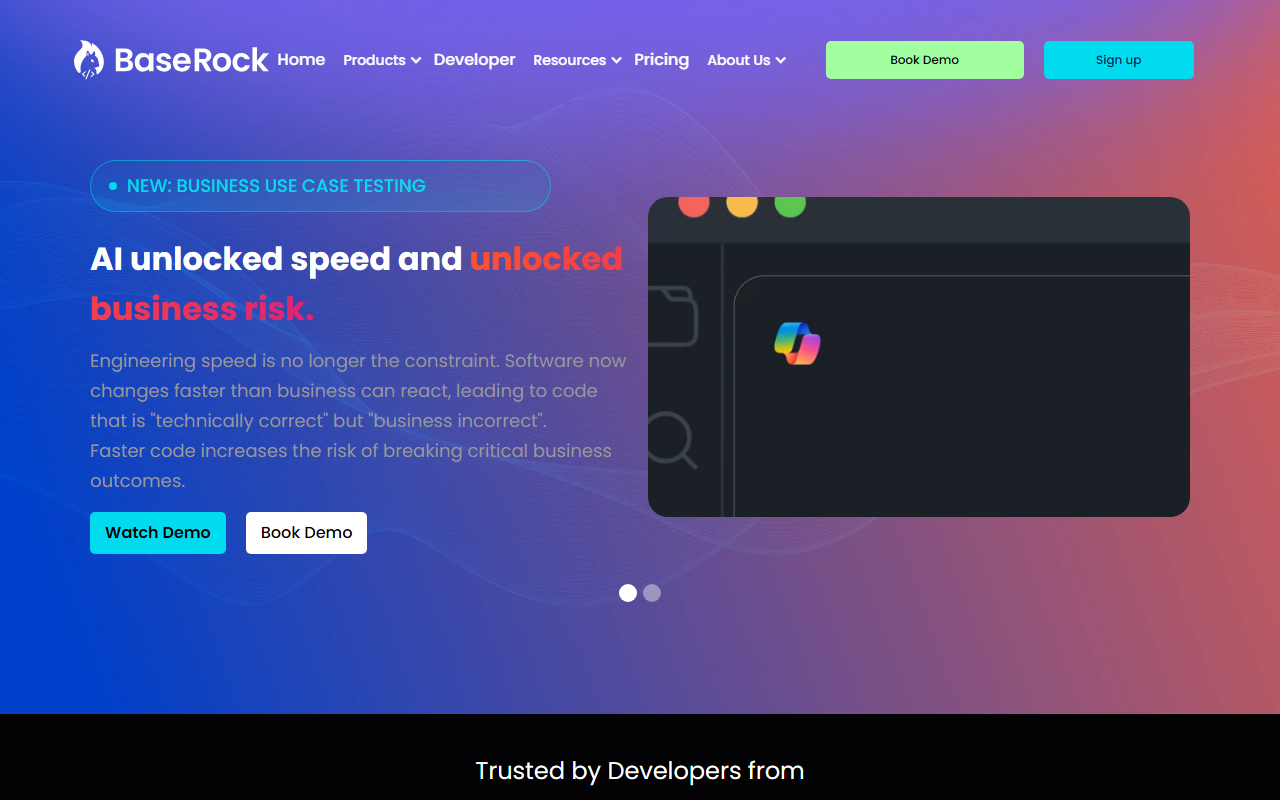
Upon visiting BaseRock AI’s website at baserock.ai, I was greeted by a clean, modern landing page that immediately communicates the platform’s focus: validating business use cases rather than just passing syntax checks. The top navigation includes tabs for Solutions, Products, Resources, Use Cases, Pricing, and About Us, but clicking on Pricing led to a generic request for a demo—no public tier list exists. The homepage uses a dark theme with bold typography and clear calls-to-action for "Watch Demo" and "Book Demo."
The layout is carefully structured to introduce the core problem first: AI coding assistants like GitHub Copilot or Cursor accelerate development but introduce business risk. A prominent section shows statistics: 80% faster QA cycles, 40% cheaper costs, and 100% coverage for autonomous edge-case discovery. These numbers appear to be internal benchmarks rather than independent audits, so I take them with a grain of salt. The site also highlights the GUARD framework in five steps—Gather, Understand, Audit, Refine, Detect—which forms the backbone of their product.
The Core Problem and BaseRock’s Approach
BaseRock AI addresses a specific pain point for modern dev teams: code that is technically correct (passes unit tests) but business incorrect (fails to deliver intended customer outcomes). The website calls this the "silent killer" and argues that traditional QA tools are not designed to catch these logical regressions. BaseRock’s solution is Business Use Case Testing (BUCT), which continuously validates customer and revenue workflows.
Under the hood, the platform integrates with sources of truth like Jira, MCP servers, GitHub, GitLab, and Bitbucket. The GUARD framework operationalizes this: it gathers business signals (requirements, tickets), maps them to the actual codebase, audits test suites through a business lens, lets users refine tests in plain English, and then autonomously runs validations on every build. During my review, I was particularly struck by the claim that BaseRock can turn natural language descriptions of user journeys into executable validations—this is where its agentic AI shines. The tool also validates four layers: system workflows (end-to-end behavior), business rules/outcomes, service interactions, and data/contracts.
The website emphasizes Enterprise-Grade Security with zero-trust architecture and SOC2 compliance, ensuring source code and proprietary data never leave the customer’s approved perimeter. This is a strong selling point for regulated industries.
Pricing, Market Position, and Alternatives
Pricing is not publicly listed on the website. This is common for enterprise-focused tools; potential customers must book a demo to get a quote. Compared to competitors, BaseRock positions itself differently than traditional test automation platforms like Testim (which focuses on UI test creation) or Mabl (which offers AI-driven test maintenance). These tools also use AI, but they tend to prioritize functional coverage over business intent validation. BaseRock’s explicit focus on revenue-critical workflows and the GUARD framework sets it apart. Another indirect competitor is manual QA outsourcing or even internal QA teams, but BaseRock aims to automate that with continuous validation. The website mentions being "Trusted by Developers from" vague logos (none shown due to missing images), but it does list impressive-sounding metrics like 80% faster cycles and 100% coverage—though I caution readers to verify these claims.
The tool is best suited for dev teams that are already using AI coding assistants and need to maintain confidence in business logic while releasing frequently. It is less ideal for small startups without complex multi-step workflows or for teams that rely heavily on manual exploratory testing and don’t have the budget for enterprise-level pricing.
Strengths, Limitations, and Recommendation
BaseRock AI’s strongest asset is its clear problem-solution alignment. It directly addresses a gap created by AI-assisted development: the mismatch between "technically correct" and "business correct." The GUARD framework provides a logical, repeatable process, and the promise of natural language test creation is compelling. The zero-trust architecture and SOC2 compliance make it attractive for enterprises with strict data governance requirements.
However, the tool has limitations. There is no free tier or self-service trial; the only way to evaluate it is through a sales-led demo, which creates friction. The website lacks detailed technical documentation, API references, or integration specifics beyond high-level mentions. The metrics (80% faster, 40% cheaper) are presented without methodology or third-party verification, leaving some skepticism. Additionally, the tool appears to be in an early stage—some pages (like "About Us") contain placeholder text like "This is some text inside of a div block." This suggests the product may still be maturing.
My recommendation: Teams already using AI coding assistants and struggling with business logic regressions should book a demo to see if BaseRock fits their workflow. Enterprises in regulated sectors will appreciate the security posture. For smaller teams or those needing immediate hands-on evaluation, wait until a self-service tier becomes available. Visit BaseRock AI at https://baserock.ai/ to explore it yourself.













Comments