

First Impressions and Core Value Proposition
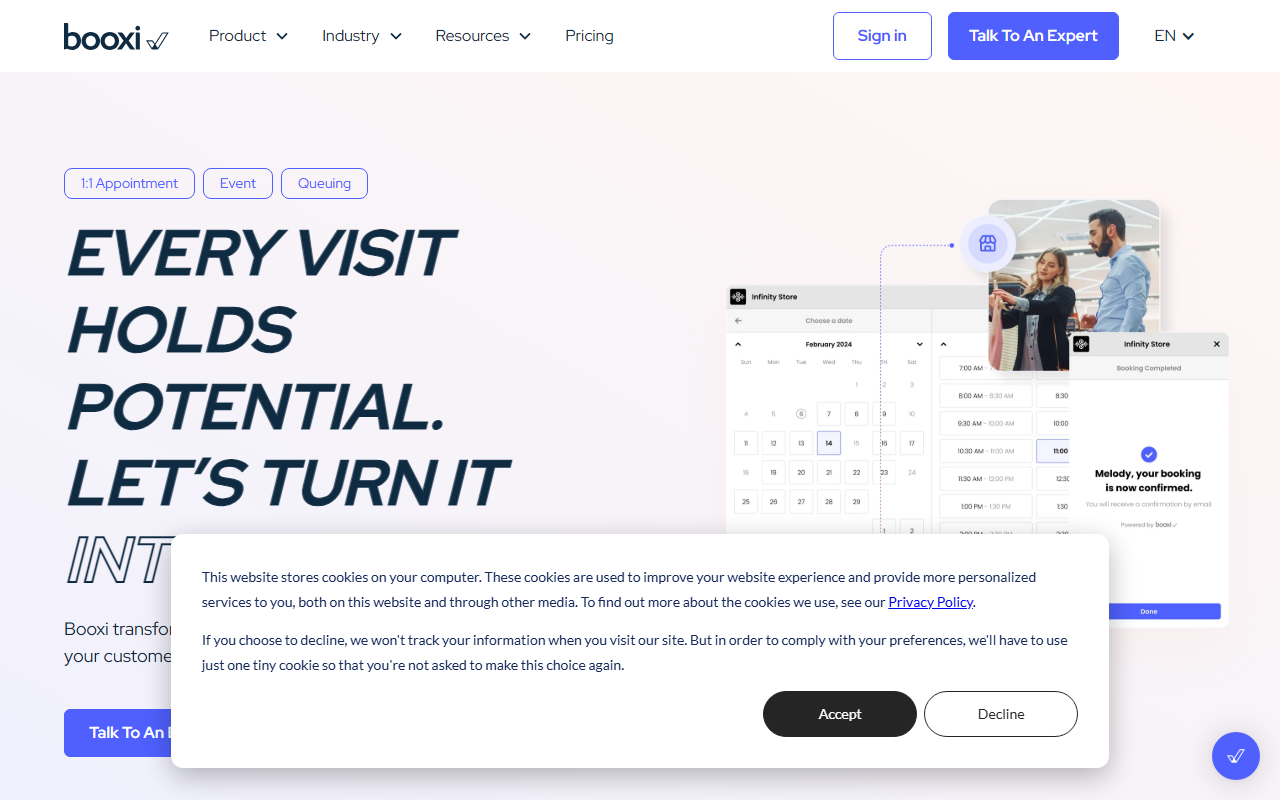
Upon visiting the Booxi website, I immediately noticed its laser focus on the retail vertical. The homepage boldly declares "Every visit holds potential," and the platform is presented as a complete system for transforming walk-ins into structured, high-value interactions. Booxi is not a generic scheduling tool; it is purpose-built for enterprise retail, addressing the specific pain points of managing appointments, events, and store traffic in physical locations. The dashboard metaphor I observed is clean and business-oriented, with clear calls to action for booking a demo, signing in, or talking to an expert. The site heavily emphasizes three core modules: 1:1 Appointments, Events, and Queue Management. This immediately signals that Booxi is about giving retailers control over every type of in-store customer interaction, from a private luxury fitting to a chaotic sale day.
Core Features and Observed Workflows
Booxi's functionality revolves around three levels of engagement. The 1:1 Appointments module is designed to capture customer intent online, predict arrival times, and turn each scheduled visit into a high-impact interaction. I particularly noted the claim that booking takes "less than 30 seconds" for customers. The Events module helps retailers plan, script, and measure everything from product launches to VIC evenings, acting as a loyalty engine. The Queue Management feature is aimed at controlling crowded stores, reducing wait times, and easing floor pressure. When testing the mindset of a retail manager, I appreciated how Booxi frames these tools not just as scheduling utilities, but as operational performance drivers. The platform integrates with key retail tech stacks—Salesforce and Shopify are explicitly mentioned—which is crucial for seamless deployment. The website also showcases impressive metrics: a 70% conversion rate after an appointment, an average 4% no-show rate (far better than industry averages), a +1-5% uplift in revenue, and a +30% increase in average basket post-appointment. While these are claimed results, they provide a strong value proposition.
Market Positioning and Alternatives
Booxi sits firmly in the enterprise retail interaction management space, directly competing with solutions like Square Appointments (more suited for small businesses) and Mindbody (focused on wellness and fitness). Unlike those competitors, Booxi is exclusively retail-centric, with specific industry templates for luxury, beauty, fashion, eyewear, department stores, home and furniture, and pet stores. This vertical specialization is its key differentiator. The platform has notable backing from major brands like Clarins, Christian Louboutin, Printemps, and Decathlon, indicating enterprise-grade trust and scalability. While the website does not list pricing publicly (you must contact sales), this is typical for B2B enterprise software. The company is also actively exhibiting at NRF 2026, underscoring its industry presence. For retailers wrestling with high no-show rates and inefficient store operations, Booxi offers a clear alternative to generic calendar tools that don't capture the nuance of physical retail.
Strengths, Limitations, and Final Verdict
Strengths: Booxi's genuine strength lies in its deep retail DNA. The platform is built from the ground up to solve the specific challenges of in-store customer interactions, from appointment conversion to queue balancing. The integration with Salesforce and Shopify is a major plus for retailers already using those ecosystems. The reported metrics (70% conversion, 4% no-show) are compelling, and the ability to track in-store results with actionable data is a powerful feature for omnichannel retailers. Limitations: The main limitation is the lack of transparent pricing. Enterprise buyers may need to engage in a lengthy sales process to get a quote. Additionally, the platform's heavy focus on high-touch retail may not suit quick-service or low-volume businesses. The steepness of the learning curve for staff, especially in event scripting, is not fully addressed on the site. Who should try it: This tool is best suited for mid-to-large retail chains in fashion, luxury, beauty, and optical that want to professionalize their in-store service and reduce operational friction. Small independent stores or service businesses (like hair salons) should look at lighter alternatives like Square Appointments or Booksy.
Visit Booxi at https://booxi.com/ to explore it yourself.













Comments