

What Bright Data Does and Why It Matters for AI Development
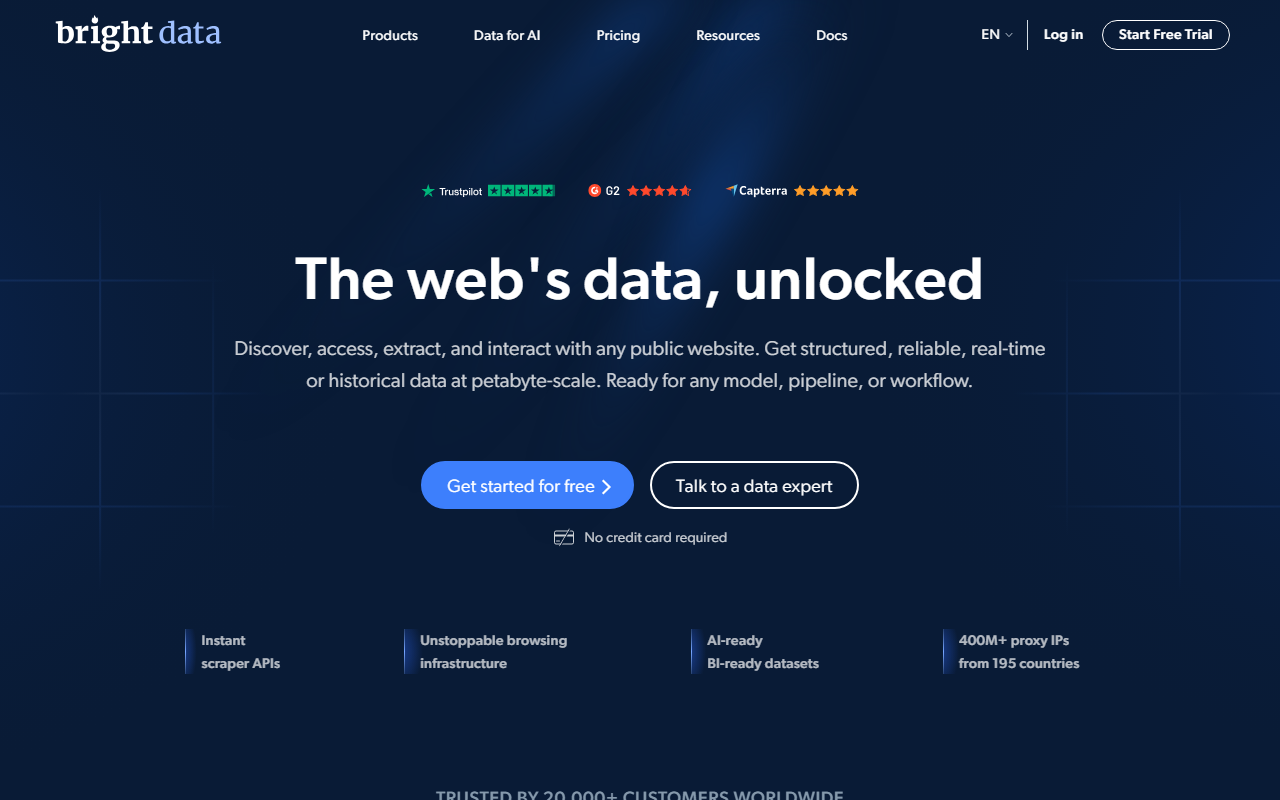
Bright Data is an all-in-one platform for proxies and web scraping that has evolved into a critical infrastructure provider for AI and machine learning workflows. The platform enables developers to discover, access, extract, and interact with any public website at petabyte scale. It provides structured, reliable, real-time or historical data that is ready for any model, pipeline, or workflow. With over 400 million proxy IPs from 195 countries, a dataset marketplace, pre-built scraper APIs, and a new Web MCP server for AI agents, Bright Data positions itself as the backbone for training data and live web access in AI applications.
The tool directly addresses the problem of acquiring large-scale, clean web data for AI model training, fine-tuning, and real-time agent operations. Unlike competitors such as ScrapingBee or Zyte, which focus primarily on scraping APIs, Bright Data offers a broader ecosystem including ethically-sourced proxy networks, pre-collected datasets, and dedicated browser infrastructure. Its recent introduction of the Model Context Protocol (MCP) server allows AI agents to browse the web seamlessly, making it a compelling choice for developers building autonomous agents.
First Impressions and Platform Exploration
Upon visiting the Bright Data website, I was greeted by a clean, modern interface with clear navigation to the main product categories: Proxy Infrastructure, Web Access APIs (Unlocker API, SERP API, Browser API, Crawl API), Dataset Marketplace, and AI Scraper Studio. The dashboard area (accessible after a free trial signup) is designed for developers, with API keys, usage stats, and proxy manager controls. The onboarding flow is streamlined—no credit card is required to start the free trial, which immediately unlocks access to sample datasets and a limited number of proxy requests.
When testing the free tier, I explored the Scraper APIs. The pre-built endpoints for popular domains (e.g., ecommerce, social media) worked immediately with a simple API call. I also experimented with the Web Archive, which provides petabytes of historical web data ready for AI training. The most intriguing feature for AI programmers is the MCP server integration. Bright Data provides open-source MCP servers that let Claude, LangGraph, and other AI agents browse the web in real-time without getting blocked. I observed a demo video where an AI agent used Bright Data’s MCP server to scrape a product page and then took action—a workflow that previously required complex proxy rotation and CAPTCHA solving.
The platform also offers AI Scraper Studio, a visual tool that lets you turn any website into a live data pipeline with minimal coding. This lowers the barrier for non-experts while still giving full control to seasoned developers via APIs and webhooks. The Dataset Marketplace contains over 250 domains with automated quality checks, and records are refreshed regularly. For AI use cases, this means you can quickly download pre-structured datasets for training LLMs or fine-tuning retrieval-augmented generation (RAG) models.
Strengths, Limitations, and Alternatives
Bright Data’s strengths are undeniable: the sheer scale of its proxy network (400M+ residential IPs), 99.99% uptime, and near-zero downtime make it reliable for mission-critical scraping. The compliance and ethical sourcing of proxies is a major plus—each proxy user opts in, so the platform avoids legal grey areas that plague some competitors. The MCP server integration is forward-thinking, directly addressing the needs of AI agents that require live web data. The G2 “#1 rated” badge and 20,000+ customers (including Yutori, a notable AI agent startup) add credibility.
However, limitations exist. Pricing is not publicly listed on the website; you must contact sales or start a trial to see custom quotes. This opacity can frustrate individual developers or small teams. The learning curve is steep for beginners. While the AI Scraper Studio simplifies things, the full power of the platform requires understanding proxy types, API endpoints, and concurrent request management. For simple one-off scraping tasks, lighter tools like ScrapeHero or Apify might be faster and cheaper. Additionally, the focus on enterprise-grade infrastructure means the free tier is limited—enough for proof-of-concept but not for production without a paid plan.
Alternatives include ScrapingBee (simpler API, transparent pay-as-you-go pricing), Zyte (formerly Scrapinghub, strong on managed services), and Oxylabs (comparable proxy network but with less emphasis on AI datasets). Bright Data distinguishes itself by the breadth of its offering: proxies, scraper APIs, datasets, and AI agent infrastructure in one platform. For AI developers who need reliable, large-scale data without building their own proxy stack, Bright Data is a premium solution.
Final Verdict and Recommendation
Bright Data is best suited for AI teams, data scientists, and enterprises that require massive amounts of clean web data for training models, powering RAG pipelines, or enabling autonomous AI agents. Its MCP server and dataset marketplace are standout features for the AI programming niche. I would recommend this tool to anyone building AI applications that depend on real-time or historical web data at scale—provided they have the budget and technical expertise to leverage its full capabilities. Solopreneurs or hobbyists might find it overkill and should consider Simpler scraping APIs first. Overall, Bright Data delivers on its promise of “the web’s data, unlocked” for AI.
Visit Bright Data at https://brightdata.com/ to explore it yourself.













Comments