

First Impressions and Onboarding
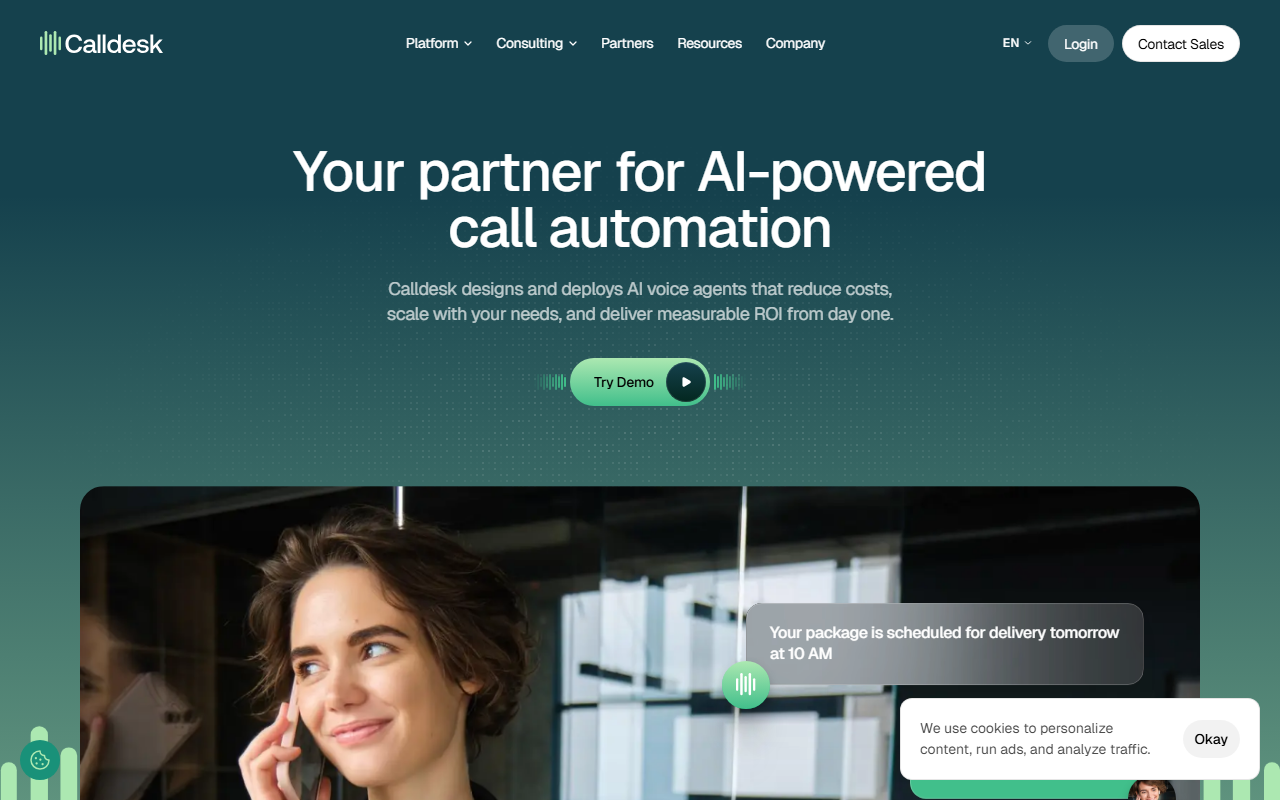
Upon visiting Calldesk’s website, I was immediately struck by the clean, enterprise-focused design. The hero section presents a simulated customer call about a package delivery—a common, low-complexity interaction that AI agents handle seamlessly. The demo interaction is front and center, letting you click through a conversation where a caller asks to change a delivery time and the AI agent responds with an available slot, then asks for confirmation. This simple but effective example makes the value proposition clear: the tool targets routine inbound calls that bog down human agents.
Calldesk’s onboarding process is presented as a structured four-week roadmap, from call analysis (via a Scanbot that connects to your existing phone system) to collaborative use-case selection, then design and pilot, and finally scaling. This phased approach is refreshingly concrete compared to many AI tools that promise immediate results without a clear plan. The emphasis on a pre-deployment assessment using a pre-trained LLM to analyze call recordings suggests the company understands that successful automation depends on understanding real traffic patterns.
The dashboard itself is not publicly accessible, but the “Calldesk Studio” is described as a fully no-code, collaborative visual builder for managing agents and workflows. Integrations with Salesforce and Zendesk are prominently listed, which will reassure enterprise buyers who need CRM connectivity out of the box.
Core Capabilities and Technology
Calldesk positions itself as an end-to-end partner for AI-powered call automation. The AI agents handle qualification, FAQs, ticket creation, email handoffs, and agent transfers with a conversation summary. The technology claims to understand nuance in 80+ languages, which is a significant differentiator for companies with multilingual customer bases. The site prominently states that the platform handles “more than 30 million calls per year” for leading enterprises, which adds credibility, even though the claim is not independently verified.
What sets Calldesk apart from general-purpose voice AI platforms (like Retell AI or PlayAI) is its focus on enterprise readiness: compliance, security, scalability, and integration with existing workflows. The no-code studio lowers the barrier for operations teams to deploy callbots without needing developer resources. The AI models used are not explicitly named, but the site references “the latest AI voice models” and LLMs for the Scanbot analysis. This suggests Calldesk likely uses a combination of proprietary fine-tuning and third-party models under the hood.
One limitation I observed: the website does not show how the AI handles complex or emotional conversations. The demo only covers a simple scheduling change. For enterprises dealing with complaints or sensitive issues, the tool’s capability may be less mature. Also, the lack of a public API or self-service developer documentation indicates the product is sold as a managed service, not a DIY platform.
Use Cases and ROI Potential
Calldesk lists several use cases: caller qualification, FAQ handling, ticket creation, and agent transfer with summary. The website shares a specific case study: Enedis achieved a 75% self-service rate for delivery point searches over the phone, freeing human agents for higher-value tasks. That’s a concrete metric that suggests real-world ROI.
For enterprises with high call volumes (e.g., customer support, logistics, utilities), Calldesk can reduce cost per call and improve 24/7 availability. The tool also promises to “free up to 20% of agents’ time” through caller identification by checking CRM data. However, those numbers come from the vendor and should be validated in pilot.
Total cost of ownership is tricky because pricing is not publicly listed. Calldesk encourages booking a demo or contacting sales. This is common for enterprise tools, but it means smaller businesses may find the barrier to entry high. The website does not mention any self-serve or free tier, so this is clearly a premium offering for large organizations.
Pricing and Verdict
Pricing is not publicly listed on the website. Based on the enterprise positioning, integrations, and custom deployment roadmap, Calldesk likely charges a per-call or subscription fee negotiable based on volume. If you are a small startup or a team with fewer than 100 monthly calls, this tool is probably overkill and too expensive. Look at simpler alternatives like Bland AI or Air AI for lower-volume use.
Calldesk’s strengths are its structured onboarding, multilingual support, and enterprise integrations. Its limitations include opaque pricing, no public API, and a managed-service model that may not suit teams wanting full control. I recommend Calldesk to enterprise customer service leaders who handle millions of calls per year and need a strategic partner to deploy AI agents quickly and compliantly. If you match that profile, request a pilot using the Scanbot analysis—it will give you data before committing.
Visit Calldesk at https://calldesk.ai/ to explore it yourself.













Comments