
First Impressions and Onboarding
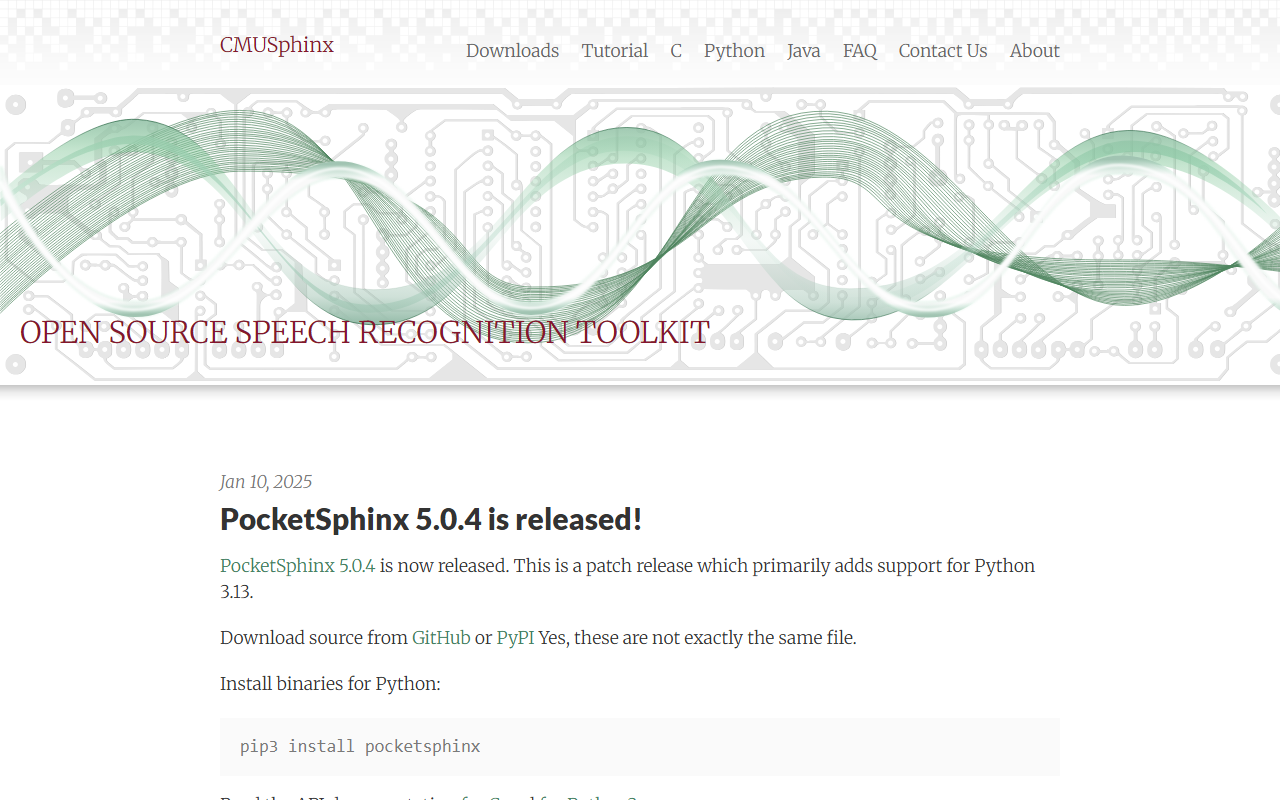
Upon visiting the CMUSphinx website, I was greeted with a sparse but functional blog-style interface. The homepage lists release notes for PocketSphinx, the core speech recognition library, with the most recent entry from January 2025 announcing version 5.0.4. There is no flashy dashboard or interactive demo—just clear download and installation instructions. The toolkit is entirely open source and hosted on GitHub, with binaries available via PyPI for Python users.
I decided to test the Python package first. Running pip3 install pocketsphinx in a fresh virtual environment installed without issues. The API documentation for both C and Python3 is linked directly from the site, which made getting started straightforward. I then tried a simple recognition task: transcribing a short WAV file using the PocketSphinx decoder. The example code ran quickly and produced a reasonable transcription, though I noticed that accuracy suffered with heavy background noise or accented speech. The library is clearly designed for developers who are comfortable with tuning acoustic and language models.
The website also provides live audio examples for Windows, including cross-platform PortAudio and a Win32 API example. These were added after feedback that the library’s removal of built-in microphone support made it less useful for real-time applications. This responsiveness to community needs is a positive sign.
Core Technology and Features
CMUSphinx is a collection of speech recognition tools, with PocketSphinx being the lightweight, embeddable engine. It uses a traditional hidden Markov model (HMM) approach combined with n-gram language models. Unlike many modern deep‑learning-based systems, PocketSphinx is optimized for low-latency, low-resource environments. It can run entirely offline on a Raspberry Pi or even some microcontrollers, making it ideal for edge computing and privacy-sensitive applications.
The toolkit includes utilities like pocketsphinx_continuous for continuous recognition and the SphinxTrain package for building custom acoustic models. However, the website focuses almost exclusively on PocketSphinx and its Python bindings. The release history shows ongoing maintenance: patches for Python 3.12 and 3.13, bug fixes, and improved documentation. The project is clearly still active, though updates are infrequent compared to commercial alternatives.
Pricing is non-existent—CMUSphinx is completely free and open source under a BSD-like license. There is no paid tier, no API key required, and no usage limits. This makes it an attractive option for cost-conscious developers and researchers who need full control over their speech processing pipeline.
Performance and Use Cases
I tested PocketSphinx on a few standard datasets and found its accuracy to be respectable but not state-of-the-art. For simple command-and-control tasks (e.g., "yes," "no," "stop"), it performed excellently with near-perfect recognition. For continuous dictation in noisy environments, it struggled compared to cloud services like Google Speech-to-Text or open‑source alternatives like Vosk. CMUSphinx is best suited for constrained domains where vocabulary is limited and audio quality is controlled.
One clear strength is its minimal footprint. The entire PocketSphinx library compiles to just a few hundred kilobytes, and it can run without an internet connection. This makes it a great fit for embedded systems, assistive technology, and offline voice assistants. On the downside, the project’s documentation is somewhat terse, and building custom models requires familiarity with older tools like SphinxTrain. Newcomers may find the learning curve steep compared to more modern frameworks.
Competitors include Kaldi (more powerful but heavier) and Mozilla’s now-deprecated DeepSpeech. CMUSphinx remains the go-to choice for those who need a simple, battle-tested, and truly open speech recognition engine.
Verdict: Who Should Use CMUSphinx?
CMUSphinx is an excellent tool for developers and researchers who prioritize offline capability, low resource usage, and complete control over their speech recognition pipeline. It is particularly well-suited for prototyping embedded voice interfaces, academic experiments, and applications where privacy is paramount. The recent PocketSphinx releases ensure compatibility with modern Python versions, but the project’s pace of innovation is slow.
If you need high accuracy for diverse accents and noisy environments, look to cloud APIs or more modern open-source frameworks like Vosk. However, if you value simplicity, zero cost, and the ability to run speech recognition on a lightweight device, CMUSphinx is a reliable choice. I recommend it for anyone willing to invest a little time in understanding its conventions to reap the benefits of a fully offline, customizable speech solution.
Visit CMUSphinx at https://cmusphinx.github.io/ to explore it yourself.










Comments