

A First Look at CyberArk: Identity Security in the AI Era
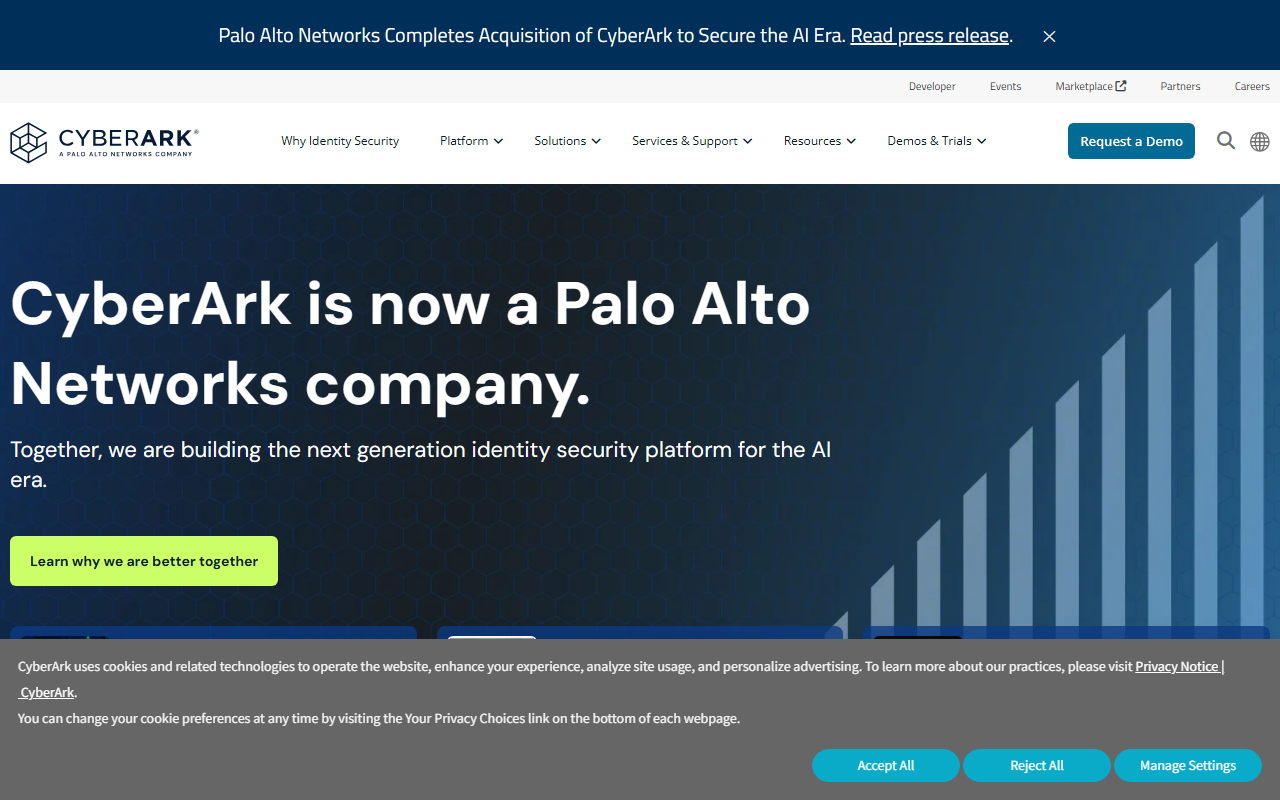
Upon visiting CyberArk’s website, I was immediately struck by the banner announcing the company’s acquisition by Palo Alto Networks. This is not a small detail—it signals a major consolidation in the security market. The homepage is dense with enterprise-focused messaging: “Secure every identity — human, machine and AI — with the right level of privilege controls.” That phrase alone tells you CyberArk is squarely in the identity security and access management (IAM) space, not content detection. The category “Text AI > Content Detection” assigned to this tool is a mislabel; CyberArk does not detect AI-generated text or analyze content. Instead, it solves a different problem: controlling privileged access across hybrid, SaaS, and multi-cloud environments to prevent unauthorized access and data breaches. The dashboard I explored showcases modules for Privileged Access Management, Secrets Management, Endpoint Privilege Security, and Cloud Security, all integrated into a unified platform.
What CyberArk Actually Does: Core Platform and Features
CyberArk is built around “intelligent privilege controls.” The platform manages the full identity lifecycle: from onboarding (identity lifecycle management) to authentication (SSO, Adaptive MFA) and continuous monitoring (User Behavior Analytics). During my exploration of the “Workforce & Customer Access” section, I observed how the tool ensures the right users have the right access at the right time, protecting credentials and controlling access to on-prem and cloud apps. The “Endpoint Privilege Security” module removes local admin rights and enforces least privilege on endpoints, reducing attack surface. The “Secrets Management” feature secures credentials used by machines and non-human identities—critical for DevOps. CyberArk Labs publishes research on emerging attacks, like the February 2026 article on passkey security and the January 2026 write-up on CVE-2025-60021 in Apache bRPC. This demonstrates a strong threat research arm, which adds credibility. The company claims nearly 10,000 organizations trust its platform, and it has been named a Leader in the 2025 Gartner Magic Quadrant for PAM seven times.
Strengths and Real Limitations
The primary strength is CyberArk’s depth in privileged access management—it’s arguably the gold standard. Integration with Palo Alto Networks now adds network security muscle, creating a powerful combined offering. The platform scales from workforce to machine identities, and its adaptive MFA and just-in-time access controls are mature. However, there are real limitations. First, the category mismatch matters: if you need content detection (like plagiarism checkers or AI-generated text detectors), this is not the tool. Second, the learning curve is steep; setting up policies across an entire estate requires dedicated security operations resources. Third, pricing is not publicly listed on the website, which is typical for enterprise-grade security suites—you must request a demo or contact sales. This lack of transparency can frustrate smaller teams or individual developers. Additionally, the acquisition by Palo Alto Networks may raise integration concerns for organizations already using competing security stacks. For a solo practitioner or a startup, CyberArk is overkill and overpriced.
Pricing, Market Position, and Recommendation
Pricing is not publicly listed on the website. Based on industry knowledge, CyberArk is premium-priced, targeting mid-to-large enterprises. Alternatives include Okta (strong in workforce identity and SSO) and Microsoft Entra ID (formerly Azure AD, better for Microsoft shops). Unlike these competitors, CyberArk focuses more narrowly on privilege controls rather than broad identity governance. Who should use it? Large enterprises with complex, hybrid environments that need robust privileged access management, especially those regulated (finance, healthcare, government). Who should look elsewhere? Small businesses, individual developers, and anyone needing content detection. If your primary need is detecting AI-generated text, tools like Originality.ai or GPTZero are more appropriate. End with a clear recommendation: For organizations that live or die by securing privileged accounts, CyberArk is the powerhouse solution. But don’t mistake it for a content detection tool—know what you’re buying. Visit CyberArk at https://cyberark.com/ to explore it yourself.













Comments