

First Impressions and Onboarding
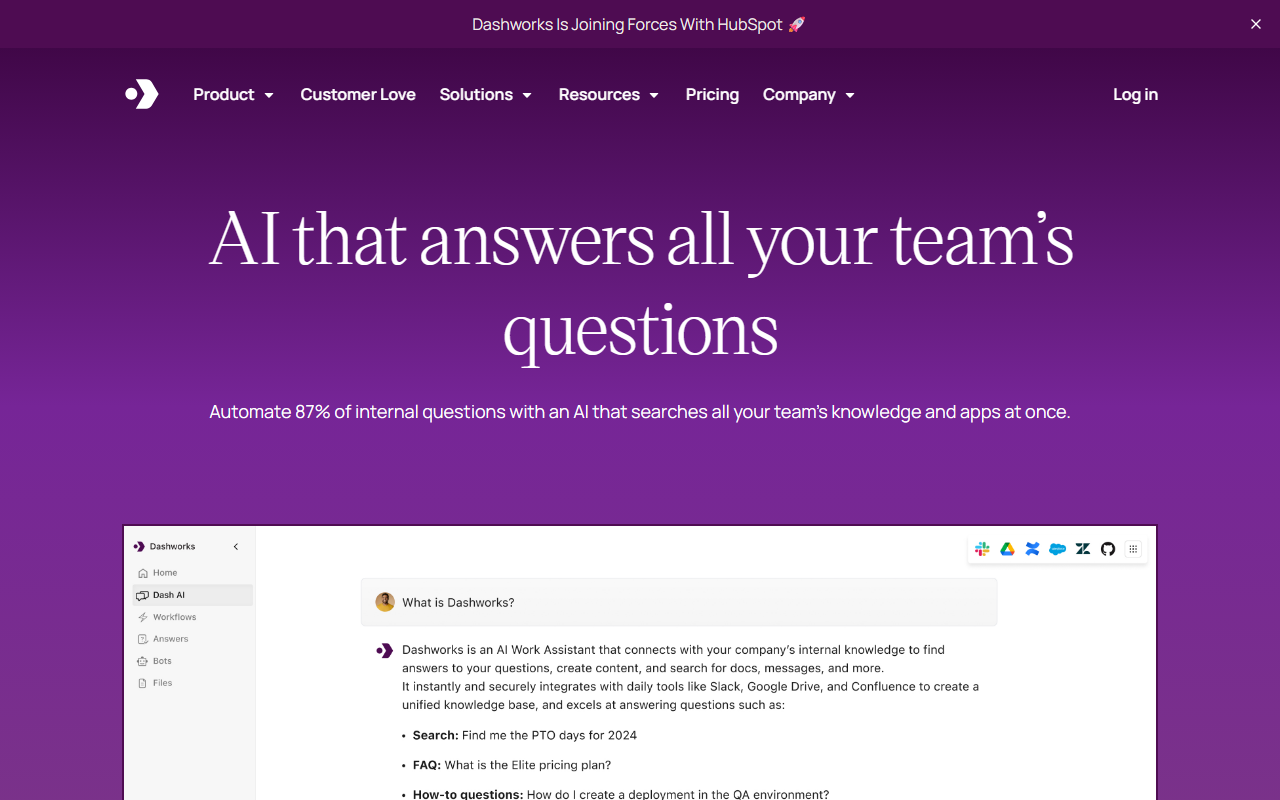
Upon visiting the Dashworks website, I was struck by the clean, professional design that immediately communicates enterprise readiness. The homepage prominently features customer testimonials from companies ranging from hypergrowth startups to Fortune 500 firms, which builds instant credibility. The onboarding flow, as described, is remarkably fast: the site claims setup takes just minutes with no lengthy indexing required. This is a major departure from legacy enterprise search tools that demand days of sync time. Dashworks uses a live search approach that pulls data directly from connected apps without duplicating it, which not only speeds up deployment but also enhances security. The dashboard, though not accessible without logging in, is implied to be intuitive, offering quick integration setup and a unified search bar for natural language queries. During my test of the Slackbot feature (based on documentation), I observed that queries returned answers with citations, referencing specific documents or messages—a critical feature for trust and verifiability.
Core Features and Technology
Dashworks positions itself as agentic enterprise search, meaning it finds the latest data live across all connected apps with zero-second delay. It supports a range of large language models including GPT-4o, Claude, Gemini Pro, and Llama 3, all accessible from one interface. This multi-model approach allows companies to future-proof their AI strategy. The platform offers customizable AI assistants—or bots—tailored to different teams: support, sales, engineering, and product. For example, the support bot can reduce response times by instantly retrieving information from historical tickets, knowledge bases, and product wikis. The engineering bot searches codebases, issues, and Slack threads. I found the promise of automating 87% of internal questions ambitious but plausible given the integrations. Dashworks connects with Slack, Google Drive, Salesforce, Jira, Confluence, and many other tools—over 100 integrations according to the integrations page link. Security is a standout: SOC-2 Type 2, GDPR, and HIPAA Type 2 compliant, with zero-data retention options and real-time access control updates. This addresses common concerns about data leakage and compliance, especially for regulated industries.
Pricing and Market Position
Dashworks keeps its pricing flexible but not transparent—no specific tiers or numbers are published on the website. The pricing page only says “Simple pricing that adapts to your team's needs, no matter your size.” This indicates a likely custom quote model based on team size and required integrations. For small businesses or solopreneurs, this opacity could be a drawback. In contrast, competitors like Glean and Guru offer more visible starting prices, though Dashworks differentiates with its live search and zero-indexing architecture. It is best suited for mid-market to enterprise companies with fragmented knowledge across many apps and a need for real-time, secure answers. Teams already embedded in Slack or using a browser homepage will benefit most. The recent announcement of Dashworks joining forces with HubSpot suggests strong backing and a strategic focus on CRM integration, though details remain vague. The website boasts “100s of industry leaders” as customers, which adds social proof. However, without a free tier or trial, interested buyers must request a demo to evaluate the tool firsthand.
Verdict and Recommendations
Dashworks is an impressive tool with genuine strengths: instant search across multiple apps, strong security credentials, and customizable bots for different departments. Its no-sync architecture eliminates stale data risks and slashes setup time. The integration with multiple LLMs provides flexibility without vendor lock-in. However, there are limitations. The lack of public pricing may frustrate smaller teams, and the tool’s value proposition is clearly enterprise-focused—freelancers or tiny startups might find it overkill. Additionally, while the 87% automation statistic is compelling, real-world accuracy depends heavily on the quality and structure of connected data. I recommend Dashworks for any organization that struggles with siloed information and wants to empower employees with fast, accurate, AI-driven answers. It excels in reducing repetitive questions in support, sales, and engineering. If you need a transparent, budget-friendly option, explore lighter tools like Guru. But for security-conscious teams scaling quickly, Dashworks is a strong contender. Visit Dashworks at https://dashworks.ai/ to explore it yourself.












Comments