

First Impressions of Lime by Datalime
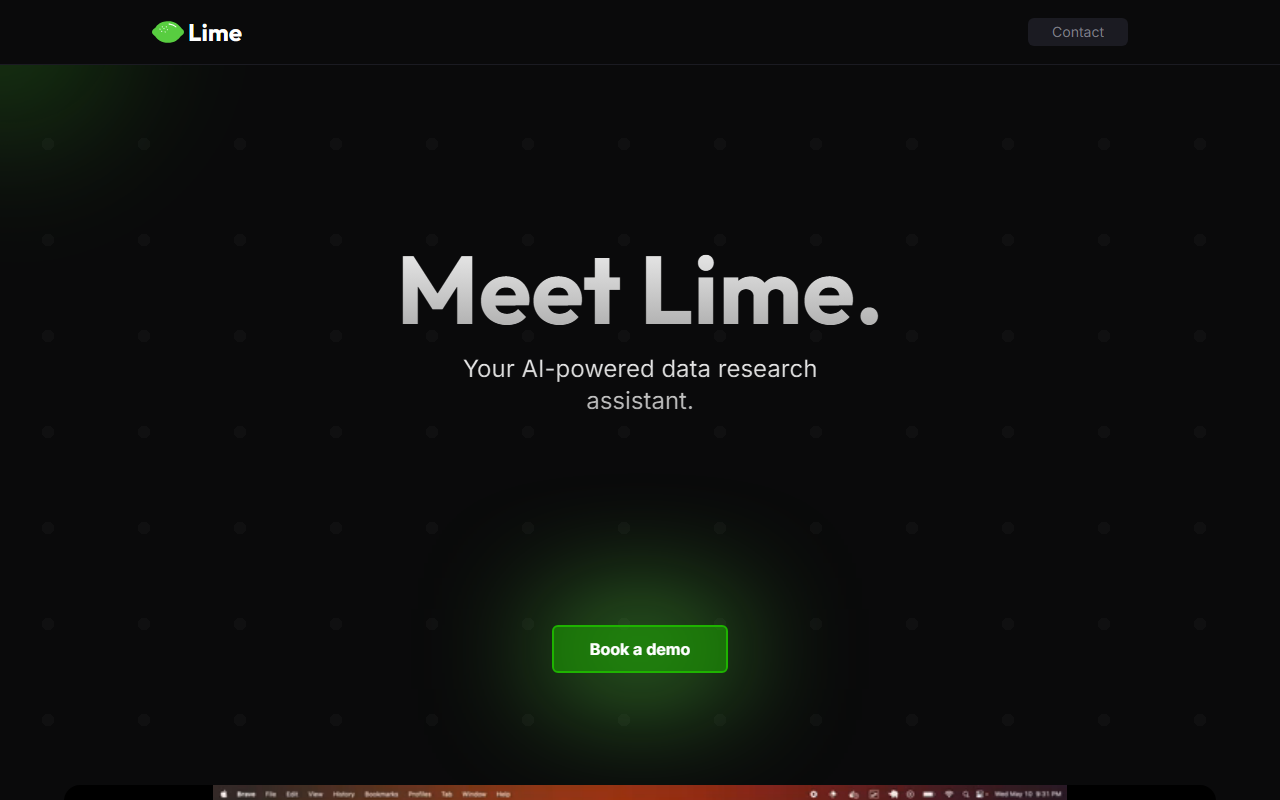
Upon visiting the Datalime website at datalimeai.com, the first thing I noticed is a minimalist, almost sparse landing page. The headline reads: 'Lime – Your AI-powered data research assistant.' Below that is a 'Book a demo' button and a contact form. There is no sign-up flow, no free tier to test, and no detailed feature list. This immediately signals that Lime is currently in an early-access or enterprise-only phase. For a journalist used to clicking straight into a tool, the lack of public entry point is both intriguing and limiting.
The interface I could observe is essentially a single-page marketing site. The company behind it, Datalime, seems to be positioning Lime as a specialized assistant for data research — likely targeting professionals who need to query databases, generate reports, or synthesize insights from structured and unstructured data. The technology layer is not disclosed, but given the category 'Text AI > AI Office,' it likely leverages large language models fine-tuned for analytical tasks. Without deeper access, I’ll have to judge based on the promise and available signals.
What Datalime’s Lime Does and Who It’s For
Based on the messaging, Lime is designed to streamline how teams interact with their data. Instead of writing SQL queries or learning complex BI tools, you ask questions in natural language and get researched answers. This is a problem many competitors tackle — tools like Pandas AI or Liner offer similar ‘chat with your data’ experiences. However, Lime seems to focus specifically on research rather than just querying. That could mean it pulls data from multiple sources, cross-references it, and presents a synthesized report.
The target audience appears to be data analysts, business intelligence professionals, and decision-makers who need fast, accurate data insights without relying on a dedicated team. It promises to ‘assist’ rather than fully automate, which suggests a human-in-the-loop design. For now, the lack of public documentation or case studies makes it hard to verify these capabilities. I would also note that the website does not mention any specific integrations (e.g., databases, CRMs, spreadsheets), which is a common pain point for such tools.
Strengths and Notable Limitations
One clear strength is the clarity of its value proposition: ‘AI-powered data research assistant.’ That phrase is specific and avoids overhyping. The design is clean, and the call to action is direct — book a demo, no clutter. For a company aiming at enterprise clients, this approach can work well. The brand name ‘Lime’ is also memorable and short.
However, there are significant limitations from a reviewer’s standpoint. The most obvious is the absence of any self-service trial or public pricing. Pricing is not publicly listed on the website. This makes it impossible to assess value or compare features with rivals like Julius AI or Defog.ai, which offer free tiers or transparent pricing. Furthermore, there is no blog, documentation, or example outputs. Without a demo, I cannot verify response quality or workflow. The contact form requires a company website and title, which may deter smaller teams or individual researchers.
Another concern is the lack of technical details: what models power Lime? Is it cloud-only? Does it support custom data connectors? The website remains silent. This might be acceptable for very early stage, but for a tool charging enterprise prices, transparency builds trust. The tool may be powerful behind the scenes, but as a reviewer, I can only report what I see — and what I see is a brochure, not a product you can test.
Final Verdict and Recommendation
Datalime’s Lime is a promising concept: an AI assistant dedicated to data research. For large organizations that already have a data infrastructure and need a conversational layer, booking a demo could be worthwhile. The company may reveal robust capabilities in a live meeting. However, for small businesses, startups, or independent analysts, the lack of accessible entry points makes it hard to recommend right now.
I would advise interested users to request a demo and inquire directly about supported integrations and pricing. Meanwhile, consider alternatives like Noteable or Rows AI, which provide visible features and free trials. If Datalime opens up public testing or shares concrete use cases, this review will need revisiting. For now, Lime remains a closed-door tool with a promising tagline but little else to evaluate.
Visit Datalime at https://datalimeai.com to explore it yourself.













Comments