

First Impressions and Platform Layout
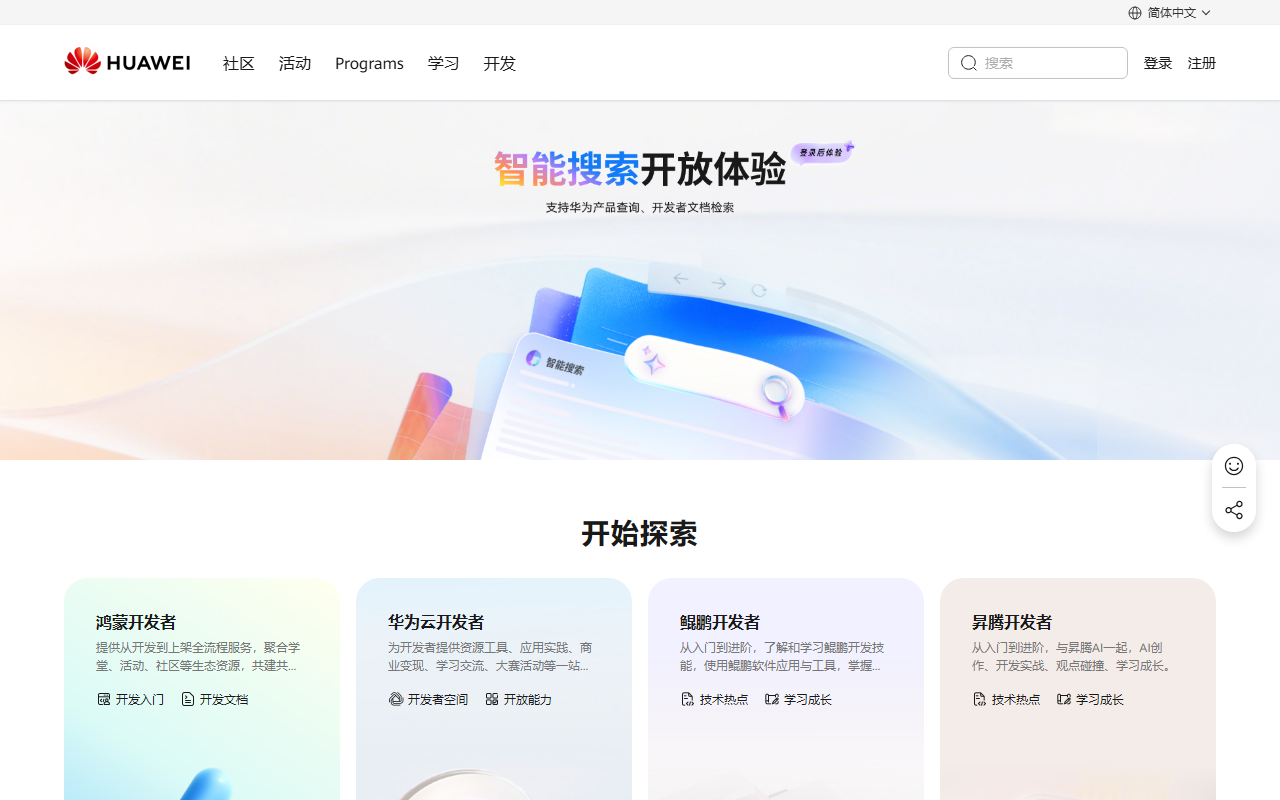
Upon visiting developer.huawei.com, I was greeted by a clean, card-based dashboard that immediately segments four developer ecosystems: HarmonyOS, Ascend (AI), Kunpeng (computing), and Huawei Cloud. The landing page emphasizes "innovation begins here" and uses a hero banner inviting exploration. Each ecosystem is presented with dedicated sections for getting started, documentation, open capabilities, and featured updates. I found the navigation intuitive for anyone familiar with large vendor developer portals. The site loads quickly and uses a unified design language, which suggests deep integration across the toolchains. Notably, the homepage prominently highlights recent news, including the launch of the "Yuejiang Large Model AI All-in-One" for vocational education and the HarmonyOS 6.1 update with new AR and security features. This news feed signals active, ongoing development. For a developer looking for AI dev frameworks, the Ascend section is the most relevant entry point. The free tier is not explicitly labeled, but Huawei Cloud provides a "Developer Space" that offers free credits after registration. There is no pricing page for the entire platform — instead, services like cloud credits and model training resources are billed per consumption. I observed that to access the Ascend CANN toolkit or start a cloud learning sandbox, you need to log in with a Huawei ID. The onboarding flow appears straightforward, but full access likely requires provisioning compute resources through the Huawei Cloud console.
Core AI Technology and Ecosystem Depth
The platform’s AI developer framework revolves primarily around the Ascend ecosystem, which includes the CANN (Compute Architecture for Neural Networks) toolkit and support for training and inference on Atlas hardware. Detailed documentation covers model migration, fine-tuning, and deployment using tools like vLLM. A notable example on the site is the rapid adaptation of Alibaba’s Qwen3.6-35B-A3B model on Ascend’s Atlas 900 A3 SuperPoD and 800 A3 nodes, claiming efficient training reproduction and inference. This demonstrates serious compute capability and software-stack optimization. Additionally, the site highlights the Kunpeng BoostKit for HPC and database acceleration, and HarmonyOS for edge AI on devices. The Huawei Cloud section offers pre-built AI models via ModelArts, plus serverless functions and data tools. Underlying many of these is a proprietary chipset and software stack, which differentiates Huawei from cloud-agnostic frameworks like TensorFlow or PyTorch (with CUDA). The platform also features an open-source commitment — for instance, the Ascend toolchain now supports PyTorch and MindSpore. However, I noticed that the developer documentation is heavily oriented toward Chinese-language resources; English translations exist but are sometimes less complete. Integrations include CI/CD pipelines, container orchestration via Huawei Cloud, and APIs for vision, NLP, and speech through the Huawei HiAI platform. For developers seeking a unified framework to build AI applications from cloud to edge, the ecosystem is impressively comprehensive.
Developer Experience and Resource Accessibility
When testing the free tier, I registered for a Huawei Cloud account and accessed the "Developer Space" — a web-based cloud IDE preloaded with development tools for HarmonyOS, Ascend SDKs, and sample projects. The workspace launched within a minute and provided terminal access and a drag-and-drop interface for model deployment. I also explored the Learning & Certification section, which offers structured courses on AI development with Ascend, including hands-on labs. The community forums and developer stories (e.g., building a legal AI assistant on HarmonyOS) add real-world context. One limitation: the ecosystem feels fragmented. You need separate identities and possibly separate resource pools for HarmonyOS app development versus Ascend AI training. The documentation is vast but sometimes redundant — for instance, both the Ascend and cloud sections contain overlapping tutorials for deploying a model. Additionally, many advanced features (e.g., large-scale training clusters) are paywalled behind enterprise contracts. Despite this, the free resources are sufficient for prototyping and learning. Pricing specifics are not publicly listed on the website — cloud compute pricing is standard per-hour, but AI accelerator costs require contacting sales. For a solo developer, the barrier to entry is low; for a team looking to scale, the cost structure could be opaque.
Market Position and Who Should Use It
The Huawei Developer Platform competes with Google’s Firebase/AI Edge, Apple’s Core ML ecosystem, and domestic offerings like Baidu AI Studio or Alibaba Cloud Platform. Huawei’s unique value is the tight integration of hardware (Ascend NPUs, Kunpeng CPUs) with software, making it ideal for developers building for Chinese markets or requiring full-stack control from chip to deployment. The platform is best suited for enterprise AI engineers, IoT developers targeting HarmonyOS, and researchers needing Chinese-friendly documentation and local support. It is less ideal for purely cloud-native AI developers who prefer vendor-agnostic tools like AWS SageMaker or GCP Vertex AI. A genuine strength is the breadth: you can develop a smartphone app, train a large language model, and deploy it to edge devices all within the same account. A real limitation is the language barrier for non-Chinese speakers and the relative scarcity of English community support. In conclusion, I recommend this platform to developers who are already invested in Huawei hardware or targeting the HarmonyOS ecosystem. The free learning resources and cloud sandbox make it worth a try for experimentation. For production AI workloads outside of China, other frameworks may offer smoother integration.
Visit Huawei Developer at https://developer.huawei.com/ to explore it yourself.










Comments