

First Impressions and Onboarding
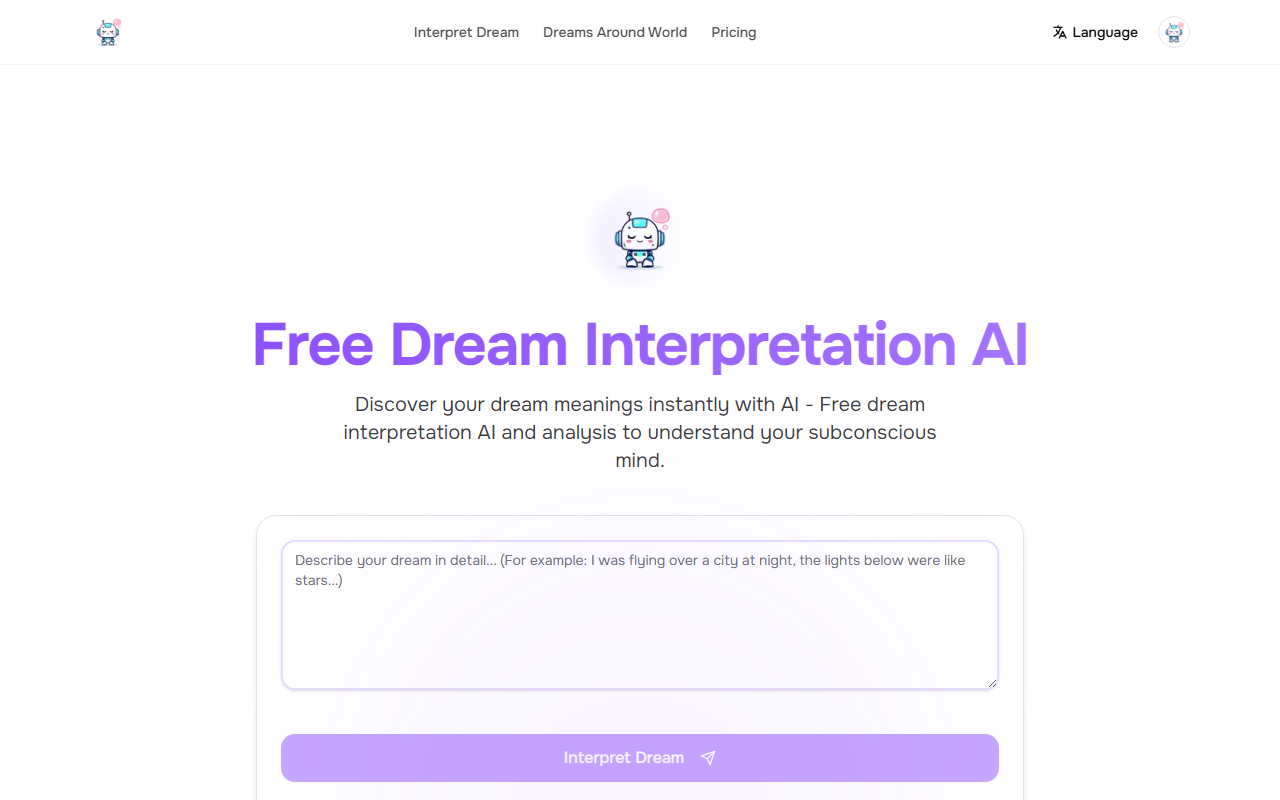
Upon visiting the site, I was greeted by a clean, minimalist dashboard with a single text box under the header 'Interpret Dream.' The design is refreshingly straightforward: you describe your dream in a few sentences, toggle optional settings like 'Roast mode' (which adds a humorous, blunt interpretation), and hit the button. No sign-up or email was required to start—a huge plus for privacy-conscious users. The dashboard also shows example dream snippets (flying, falling, teeth falling out) that serve as inspiration. Below the main tool, there is a 'Dream Explorer Map' with a grid of user-submitted dreams from around the world, allowing you to browse interpretations from different cultures. The entire onboarding took less than 30 seconds, and I was immediately writing my own dream into the box.
How Dream Interpretation AI Works
The tool claims to use 'advanced AI technology' combining a comprehensive symbol database with pattern recognition. While the website does not specify the underlying model (likely a fine-tuned transformer or a wrapper around GPT), the responses I observed were structured, contextual, and surprisingly nuanced. I tested a dream about being chased in a maze. The interpretation first identified common symbols (the maze, the pursuer) then offered psychological angles (feeling trapped, avoiding a problem) and spiritual angles (the maze as a life path). Users can also toggle between 'Standard interpretation' and 'Roast mode' for a more playful, sassy take. The tool also provides multiple interpretation methods: modern, spiritual, and cultural perspectives, which are displayed in a tabbed layout below the main result. The website mentions a database of '1000+ symbols' and '24/7 availability,' suggesting the AI operates on a trained model rather than a static lookup table.
Accuracy and Depth of Analysis
Over several tests, I found the interpretations to be consistently relevant and detailed. The AI did not just dump generic definitions but tailored the reading to my specific dream narrative. For example, a dream about flying over cities produced an analysis that touched on freedom, ambition, and a desire to escape current limitations. However, the accuracy claim of '95%' is vague and unverified—it likely refers to user satisfaction ratings rather than objective correctness, since dream interpretation is inherently subjective. One limitation is that the free tier appears to be the only option; there is no premium upgrade or API mentioned. This means the tool may be supported by ads (I saw none) or user data collection. Another limitation: the AI occasionally mixed metaphors or overly relied on common Jungian symbols (e.g., water = emotions), which may not resonate with users seeking a more scientific or personalized reading. Still, for a free tool, the depth is impressive.
Target Audience and Final Verdict
Dream Interpretation AI is best suited for casual explorers, dream journal enthusiasts, and anyone curious about what their subconscious might be saying. It is also valuable for psychology students or writers looking for symbolic inspiration. However, serious researchers or clinicians should look elsewhere—tools like the dream analysis modules in professional therapy apps (e.g., DreamCloud or the Dream Moods dictionary) offer more academically grounded frameworks. Compared to other AI dream interpreters, this one stands out for its user-friendly design, cultural map feature, and humorous roast mode. The biggest strength is instant, free access; the biggest weakness is lack of transparency about the AI model and data privacy. I would recommend it as a fun, insightful starting point, but not as a substitute for professional guidance. Visit Dream Interpretation AI at https://dream-interpretation.ai/ to explore it yourself.













Comments