

First Impressions and Core Functionality
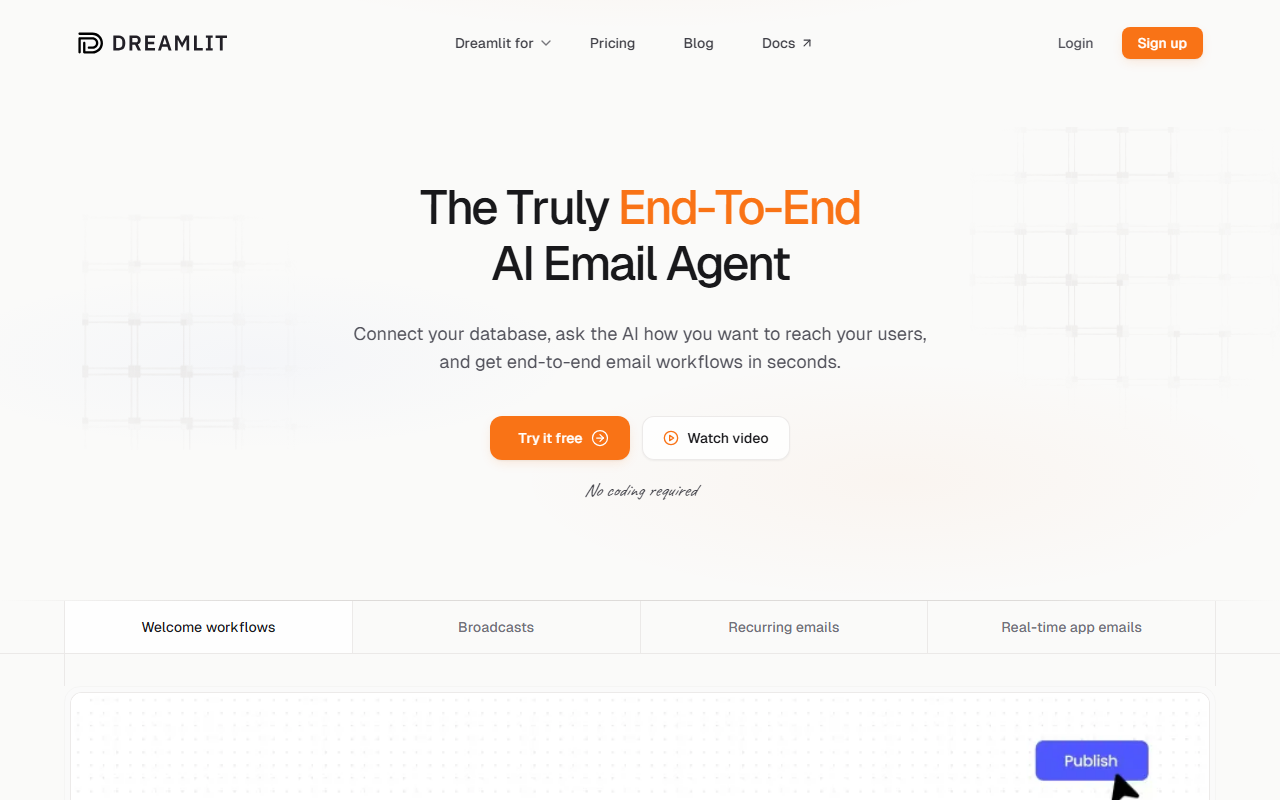
Upon visiting Dreamlit AI’s website, I was struck by the clarity of its value proposition: “The Truly End-to-End AI Email Agent.” The home page features a simple landing section with a hero image, a call-to-action button labeled “Try it free,” and a short video preview. There is no clutter or dense documentation—just a direct promise that you can connect your database, describe what you want in natural language, and receive a ready-to-use email workflow in seconds.
Dreamlit AI is distinctly different from template-based email tools or traditional marketing automation platforms. Instead of configuring triggers, segments, and email templates manually, you start by integrating your data source (such as a CRM, a product database, or a lead list). Then, you type a request—for example, “Send a welcome sequence to new users who signed up in the last 7 days” or “Create a reactivation campaign for customers who haven’t opened emails in three months.” The AI interprets the intent, generates the email copy, sets up targeting logic, and builds the entire workflow automatically.
During my exploration, I noticed that the tool emphasizes a no-learning-curve approach. The phrase “No learning curve. Just ask the AI.” appears prominently. This suggests that the developers have invested heavily in natural language understanding and process orchestration behind the scenes. From a user experience standpoint, this is a massive shift away from the steep onboarding typical of enterprise email tools.
Technology, Integrations, and Pricing
Dreamlit AI’s landing page does not specify which large language model it uses—whether GPT-4, Claude, or something proprietary. However, given its real-time email generation and workflow structuring capabilities, it likely leverages a powerful foundation model fine-tuned for marketing logic. The tool also appears to offer direct database connectivity; the website mentions “Connect your database” without listing specific integrations. This indicates that the agent can pull and push data via API rather than relying solely on pre-built platform connectors.
Pricing is not publicly listed on the website. The only option shown is a “Try it free” button, which may indicate a freemium tier or a limited trial. Without a pricing page, prospective enterprise customers will need to contact sales or sign up to see plans. This lack of transparency is a minor drawback compared to competitors who list monthly subscriptions upfront.
On the technical front, the “end-to-end” claim implies that the agent handles everything from data query to email rendering and possibly sending infrastructure (SMTP, deliverability). That would make it more integrated than many AI writing tools that only generate copy and leave execution to a separate platform.
Market Positioning and Competitors
Dreamlit AI sits at the intersection of AI writing assistants and marketing automation platforms. Direct competitors include Copy.ai’s email workflow templates, which provide AI-generated copy but require manual linking to an email service provider. Another is Mailchimp’s automation builder, which offers triggers and conditional paths but demands significant configuration. Dreamlit’s advantage is its zero-configuration promise: describe the campaign and get a fully functional sequence.
That said, enterprise users accustomed to fine-grained control (A/B testing, advanced suppression lists, granular analytics) may find the black-box approach limiting. The tool seems best suited for small to mid-sized teams or solo marketers who want to launch campaigns quickly without hiring a developer. For large businesses with complex compliance needs, the lack of visible integration details may be a concern.
Dreamlit AI does not appear to have notable funding announcements or user base numbers on its website. It is likely an early-stage product, which means core features may evolve rapidly, but also that support and documentation are still maturing.
Strengths, Limitations, and Recommendation
The primary strength of Dreamlit AI is its sheer simplicity. By turning email campaign setup into a conversational prompt, it reduces time from idea to execution to minutes. The end-to-end nature—from database access to finished workflow—solves a real pain point for marketers who dread toggling between scripts, templates, and sending schedules.
However, the tool has limitations. First, the absence of transparent pricing makes it harder to evaluate cost-effectiveness. Second, reliance on AI reasoning means that complex logic (e.g., time-delayed conditions based on user behavior across sessions) may not always be parsed correctly. Third, without a publicly available knowledge base, users cannot pre-learn best practices or troubleshoot effectively during the trial.
I recommend Dreamlit AI for anyone who manages recurring email campaigns but lacks coding skills or the budget for a full marketing operations team. Content creators, startup founders, and growth marketers will benefit most. If you need deep customization, enterprise-level reporting, or multi-channel campaigns, you might still prefer a traditional platform. Visit Dreamlit AI at https://dreamlit.ai/ to explore it yourself.













Comments