

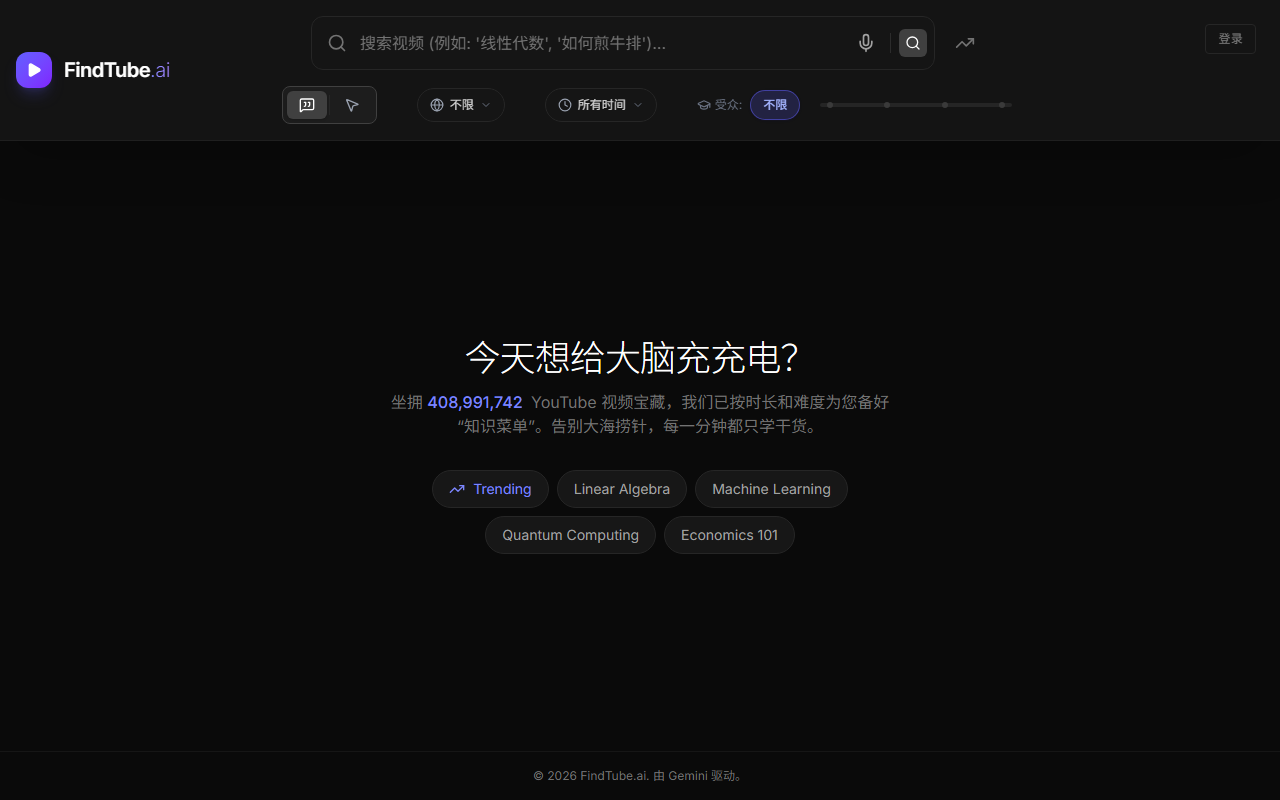
First Impressions and Onboarding
Upon visiting FindTube.ai, I was greeted by a clean, minimalist interface. The homepage presents a search bar at the top, flanked by dropdown menus for language, duration, and education level (Primary, Middle, University, Graduate). Below the search area, a series of category tiles — STEM, Economics, Business, Health & Life Sciences, Humanities — invite exploration. I noticed a “Trending” section and a “Loading topics…” placeholder, which suggests dynamic topic generation based on the video library. The lack of a sign-up wall was refreshing; I could immediately start querying without creating an account.
Core Functionality and Observed Workflow
FindTube.ai markets itself as an “Educational Video Library & AI Deep Semantic Search.” The core promise is that instead of retrieving entire videos like a standard search engine, it analyzes subtitles to pinpoint the exact moment where a specific concept is discussed. To test this, I searched for “quantum entanglement.” The tool returned a list of video results, each tagged with a source (e.g., YouTube channel), difficulty level, and a short excerpt from the subtitles. Clicking a result opened the video at the precise timestamp where the term appeared. The semantic aspect became clear when I queried “how does gravity bend light” — it returned clips that didn’t explicitly use those words but were conceptually related (e.g., videos on general relativity). The library appears to be curated: I saw mostly high-quality channels like Kurzgesagt, 3Blue1Brown, and academic lectures. The interface also lets users filter by “All Languages,” suggesting multilingual subtitle support, though I only tested English.
Technical Details and Market Position
FindTube.ai’s search is powered by what the website calls “deep semantic search.” This likely uses a transformer-based model (similar to BERT or Sentence-BERT) to encode subtitle text into high-dimensional vectors, enabling similarity matching even when query and clip don’t share exact keywords. The tool does not mention a specific model or API, and I found no public API documentation. Pricing is not publicly listed on the website, which implies it may be a free tool (at least for now) or monetized through future premium tiers. For context, competitors include Perplexity (which indexes web pages, not video subtitles) and YouTube’s own search (which relies on video titles, descriptions, and transcript text but lacks semantic depth). FindTube.ai’s unique differentiator is its curated approach: it prioritizes educational content across math, science, humanities, and more, filtering out entertainment or low-quality videos. That curation, combined with semantic search, makes it a promising resource for students, educators, and lifelong learners. I did not observe any user base numbers or funding information on the site.
Strengths, Limitations, and Final Verdict
Genuine strengths: The semantic search truly works well for conceptual queries, saving time by jumping directly to the relevant clip. The curation ensures reliable, academic-grade content. The interface is snappy and mobile-responsive. Real limitations: The video library is not exhaustive — I found no results for niche topics like “Mecanum wheel kinematics” or very recent 2025 lectures. The tool lacks user accounts, playlists, or bookmarking features, which limits its use for long-term study planning. Additionally, without an API, developers cannot integrate it into learning management systems. Who should try it: Students procrastinating on essay research (hey, instant clip references!), educators who need quick video examples during lessons, and autodidacts exploring new fields. Who should look elsewhere: Researchers needing the absolute latest papers or niche technical tutorials — YouTube’s or Google Scholar’s native search may still be better. All in all, FindTube.ai is a focused, well-executed tool that excels at its narrow mission: making educational video consumption more efficient.
Visit FindTube.ai at https://findtube.ai/ to explore it yourself.













Comments