

What is FINH?
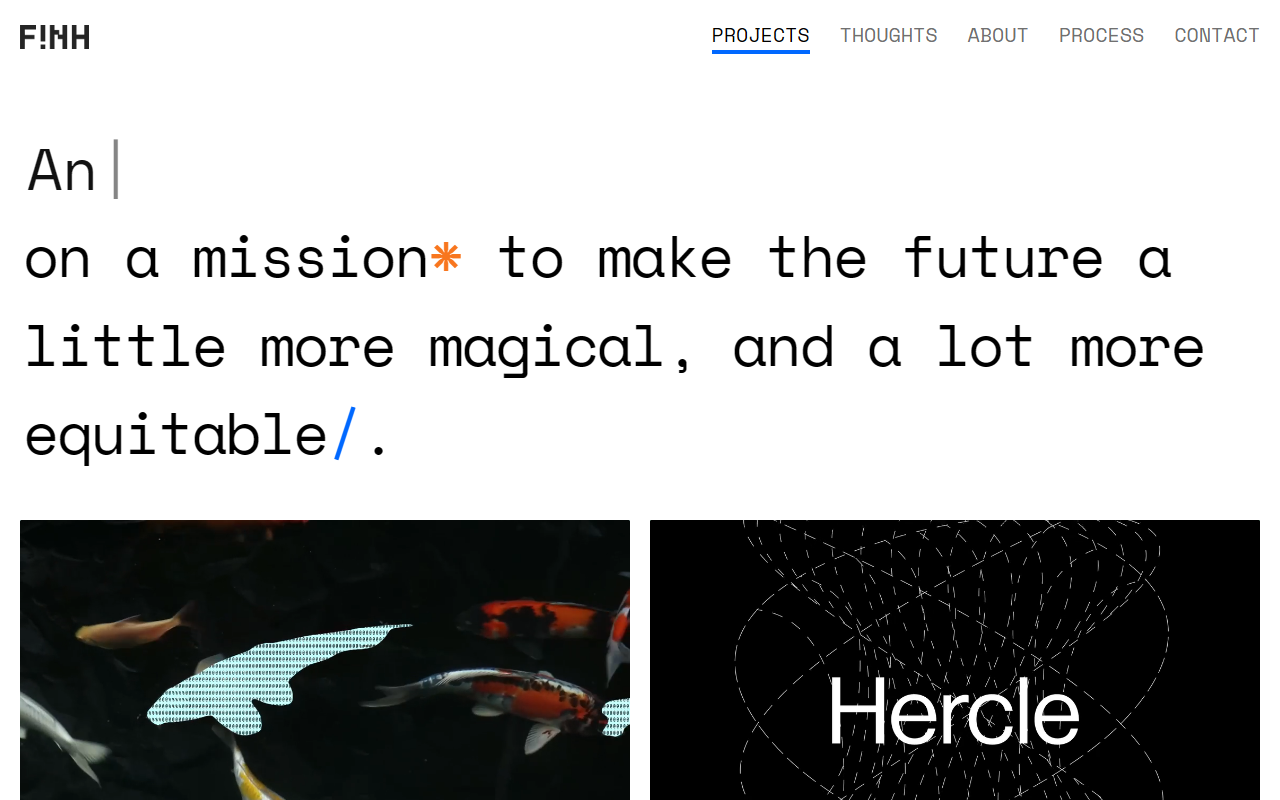
Upon visiting finh.cc, I was greeted not by a dashboard or a sign‑up form, but by a minimalist list of project names and short taglines. The site brands itself as “on a mission to make the future a little more magical, and a lot more equitable.” FINH appears to be a design studio – or perhaps an innovation lab – that creates a wide array of AI‑powered products and experiences. From ASH (“Creating a Pokedex – but real!”) to YARN (“Tangible AI for small storytellers”) and WHATISIT? (“A little bit of AI magic”), the studio explores how artificial intelligence can be embedded into physical and digital objects, especially for children and creative education.
The project FABA+ is an interactive speaker for kids aged 3+, while CUBETTO PLAYSET offers a tangible programming interface. There is even SEDIA_2 – “Teaching a chair to think and learn.” These examples show FINH’s focus on blending AI with design to create playful, educational, and sometimes whimsical tools. The underlying technology is not publicly detailed, but the descriptions suggest multimodal AI capabilities – vision, language, and physical interaction.
Exploring the Site: A Portal of Projects
Landing on FINH’s home page, I saw a long, scrolling list of 26 items, each with a bold title and a one‑line descriptor. There is no traditional “tool” to try, no free tier, and no API documentation. Instead, each project name is a hyperlink (though clicking leads to separate pages that I did not see in the provided content). The interface is exceptionally clean – black text on white, with minimal typographic styling. This is clearly a portfolio site, not a SaaS product.
For example, ASK BYTE is described as “Your kid’s guide through cyberspace,” while NOONES is “The world’s Bitcoin Messenger and Marketplace.” The variety is striking: some projects lean into finance (ANCHORWATCH, RYSK), others into education (LUII for Braille, VILLAGE for child investment), and many into AI‑driven storytelling and play (NOVA STORIES, MOON, MOON & MOON). I found myself wishing for more details on each – how the AI works, who built it, and whether any of these are available to the public. As it stands, FINH reads more like a pitch deck than a functional tool.
Strengths and Limitations
The most obvious strength of FINH is its sheer breadth of imagination. It demonstrates how AI design can be applied across vastly different domains – from a Pokedex‑like object recogniser (ASH) to a blockchain messenger (NOONES) and even a thinking chair (SEDIA_2). The studio clearly has a design‑forward, child‑friendly aesthetic that could inspire product managers and designers looking for creative AI use cases.
However, there are real limitations. First, the site gives almost no technical detail about the AI models or algorithms used. For a developer or tech lead evaluating a tool, this is a deal‑breaker. Second, there is no way to actually interact with any of these projects from the homepage – no sandbox, no demo, not even a download link. FINH is essentially a gallery, not a tool you can try today. Pricing is not publicly listed on the website; the only call to action is a “SAY HI!” link, suggesting a consultative approach.
Compared to platforms like RunwayML or Stable Diffusion (which offer immediate image‑generation tools), FINH focuses on bespoke, product‑level design rather than a general‑purpose AI utility. It is best suited for venture capitalists, educators, or innovation officers exploring the future of AI‑embedded products. If you need a ready‑to‑use AI design tool for your next project, look elsewhere – at least until FINH releases any of its concepts as actual software.
Who Should Pay Attention?
FINH is ideal for two groups: design‑minded experimenters who want to see how AI can be woven into tangible, playful products, and investors or startup founders seeking inspiration for new product categories. The studio’s projects, such as CUBETTO PLAYSET and YARN, hint at a future where AI is integrated into physical toys and learning tools – a space that is still nascent.
If you are a developer or a designer looking for a hands‑on AI tool to create images or prototypes immediately, FINH will disappoint. There is no API, no sign‑up, and no clear way to use the “AI magic” yourself. But if you are curious about what a creative studio can dream up with AI, or if you are scouting for innovative product ideas to pursue, FINH offers a fascinating glimpse into possible futures.
Visit FINH at https://finh.cc/ to explore it yourself.













Comments