

What Is Forvibe and What Problem Does It Solve?
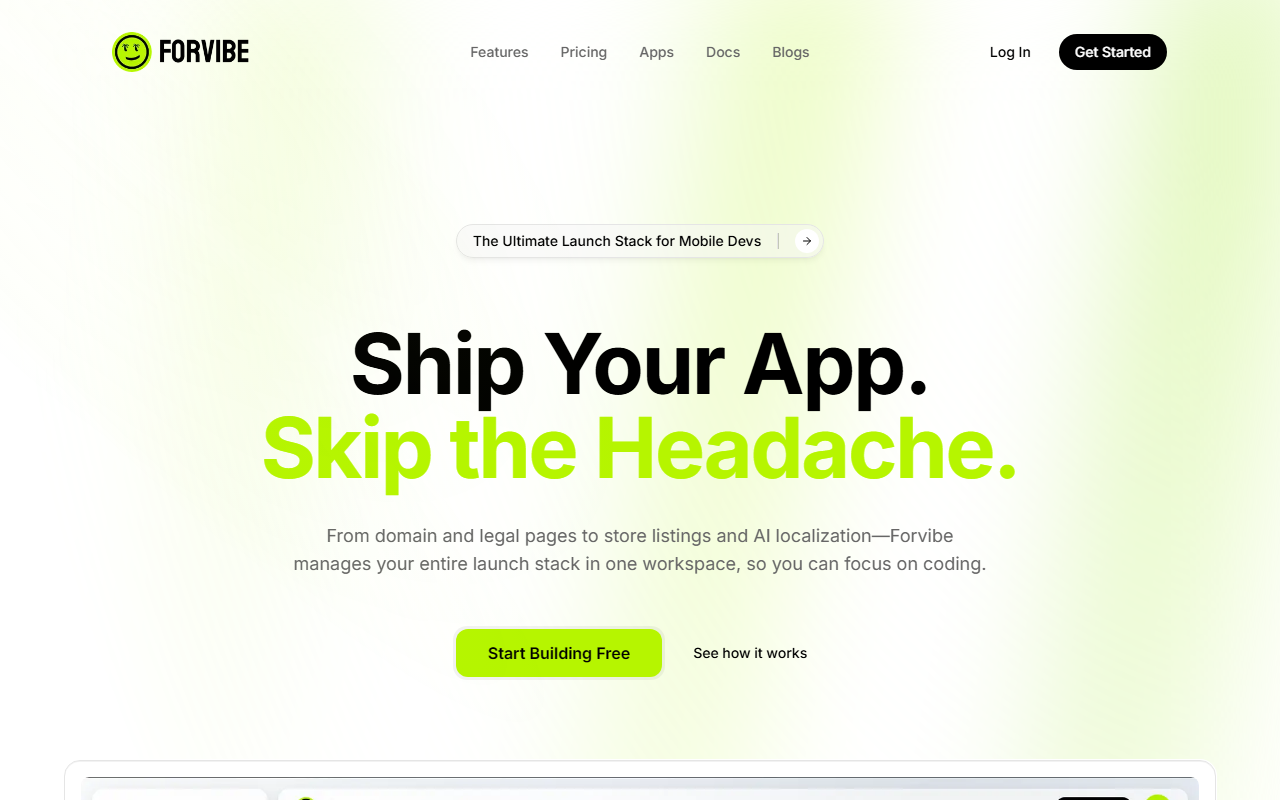
Forvibe is a dedicated platform for indie developers and small teams who dread the non-coding parts of shipping an app. It replaces the fragmented workflow of DNS setup, store metadata duplication, screenshot design, legal text drafting, and localization with a single AI-driven workspace. I visited the site and immediately noticed the bold claim: launch in under 30 minutes instead of 40+ hours. The tool targets the gap between coding and the App Store/Play Store submission process, offering AI-generated landing pages, store listings, screenshots, legal pages, and even a pre-submission check that simulates Apple's review against over 400 real rejection cases.
Hands-On With Forvibe: Interface and Workflow
Upon signing up for the free tier, I was greeted with a clean dashboard that asks you to connect your App Store Connect and Google Play Console accounts. The onboarding flow is well-structured: you link stores, generate assets, and ship in three steps. I tested the free simulation of Apple review—within seconds, Forvibe scanned my placeholder metadata and flagged a missing privacy policy disclosure and a screenshot with a loading spinner. The RAG-backed detection felt accurate, and the one-click fix prompt (to paste into Claude or Cursor) was a nice touch. The AI localization feature supports 175+ countries; I tried generating Turkish and Japanese store listings, and the cultural adaptation looked natural. The landing page builder offers 10+ templates and deploys instantly to a forvibe.app subdomain or custom domain—no DNS or hosting configuration needed.
Pricing, Limitations, and Competitor Context
Pricing is transparent: a free tier with 1 project and 200 one-time AI credits, then Indie Dev at $9.99/month (unlimited projects, +500 credits/month, custom domain, no branding) and Startup at $29.99/month (up to 5 team members, +2000 credits/month). Compared to tools like AppLaunchpad (which focuses only on store screenshots) or Copilot for App Store Optimization, Forvibe is broader but credit-heavy for frequent launches. A genuine limitation: 200 free credits vanish quickly if you generate multiple screenshots and translations—heavy users will need the paid tier. Also, the CLI code scan is limited to code that never leaves your machine, which is good for privacy but requires you to set up your own AI key. There is no public API at launch, which may disappoint developers wanting custom integrations.
Final Verdict: Who Should Use Forvibe?
Forvibe is best suited for solo indie developers or small teams who release apps frequently and want to cut launch overhead. It excels at automating repetitive tasks and reducing rejection risk. However, if you only ship one app per year, the free tier may be enough. For larger teams with complex workflows or those needing API access, consider alternatives or wait for Forvibe's roadmap to expand. I recommend starting with the free tier to test the pre-submission check and localization; the Indie Dev plan pays for itself if you value time over money. Visit Forvibe at https://forvibe.app/ to explore it yourself.













Comments