

First Impressions and Onboarding
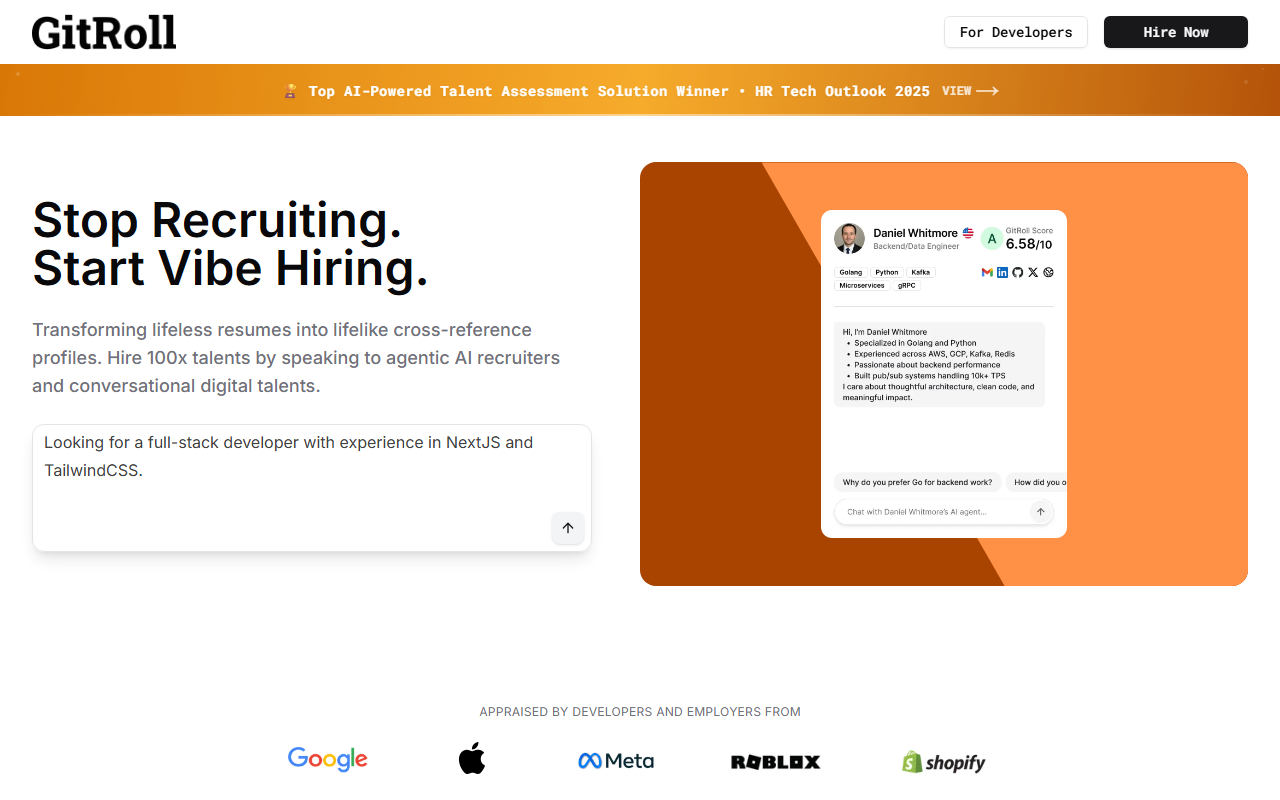
Upon visiting GitRoll, the bold claim "Stop Recruiting. Start Vibe Hiring." immediately sets an ambitious tone. The site highlights an agentic AI recruiter named Shrimpy, which promises to autonomously source, vet, and coordinate candidates. The dashboard is clean and product-focused, with a prominent "Hire Now" call-to-action. I tested the free tier by scanning my own GitHub profile—just entering a username triggered a deep analysis within seconds. The resulting report included a CURISM score (a proprietary metric blending code quality, uniqueness, impact, social proof, and momentum), language proficiency breakdowns, and even bug and improvement suggestions for my repos. This hands-on experience proved the tool's core value: transforming raw open-source contributions into actionable hiring signals.
Key Features That Stand Out
GitRoll aggregates data from 150 million profiles across GitHub, LinkedIn, X, Stack Overflow, blogs, and more. This multi-source enrichment creates cross-reference verified talent profiles. The agentic AI recruiter (Shrimpy) can define job requirements, search the pool, rank matches, and even schedule interviews—all while learning from outcomes. Another standout is the Conversational Talent Profile: employers can chat with an AI avatar of the candidate that has been vetted by code contributions and project metrics. This allows probing motivations, work style, and collaboration preferences without the candidate being online. Deep Code Analysis inspects pull requests, dependencies, and commit history to quantify hard and soft skills. The PeopleMCP feature enables agent-to-agent collaboration for automation workflows.
Strengths and Limitations
Strengths: GitRoll excels at surfacing real coding skills from open-source footprints. The CURISM score provides a standardized, quantitative filter that goes beyond a resume. The conversational profiles are genuinely innovative—they save time during initial screening. Auto-sourcing and smart escalation further streamline the recruiter's workflow. The tool claims 80% saved cost, 60% reduced time-to-hire, and 50% improved retention.
Limitations: The platform heavily favors developers with active public profiles. Junior developers or those with primarily private contributions may receive weak or no scores. Also, the AI avatar conversations, while impressive, cannot fully replace human judgment on cultural fit. Pricing is not publicly listed on the website; interested teams must contact sales for a quote. This lack of transparency may deter smaller companies. Compared to alternatives like HackerRank (which uses live coding tests) or Codility (which focuses on skills assessments), GitRoll is more passive—it analyzes past work rather than simulating future performance.
Who Should Use GitRoll?
GitRoll is best suited for mid-to-large tech companies and recruiting agencies that hire open-source-heavy roles or need to filter large candidate pools quickly. Startups scaling their engineering teams will also benefit from the automated sourcing. However, organizations hiring for very specialized roles that require hands-on technical interviews (e.g., embedded systems) may find GitRoll's analysis too broad. Additionally, companies focused on diversity and inclusion should note the bias toward public GitHub activity. Overall, GitRoll is a powerful addition to a tech recruiter's toolkit—especially for finding hidden gems in the open-source community.
Visit GitRoll at https://gitroll.io/ to explore it yourself.










Comments