

First Impressions and Onboarding
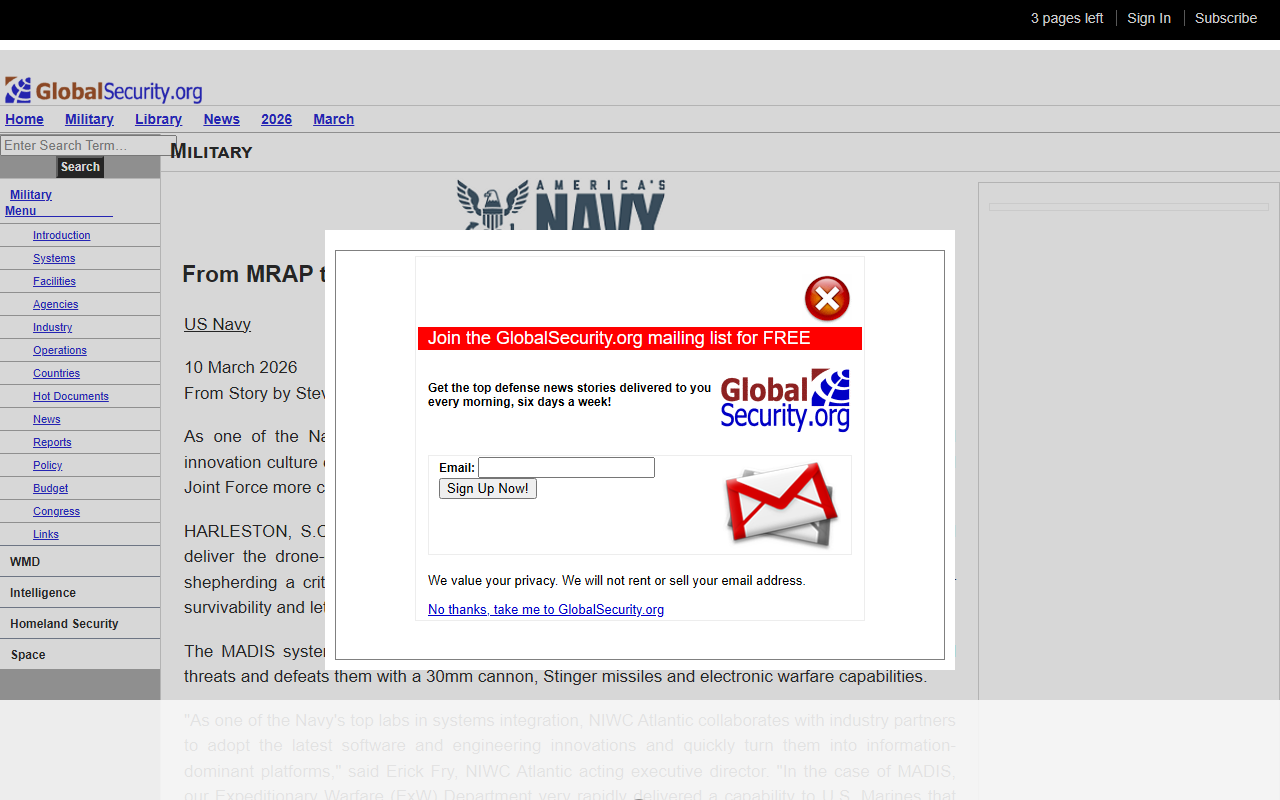
Upon visiting GlobalSecurity.org, I was immediately struck by the sheer volume of content. The homepage presents a dense, text-heavy layout with a hierarchical menu listing countries, weapon systems, and hot topics. There is no signup or onboarding flow – the site is fully open and free to browse. The design feels archaic, reminiscent of early 2000s directories, with no AI chatbot or intelligent search. The site loads quickly, but navigation is entirely manual through lists and links.
What GlobalSecurity.org Actually Does
GlobalSecurity.org is not an AI tool in the traditional sense. It is a massive, hand-curated database of over 50,000 individual profiles covering past wars, ongoing conflicts, and emerging crises, along with detailed entries on land, sea, air, and space weapon systems. It also provides country-by-country breakdowns of para-military groups and political situations. The site has been actively maintained since 2000, offering a depth of background that few other sources match. Its primary value lies in its breadth: you can find a profile for almost any country (e.g., Andorra, Nauru) and for niche topics like Directed Energy weapons or the Rohingya Genocide. The site also aggregates latest news updates and daily summaries (e.g., Iran Daily Summary). It functions as a reference library for military and security affairs, not as an AI-driven reading assistant.
The technology behind it is basic HTML and server-side scripts. There is no API, no integration with any AI model, and no adaptive content recommendations. The search function appears to be a simple keyword lookup. For a tool classified under 'Text AI > AI Reading', this is a stark mismatch. However, if you consider 'AI Reading' as a category for resources that support human reading of complex security texts, then GlobalSecurity.org fits as a foundational dataset – but it does not provide any AI augmentation itself.
Strengths and Real Limitations
Strengths: The comprehensiveness is unmatched. Over two decades of curation means the site has profiles even the CIA World Factbook and Jane's Defence might lack. The content is free, with no paywall or registration. It covers both historical and current topics, making it useful for longitudinal research. The site's neutrality is reasonable, though it mixes news with factual profiles.
Limitations: The site has no AI features. It cannot summarize, answer questions, or suggest related reading intelligently. The interface is clunky and not mobile-friendly. There are no filters, no advanced search, and no export options. The privacy policy is dated 2018, suggesting limited updates to compliance. The information is only as current as the last manual update – some profiles may be outdated. For an AI reading tool, users would expect smart interactions, but here you get a static encyclopedia.
Pricing is not publicly listed on the website. The site appears to be supported by donations or institutional backing; no premium tiers are advertised.
Who Should Use GlobalSecurity.org?
GlobalSecurity.org is best suited for researchers, journalists, and military history enthusiasts who need a broad, free reference for security topics. It can serve as a primary source for background research before using actual AI tools. Students writing papers on conflict studies will find it invaluable for quick country profiles.
Who should look elsewhere? Anyone expecting an AI-powered reading assistant (like ChatGPT with web search, or Perplexity) will be disappointed. Similarly, professionals needing real-time, API-accessible data should consider alternatives such as the Jane’s Defence system (paid) or the open-source ACLED database. Unlike these competitors, GlobalSecurity.org offers zero automation and no machine-readable data.
My recommendation: if you need a solid, manually curated repository of security information and are comfortable with old-school browsing, GlobalSecurity.org is a valuable resource. But do not come expecting artificial intelligence – this is a library, not a smart tool. Visit GlobalSecurity.org at https://globalsecurity.org/ to explore it yourself.













Comments