

First Impressions and Onboarding
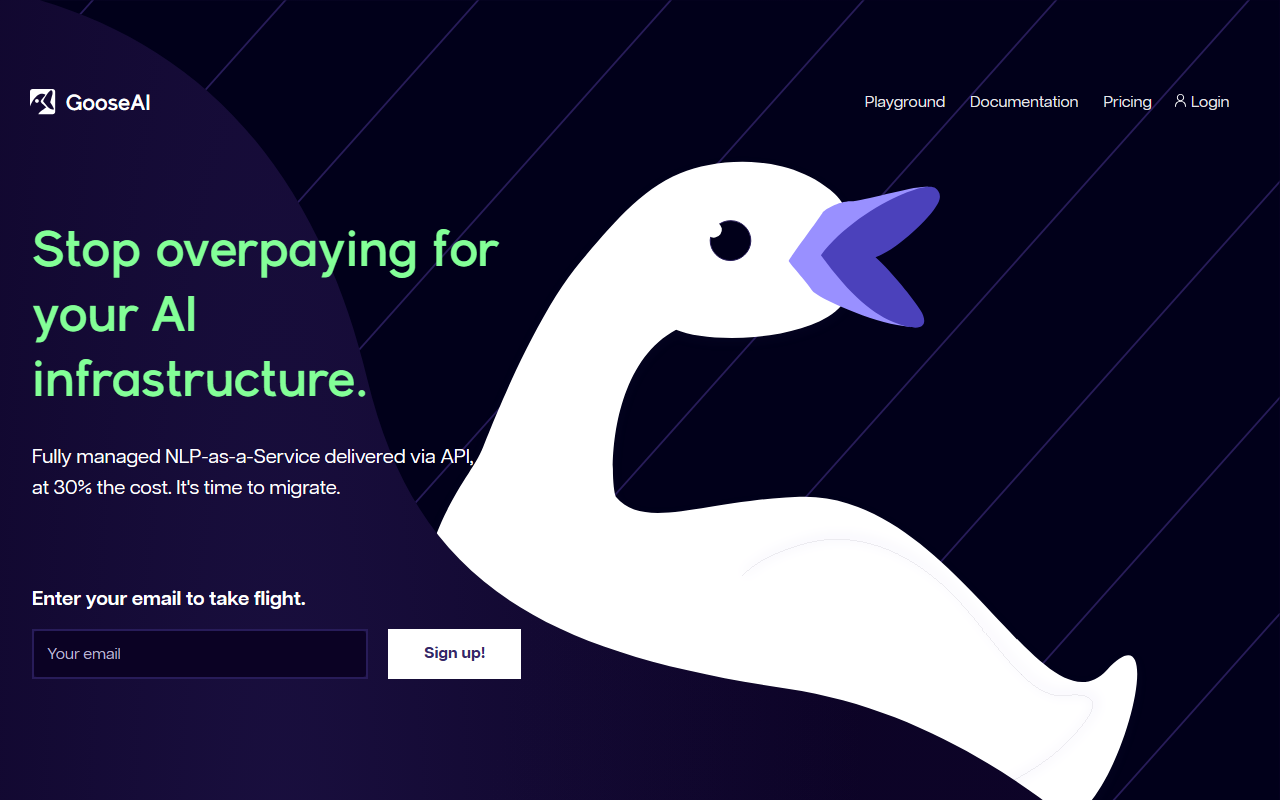
Upon visiting GooseAI's landing page at https://goose.ai/, I'm greeted by a clean, minimalist design that immediately focuses on the value proposition: stop overpaying for AI infrastructure. The hero section cleverly uses goose-themed puns, but the message is serious—fully managed NLP-as-a-Service delivered via API at 30% the cost of competitors. The call-to-action asks for an email to "take flight," which suggests a signup flow rather than an immediate free trial. I did not create an account, so I cannot speak to the dashboard or API key generation process directly. However, the site does include a code snippet showing how to switch from OpenAI to GooseAI by changing just one line: setting openai.api_base to "https://api.goose.ai/v1". That simplicity is a strong selling point for developers looking to migrate quickly.
Pricing and Model Selection
GooseAI offers four tiers of model sizes, each priced per request. The small model (GPT-Neo 1.3B or Fairseq 1.3B) costs $0.000110 per request. The medium (GPT-J 6B) is $0.000450, large (Fairseq 13B) is $0.001250, and massive (GPT-NeoX 20B) is $0.002650. These prices are significantly lower than OpenAI’s GPT-3.5-turbo or GPT-4 API rates, especially for comparable model sizes. The models are all open-source variants from the EleutherAI and Fairseq families, which means GooseAI is essentially offering managed inference for these community-driven models. They also note “classic NLP use cases” like text completion and generation, with question/answer and classification marked as “Coming Soon.” This is a honest limitation—you won’t find the broad suite of capabilities that OpenAI offers (e.g., embeddings, moderation, fine-tuning).
Technical Details and Market Positioning
The service is a joint venture between CoreWeave (a specialized GPU cloud provider) and Anlatan (the company behind NovelAI, an AI storytelling platform). This partnership gives GooseAI access to optimized GPU infrastructure, which likely enables the “industry’s fastest generation speeds” they claim. The API appears to be OpenAI-compatible, as shown by the Python and JavaScript examples. Unlike competitors such as Cohere or AI21 Labs, GooseAI focuses exclusively on open-source models and a pay-per-request model without subscription tiers. There is no mention of fine-tuning, embedding endpoints, or safety filters—features that enterprises often require. Additionally, the lack of a free trial tier (you must sign up first) may deter casual testers. For developers who just need raw text generation at scale and are comfortable with open-source models, GooseAI’s low pricing and single-line migration are compelling.
Who Should Use GooseAI?
GooseAI is best suited for cost-conscious developers, startups, and small teams who want to run open-source LLMs without managing their own serving infrastructure. If your use case is straightforward text generation or completion and you are currently paying OpenAI’s rates, the 70% cost saving is significant. However, if you rely on advanced features like chat completions with system roles, embeddings, or fine-tuning, GooseAI may not yet meet your needs. Similarly, organizations requiring enterprise-grade security or compliance will need to evaluate further, as the website provides no information about data handling or SLAs. In summary, GooseAI delivers exactly what it promises: a cheaper, simpler alternative for open-source NLP models with an easy migration path. Visit GooseAI at https://goose.ai/ to explore it yourself.













Comments