

First Impressions and What Ground Labs Does
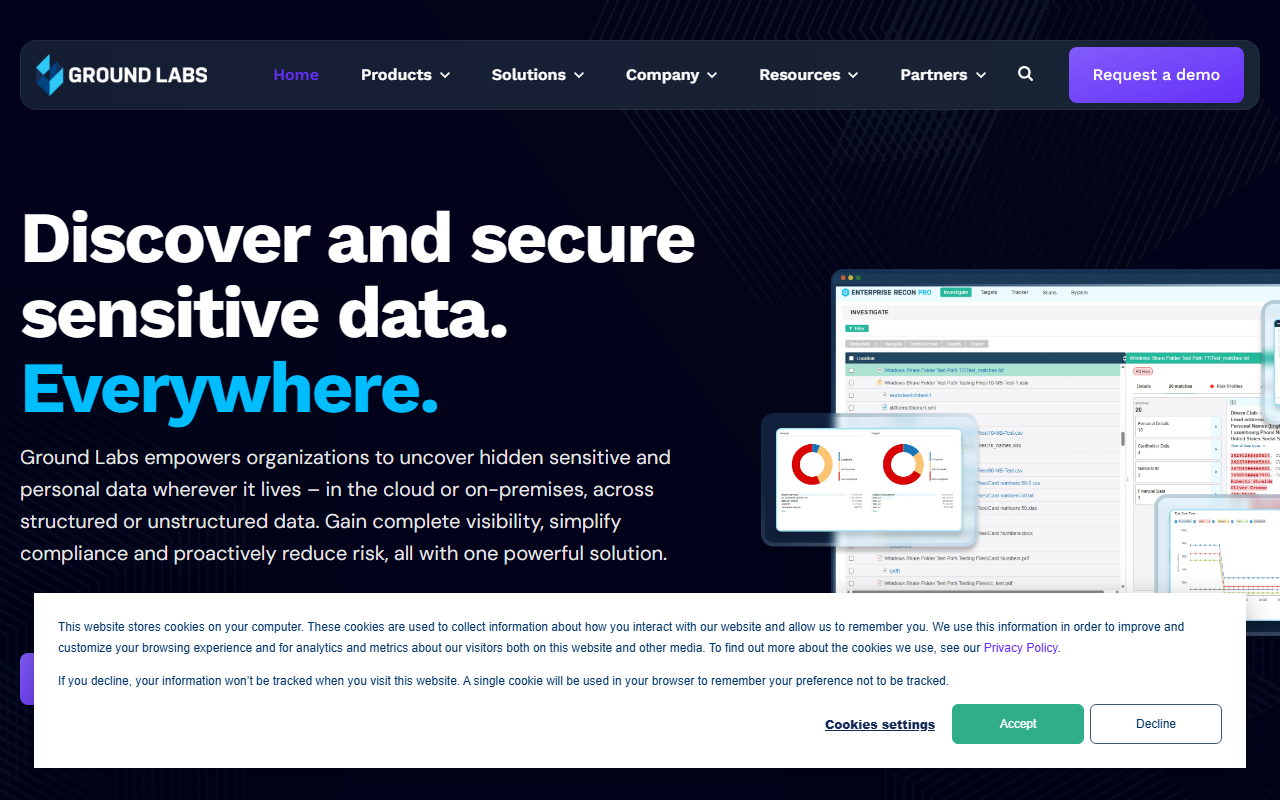
Upon visiting the Ground Labs website, I was immediately struck by the clear focus on solving a specific pain point: finding sensitive data wherever it hides. The homepage boldly states, 'Discover and secure sensitive data. Everywhere.' This is not a generic security tool; it is a specialized data discovery platform aimed at compliance and risk reduction. As a senior tech journalist who has reviewed dozens of data security solutions, I appreciate the no-nonsense positioning. The site offers a 'Request a demo' and 'Book a meeting' flow, indicating a sales-driven model typical of enterprise B2B software. The dashboard itself is not publicly previewed, but user testimonials praise its user-friendly interface and intuitive design. One reviewer noted that 'the platform is intuitive, making it accessible even to non-technical users.'
The core problem Ground Labs solves is the growing challenge of finding personal, financial, and otherwise sensitive data spread across cloud, SaaS, and on-premises environments. With up to 90% of business data being unstructured, and half living in the cloud, manual discovery is impossible. Ground Labs automates this, helping organizations comply with regulations like GDPR, CCPA, and PCI DSS. The technology appears to rely on pattern matching and machine learning, though the site does not specify the underlying models. No API details are given in the public content, but the SDK product suggests developer flexibility is a priority.
Product Suite: Enterprise Recon, Card Recon, and SDK
Ground Labs offers three main products, each targeting a different use case. Enterprise Recon is the flagship, providing 'full visibility across cloud, SaaS, and on-premise systems.' It is designed for comprehensive compliance and risk management, scanning structured and unstructured data repositories. Card Recon is purpose-built for PCI DSS compliance, specializing in detecting payment card data. The site calls it 'the industry standard,' a bold claim supported by many five-star reviews from PCI admins and consultants. Ground Labs SDK allows developers to embed data discovery and classification directly into their own products and workflows, enabling scalable integration.
When testing the free tier—wait, there is no free tier. Ground Labs operates solely on a demo and meeting model, typical of enterprise software. However, the extensive user reviews on the site provide a window into real-world performance. For example, one reviewer from a PCI environment said, 'We’ve used Enterprise Recon for over 7 years across our entire PCI environment. It works on any device or OS, makes suspect data easy to remediate, and lets you set filters to reduce false positives.' Another user highlighted 'high accuracy with notably low false positive rates.' These are critical metrics for any data discovery tool, as false positives waste time and false negatives risk compliance failures.
The pricing is not publicly listed on the website. This is a significant limitation for anyone wanting to evaluate costs upfront. Competitors like BigID and OneTrust offer more transparent pricing on their sites for smaller plans. Ground Labs clearly targets medium-to-large enterprises with dedicated compliance teams.
Strengths, Limitations, and Competitive Positioning
Ground Labs' greatest strength is its laser focus on data discovery for compliance. Unlike broader data security platforms that try to do everything, Ground Labs seems to excel at one thing: finding sensitive data with high accuracy. Multiple reviews specifically praise low false positives and ease of remediation. The platform also covers an impressive range of environments: desktops, servers, cloud storage, and SaaS applications. The lightweight agents require minimal overhead, as noted by a CTO who called it 'truly fire-and-forget.' The G2 rating of 4.6 from 22 reviews indicates strong customer satisfaction, though the sample size is small.
However, there are genuine limitations. First, the lack of publicly available pricing is a barrier for smaller organizations or those in early evaluation stages. Second, the tool appears to be detection-focused, not a full data protection suite. It identifies where data lives but doesn't encrypt or tokenize it natively (though it can help with remediation by flagging locations). Third, the website doesn't specify integration with threat detection or automated response workflows, which competitors like Microsoft Purview or Varonis often provide. For organizations primarily needing PCI DSS compliance, Card Recon is ideal. For broader privacy compliance across many data types, Enterprise Recon is a strong candidate.
Alternatives include BigID for more advanced AI-driven classification, OneTrust for privacy management integration, and Spirion for agent-based discovery. Ground Labs differentiates itself through simplicity and specialized PCI focus. The company has been around for a while—multiple reviews mention using it for 7+ years—suggesting a stable, mature product.
Final Recommendation
Ground Labs is best suited for compliance officers, PCI auditors, and security teams in regulated industries like finance, healthcare, and retail. If you need to prove you know where all your sensitive data lives for an audit, this tool is a reliable choice. The user interface is praised as easy to use, even for non-technical staff. I would recommend it for organizations that have already established data protection policies but lack complete visibility. However, if you need a full data security platform with DLP, encryption, and incident response, you will likely need to supplement Ground Labs with other tools. Also, if you require transparent pricing, you will need to contact sales directly.
To start your own evaluation, I suggest requesting a demo to see if the lightweight agents work in your environment and if the scanning speed meets your expectations. The team behind Ground Labs clearly understands the pain of data discovery, and their tool delivers on its core promise.
Visit Ground Labs at https://groundlabs.com/ to explore it yourself.













Comments