

First Impressions and Onboarding Experience
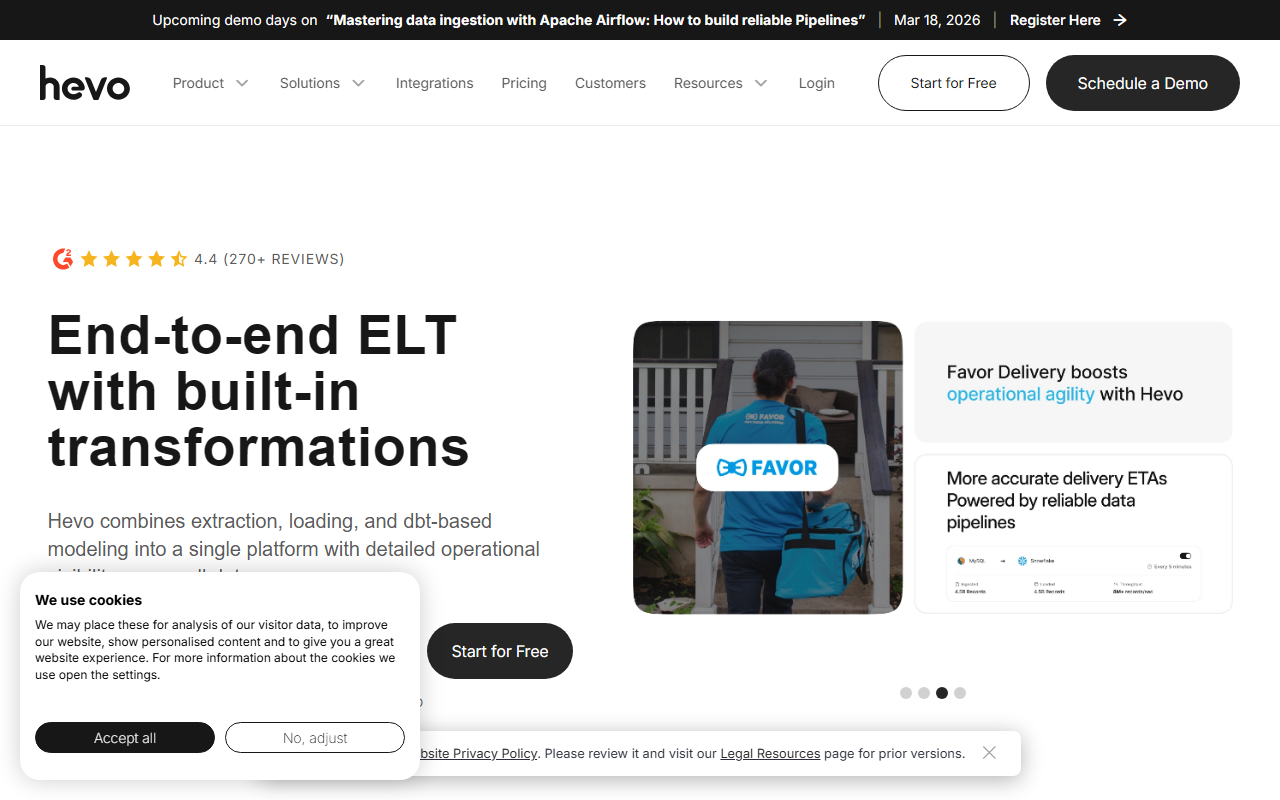
Upon visiting hevo.io, I was greeted by a clean, enterprise-oriented landing page that immediately highlights the platform’s core promise: end-to-end ELT with built-in transformations. The call-to-action for a free trial is prominent, and no credit card is required — a refreshing start for cost-conscious teams. I clicked through to the product documentation and demo videos available on the site. The onboarding flow appears well thought out: you select a source (from 150+ pre-built connectors), choose a destination (like Snowflake or BigQuery), and configure a pipeline in just a few clicks. The interface emphasizes visibility — every pipeline’s status, logs, and schema drift alerts are presented in a single dashboard. I particularly noted the “Reliability Engine” feature, which automatically handles record failures and schema changes without manual intervention.
Core Features and Technical Depth
Hevo solves a critical problem for data teams: moving and transforming data at scale without operational overhead. The platform combines extraction, loading, and dbt-based modeling into one workflow. This eliminates the need for separate tools for transformation — a clear advantage over traditional ETL approaches. Under the hood, Hevo uses Change Data Capture (CDC) for near‑real‑time database replication, ensuring production databases are not impacted. It also handles high‑volume file replication from cloud storage like S3. The platform scales automatically — whether your data grows 10x or 100x, no infrastructure changes are required. For developers, Hevo offers a robust API, CI/CD integration, and advanced pipeline orchestration. I was impressed by the emphasis on observability: real‑time logs and granular system‑level insights give engineers full control. The platform also supports 2000+ data teams (as claimed on the site) and processes over 1PB monthly, backed by customer stories from ThoughtSpot, Postman, and Deliverr — all reporting significant time and cost savings.
Pricing, Positioning, and Market Comparison
Hevo markets itself on transparent pricing, but exact tier costs are not publicly listed on the website — you must request a demo or start a free trial to see specific numbers. The “Start for Free” option likely includes a usage‑limited tier, which is ideal for testing. When compared to competitors like Fivetran and Airbyte, Hevo differentiates itself by embedding dbt transformations directly into the pipeline, reducing toolchain complexity. Fivetran also offers dbt integration, but Hevo’s all‑in‑one approach with native observability and automatic scaling is a strong selling point for mid‑size to large enterprises. Stitch (by Talend) is another alternative but lacks the same level of automation and transformation depth. Hevo is best suited for data engineers and architects who need to manage hundreds of source connections with minimal coding and maximum reliability. Smaller teams or those with very simple data needs might find Hevo’s feature set overkill — a lightweight tool like Airbyte’s open‑source version could suffice.
Final Verdict: Strengths, Limitations, and Recommendations
Hevo’s genuine strengths lie in its ease of setup, automated schema handling, and comprehensive visibility into pipeline health. The dbt integration is a standout, making it easy to deliver analytics‑ and AI‑ready data. However, there are limitations: the lack of public pricing makes initial evaluation less transparent, and the platform’s heavy focus on ELT may not appeal to teams that prefer raw data ingestion without transformation. Additionally, while the connector library is extensive (150+), some niche sources may require custom builds — though Hevo offers to build connectors on request. For data teams looking to streamline their ETL/ELT operations, especially those already using dbt, Hevo is a powerful choice. I recommend starting with the free trial to validate its fit for your data volume and complexity. Visit Hevo at https://hevo.io/ to explore it yourself.










Comments