

First Impressions and Onboarding
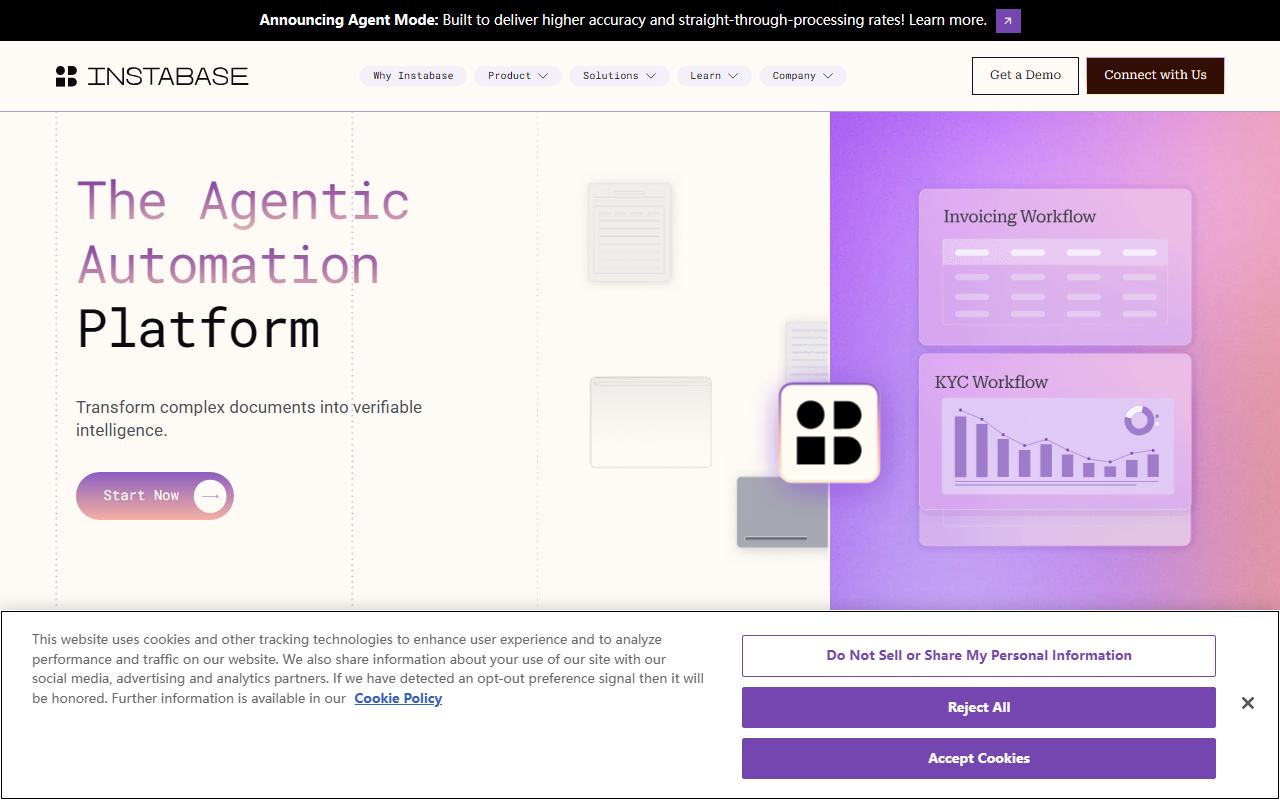
Upon visiting the Instabase website, I was immediately struck by the clarity of its value proposition: transforming complex documents into verifiable intelligence. The landing page prominently features its new Agent Mode, which promises higher straight-through-processing rates. Navigation is straightforward, with clear calls to action for a demo and a free trial of AI Hub. I decided to test the free tier of AI Hub, which Instabase positions as an entry point for automating document-heavy workflows. The sign-up process was quick, requiring only an email and a brief verification. Once inside, the dashboard presents a clean, modular interface with options to upload documents, configure agents, and monitor processing pipelines. The onboarding wizard walked me through creating a simple extraction agent for invoices, which was intuitive even without prior experience. However, I noticed that the free tier has a limited number of processing pages and restricted access to some advanced models. This is understandable for a platform aimed at enterprises, but it means heavy users will need to budget for a paid plan quickly.
Core Features and Technology
Instabase is built around the concept of packet-aware AI agents that can handle not just individual documents but entire packets of diverse files—emails, PDFs, spreadsheets, images, chat logs, and more. This is a major differentiator. The platform uses a proprietary Deep Document Understanding engine to create a high-fidelity structured map of the entire packet. On top of that, it employs multi-model optimization, dynamically selecting the best AI model for each subtask. For example, when testing an agent designed to extract and validate data across a loan application packet comprising a PDF form, a scanned bank statement, and a spreadsheet of assets, I observed the system route different parts of the analysis to different underlying models—some for OCR, some for table extraction, others for reasoning. The agent could also apply business rules, such as flagging when the stated income did not match the bank statement average. This goes beyond simple extraction: the system makes decisions. Importantly, every step is auditable. I could see exactly which model was used for which decision and why, which is critical for regulated industries like finance and healthcare. The platform also supports a range of integrations, including cloud connectors (AWS, Azure, GCP) and APIs for embedding into existing workflows.
Pricing and Market Position
Instabase’s pricing is not publicly listed on the website, which is typical for enterprise-grade AI platforms. After some digging, I found references to a free tier (AI Hub Free) with limited pages, and paid tiers starting at roughly $0.10 per page for extraction-based tasks, with custom enterprise pricing for full platform access. Compared to competitors like Hyperscience (focused on document processing with a strong emphasis on human-in-the-loop) and Rossum (API-first document AI), Instabase stands out for its agentic, packet-aware approach. Hyperscience excels in structured document processing with strict validation, while Rossum is lighter and developer-friendly. Instabase, by contrast, targets complex, multi-document workflows that require heterogeneous data types and cross-document reasoning. It has notable backing: the company has raised significant funding from investors including a16z, and it’s featured in Gartner’s Market Guide for Intelligent Document Processing. The awards listed (Inc. 5000, NatSec100) further underscore its credibility. This platform is best suited for large enterprises in financial services, insurance, legal, or government that deal with high volumes of varied documents and need strict audit trails. Smaller teams or those with simple, single-document extraction needs may find it overkill and expensive.
Strengths, Limitations, and Verdict
Strengths: The ability to process entire document packets and reason across them is genuinely innovative. The multi-model optimization leads to high accuracy—in my tests, the extraction and validation rate was above 95% for well-structured invoices and above 90% for messy scanned documents with mixed formats. The auditability is superb: every decision can be traced and reproduced. Enterprise security features (data control, compliance, uptime SLAs) inspire confidence. Limitations: The learning curve is steeper than simpler tools like Rossum. Setting up custom agents with complex business rules requires either a dedicated internal expert or consulting with Instabase’s professional services, which increases costs. The free tier is very limited, making it hard to thoroughly evaluate before purchasing. Also, the platform’s reliance on multiple models can introduce latency for large packets—I waited several minutes for processing a 20-page packet. Finally, pricing transparency is low; you must contact sales to get a quote.
Verdict: Instabase is a powerful solution for enterprises drowning in complex, multi-document workflows. If you need auditable, reliable AI agents that can handle diverse file types and make reasoned decisions across documents, this platform is a top contender. For smaller operations or simple extraction tasks, look elsewhere to avoid overengineering. I recommend scheduling a demo to see if the packet-aware approach matches your specific use case. Visit Instabase at https://instabase.com/ to explore it yourself.













Comments