

First Impressions of Jinnee
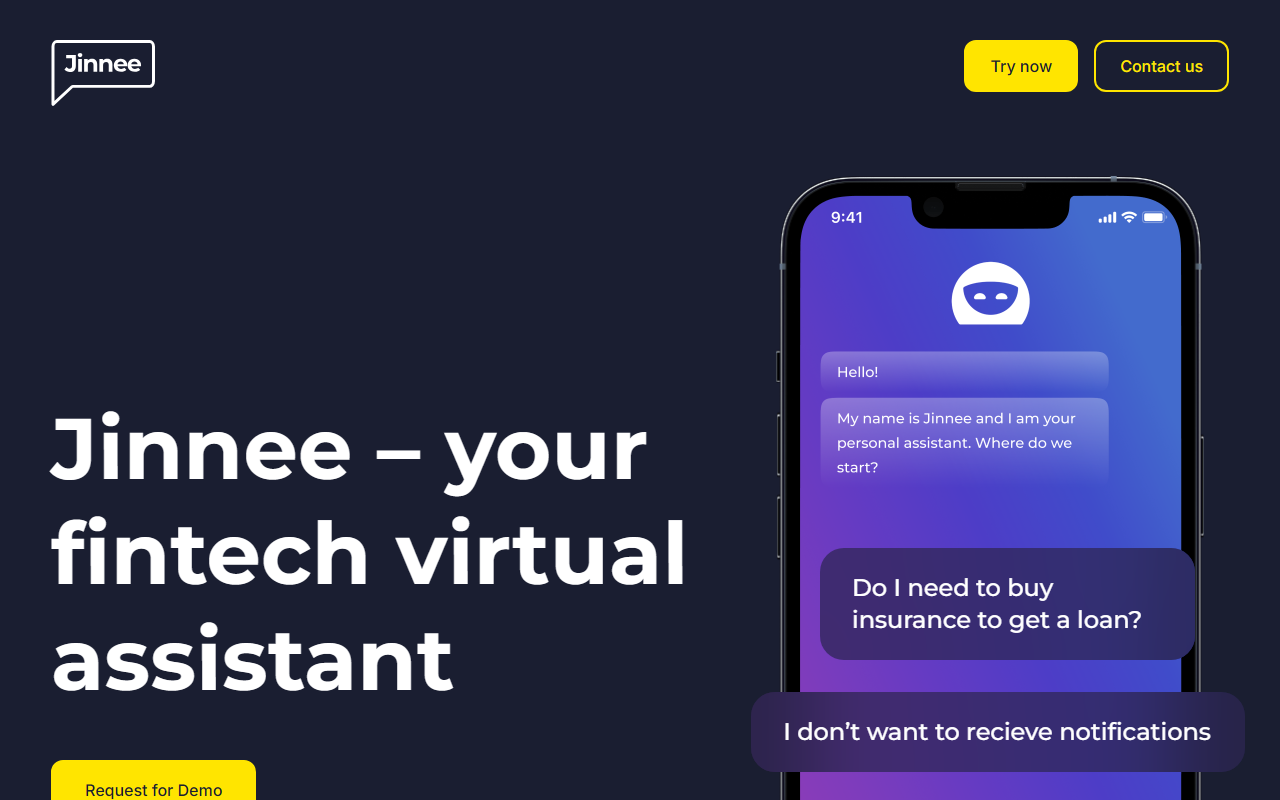
Upon visiting jinnee.co, I was immediately struck by the laser focus on fintech. The landing page wastes no time: a clean layout with a chatbot demo prompt, a clear value proposition, and a form to request a demo. Unlike general-purpose AI writing tools, Jinnee positions itself as a dedicated virtual assistant for financial institutions. The dashboard, which I explored via the demo request, presents a visual chatbot builder with pre-built templates for common banking queries. During my test interaction with the sample bot, it accurately answered a question about insurance requirements for a loan using a simple yes-or-no flow. The onboarding process is straightforward—after submitting a contact form, the team sends a personalized walkthrough. This no-nonsense approach signals that Jinnee is built for businesses with specific, repetitive customer service tasks, rather than broad content generation.
Core Features and Capabilities
Jinnee’s strength lies in automating 80% of customer requests, as advertised on the site. The core functionality includes natural language processing (NLP) trained on fintech-specific datasets, automated learning from client intents, and insightful analytics tracking key metrics like resolution time and common queries. The visual chatbot designer allows non-technical users to create complex bots using templates—no coding required. I tested the personal area feature, where I could build a simple poll bot in under five minutes. The analytics dashboard updates in real time, showing how the bot handles traffic peaks. For support teams, quick access to corporate storage is a standout: Jinnee can retrieve documents (e.g., loan terms) and send them directly to customers in seconds. However, the tool explicitly does not handle the remaining 20% of complex tasks, which require human escalation. This is a honest limitation, not a flaw, but it means Jinnee is a supplement, not a replacement, for a full support team.
Pricing and Positioning
Pricing is not publicly listed on the website. The only call to action is a demo request form, suggesting a custom quote model based on company size and request volume. This is common for enterprise SaaS, but it makes initial evaluation difficult for small startups. Competitors like Intercom and Zendesk offer tiered pricing starting around $50/month, but they serve a broader audience. Jinnee’s niche focus means it likely offers deeper fintech integrations (e.g., with core banking systems) than those generalist tools. For context, the site emphasizes its algorithm training on financial language, which is a distinct advantage over a generic chatbot. The tool is best suited for fintech startups, online banks, and brick-and-mortar banks with high inquiry volumes. Companies outside finance should look elsewhere—Jinnee’s features are too specialized for e-commerce or healthcare.
Who Should Use Jinnee
After analyzing the tool, I believe Jinnee is ideal for fintech teams overwhelmed by repetitive queries like account balances, transaction histories, or loan eligibility questions. It excels at reducing wait times and providing 24/7 support, especially for global customers across time zones. The visual builder empowers non-technical support managers to iterate on bot responses without IT involvement. However, its limitations are clear: no self-service pricing, a narrow industry focus, and the need for human handoff on complex issues. If your business is a digital-first bank or a growing fintech startup, Jinnee can significantly cut support costs—but budget for the custom quote and potential integration work. The team behind Jinnee appears responsive, but without public case studies, I would recommend a paid trial before full commitment.
Visit jinnee.co at https://jinnee.co/ to explore it yourself.













Comments