

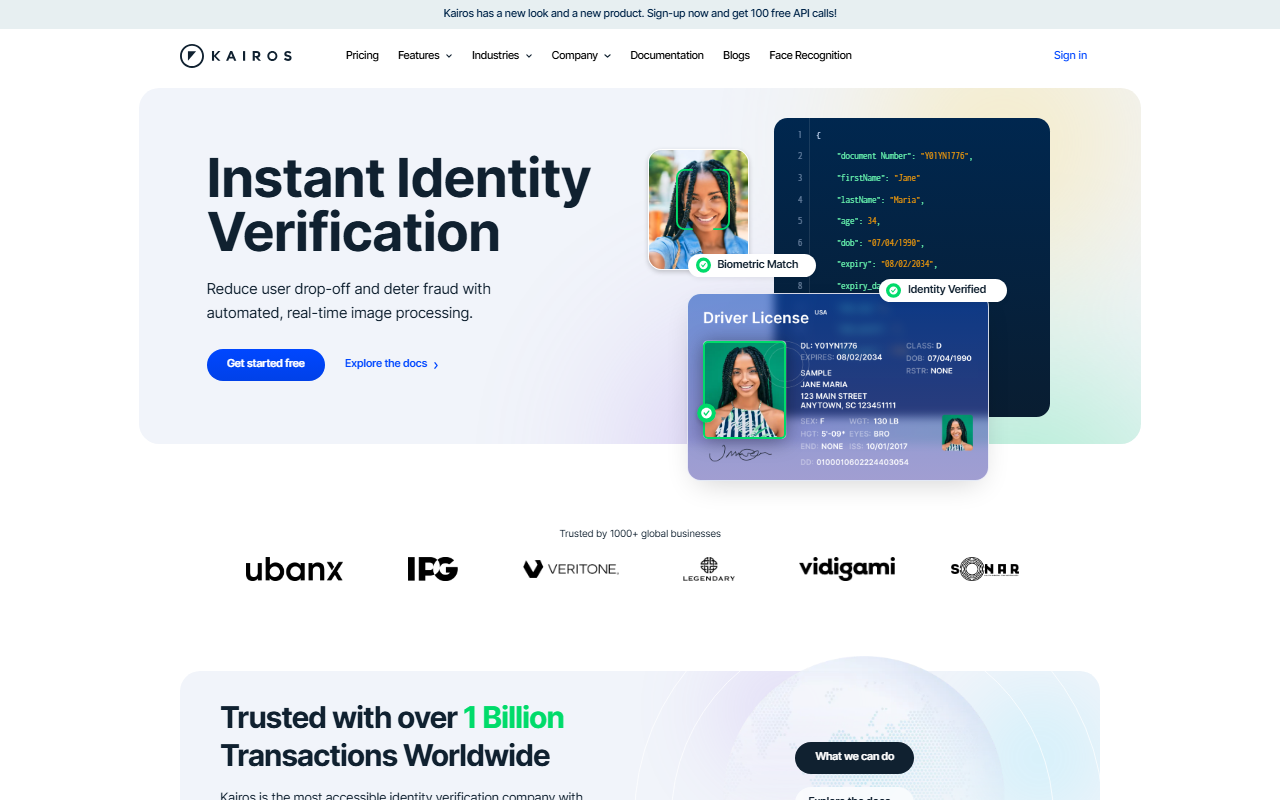
Upon visiting Kairos’s website, the first thing I noticed was the clean, developer-focused landing page. A large hero section touts “Instant Identity Verification” with a sample JSON output showing scanned fields like age, date of birth, and expiry. The layout is sparse but purposeful, leading you to a “Get started free” button and documentation links. After signing up for the free tier (which includes 100 free API calls), I accessed the dashboard. It features a manual upload tool where you can drag and drop a front of an ID card and a selfie. I tested it with sample images provided in the documentation—a synthetic Canadian driver’s license and matching face. Within seconds, the dashboard returned verification results: the ID text was extracted (country, issue date, first name, expiry), an authentication score of 99/100, and a liveness rate. The entire process felt seamless and fast.
What Kairos Does and How It Works
Kairos is a cloud-based AI platform that automates identity verification. It solves the problem of balancing user growth with security during onboarding. Instead of requiring manual reviews or creating friction with multiple steps, Kairos offers a suite of checks in one API call. The core features include ID document verification (supports 4000+ ID types from 200+ countries), liveness detection (checks that a selfie is from a live person, not a photo or video), biometric matching (compares selfie to ID photo), age estimation (from a single selfie), and additional fraud checks like expiry validation. The technology appears to use computer vision and deep learning models, though the website does not specify the exact models. An API is available with clear documentation, and the platform integrates via REST endpoints. Pricing is not publicly listed on the website; you must contact sales to get rates. There is a free tier with 100 API calls to start.
Strengths and Market Position
Kairos’s key strength is its comprehensive, all-in-one identity verification in a single API call. Unlike competitors like Onfido or Jumio, which often require separate SDKs for different checks, Kairos bundles document scanning, liveness, biometrics, and age estimation into one step. This reduces integration complexity and potential user drop-off. The platform claims 10 years of experience in unbiased algorithms, emphasizing accuracy across diverse ethnicities—a critical factor for global compliance. The dashboard also provides manual upload for quick testing, which is developer-friendly. With over 1 billion transactions processed and 1000+ business customers, Kairos has proven scale. The free tier is a nice entry point for startups evaluating the tool.
However, there are real limitations. The most obvious is the lack of transparent pricing on the website. You cannot simply sign up and get a standard plan; you must go through a sales process, which can delay procurement for smaller teams. Also, the manual upload interface, while functional, is basic—no batch processing or advanced filtering. The verification results displayed only basic fields; there is no real-time confidence score breakdown for each checking module. For a tool that markets itself as “developer-centric,” a more interactive API console would be welcome.
Who Should Use Kairos
Kairos is best suited for medium to large businesses that need reliable, high-volume identity verification with minimal friction. Industries like fintech, crypto, gaming, and travel would benefit from the combined liveness and document checks. Startups with fewer than 1000 monthly verifications may find the free tier useful for testing, but should be aware that pricing conversations may start at enterprise levels. If you need a fully self-serve, pay-as-you-go model with published prices (like Veriff or ID.me), Kairos might not be ideal. But if you prioritize a single-API solution with strong accuracy claims and established trust, Kairos is worth a demo.
Visit Kairos at https://kairos.com/ to explore it yourself.













Comments