

First Impressions and Onboarding
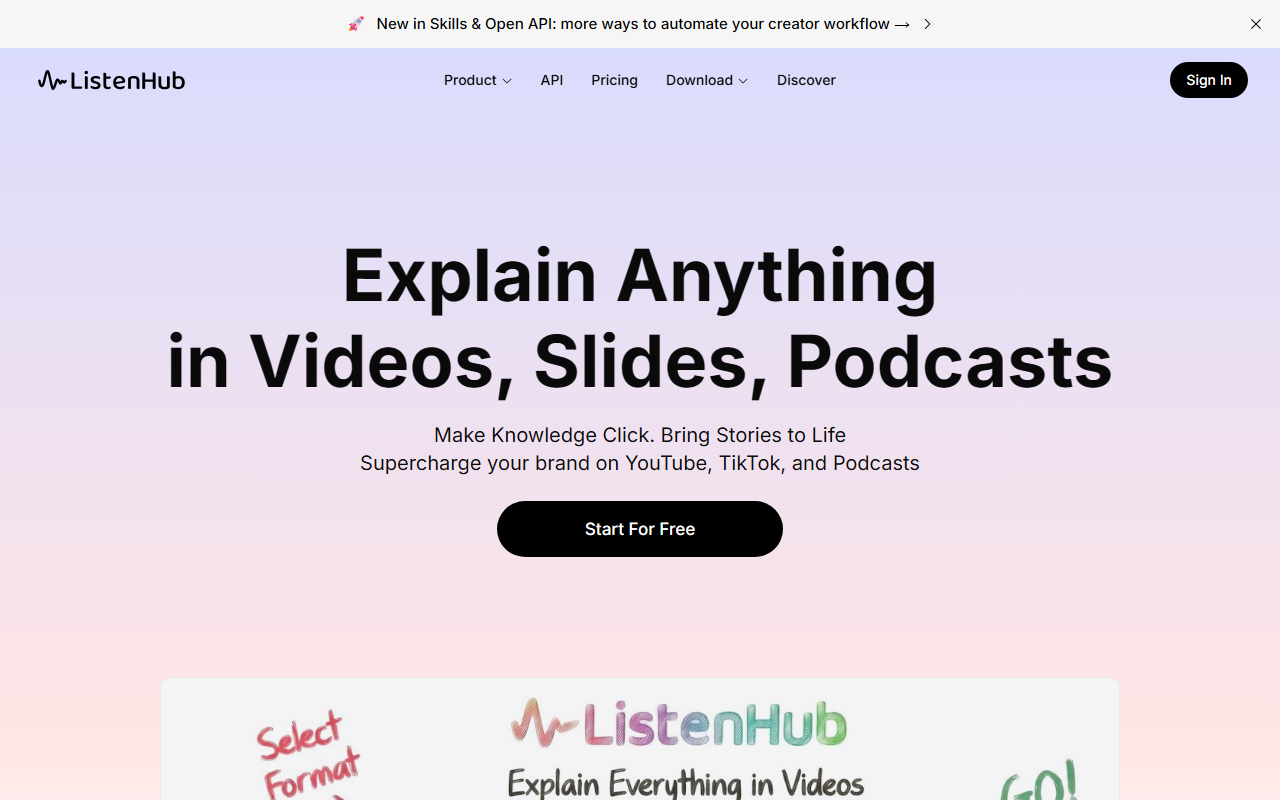
Upon visiting ListenHub, the first thing that struck me was the clean, modern interface. The homepage immediately presents four primary tools: Explainer Video, Slides, AI Podcast, and Text to Speech. Below these, there are audio samples labeled “Quick Insight” with topics like the India‑EU FTA and a humorous piece about Shakespeare’s smartphone. A “Try It Out” button is available for each tool, making it easy to test the functionality without signing up. I clicked on the Text to Speech feature and pasted a short paragraph from One Hundred Years of Solitude. Within seconds, a natural‑sounding voice read the text back, with decent pacing and intonation. The dashboard also shows recent creations, suggesting a workspace where users can manage their projects. Overall, the onboarding is frictionless; the tool makes it clear what it does right away.
Feature Set and Performance
ListenHub positions itself as a versatile AI reading and content creation platform. It accepts inputs like videos, slides, podcasts, PDFs, and plain text, then generates explainer videos, AI‑voiced podcasts, dubbed videos, or audio books. I tested the “AI Podcast” option by dropping a PDF link (a sample article about renewable energy) and chose the “Quick Insight” style. The output was a 4‑minute podcast with two AI voices (Mars and Mia) discussing the content in a conversational manner. The voices were clear and had good emotion, though they occasionally stumbled over complex scientific terms. The text‑to‑speech engine offers multiple voices and languages, plus an “AI Rewrite” toggle to make the text sound more conversational. For video over voice, the tool automatically aligns audio with video clips, which worked smoothly in a test with a short travel clip. The technology appears to rely on custom TTS models and possibly a LLM for summarization and rewriting, though specifics aren’t disclosed. There is no visible API or integration page, which may limit enterprise use. Pricing is not publicly listed on the website; the “Start For Free” button leads to a sign‑up form without any tier details.
Positioning and Use Cases
ListenHub sits in a growing market of AI‑powered content repurposing tools. Unlike Descript, which focuses heavily on audio/video editing, or Murf.ai, which specializes in voice‑over synthesis, ListenHub aims to be an all‑in‑one solution for transforming existing content into multiple formats. It is best suited for YouTubers, podcasters, educators, and brand marketers who need to quickly turn a blog post, presentation, or lecture into an explainer video or podcast episode. The ability to generate both text‑to‑speech and video‑over‑voice from the same source is a strong differentiator. However, creators who require fine‑grained control over voice parameters (like pitch, speed, and emphasis) might find the current options limited. The samples on the landing page show a mix of factual and creative content, indicating intended use for both professional and casual storytelling. The tool appears to be relatively new; there are no obvious user counts or funding announcements, but the interface feels polished.
Strengths, Limitations, and Verdict
Strengths: ListenHub excels at turning a single piece of content (text, video, or PDF) into multiple formats: podcast, explainer video, dubbed video, or audio book. This saves creators significant time. The voice quality is above average, with natural cadence and emotional nuance. The interface is intuitive, and the “Try It Out” buttons make evaluation risk‑free.
Limitations: The lack of transparent pricing is a major drawback—users must sign up to see costs. Additionally, the tool does not support real‑time voice cloning or advanced editing (e.g., waveform trimming). Some generated outputs occasionally mispronounce domain‑specific words. Without an API or team collaboration features, it may not scale for larger production teams.
Recommendation: If you are an individual creator or small education channel looking for an easy way to produce audio and video explanations from existing content, ListenHub is a solid choice. For those needing deep customization or enterprise‑level integrations, consider alternatives like Descript or Amazon Polly. Start with the free tier to see if the output quality meets your expectations.
Visit ListenHub at https://listenhub.ai/ to explore it yourself.













Comments