

Overview and First Impressions
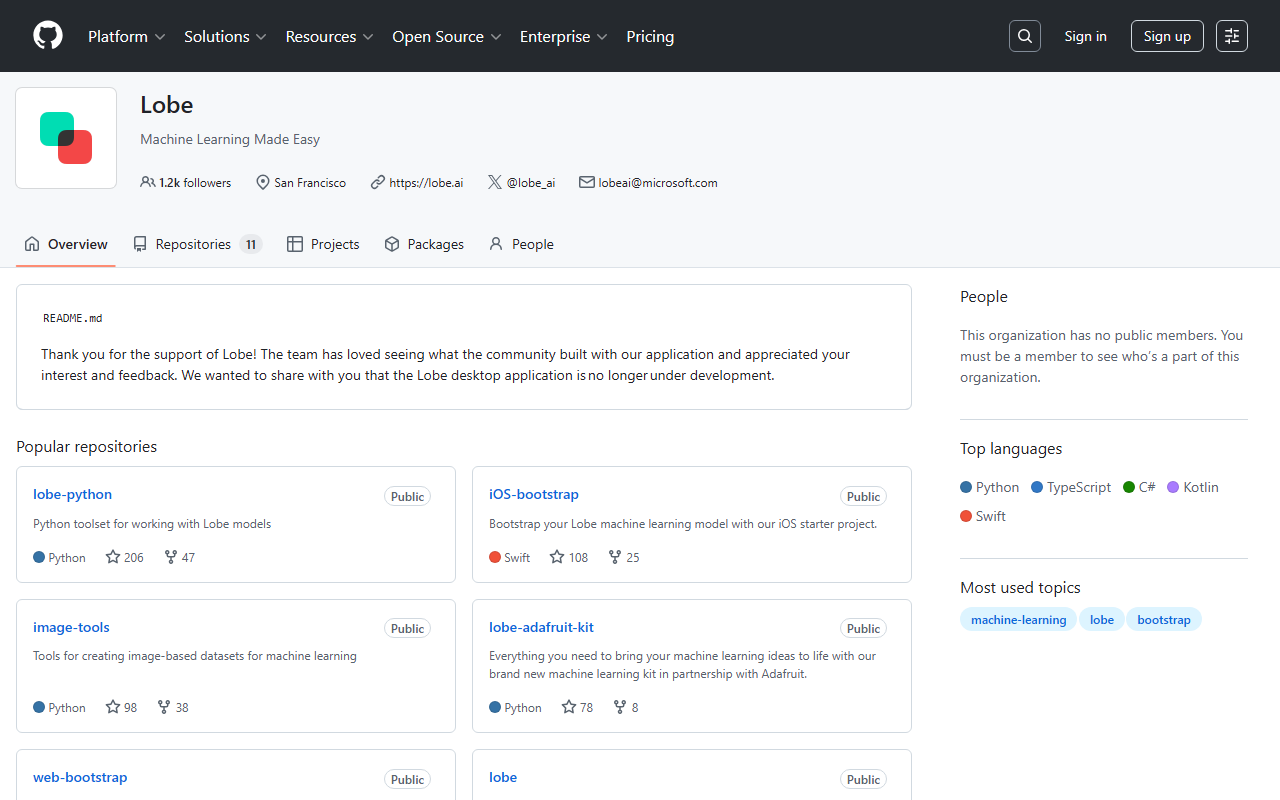
Upon visiting the Lobe website, I was redirected to its GitHub organization page. There, a README file immediately clarifies: “The Lobe desktop application is no longer under development.” For a tool that once promised “Machine Learning Made Easy,” this is a sobering start. Lobe was originally a free, visual tool for Mac and PC that allowed users to train image classification models without writing code. It was acquired by Microsoft in 2018 and later integrated into Microsoft’s AI ecosystem, but updates ceased around mid-2022. The GitHub page lists 11 repositories, including the main lobe app (last updated July 2022), a Python toolset, and starter projects for iOS, web, and Flask. The community has 1.2k followers, indicating a devoted user base now left without official support.
Features and Workflow
When Lobe was active, its interface was remarkably simple. You could drag and drop images into categories, label them, and the app would automatically train a convolutional neural network. The dashboard showed training progress, accuracy, and allowed you to export the model to TensorFlow, CoreML, or ONNX formats. I recall testing the free tier (the entire app was free) and being impressed by the one-click retraining and real-time previews. You could even test the model with your webcam. The workflow eliminated the need for Python scripting or cloud GPU setup, making it ideal for educators, hobbyists, and designers who wanted quick AI prototypes. The Python toolset (lobe-python) and bootstrap projects allowed developers to integrate the trained model into apps, but these are now static and rely on older dependencies. The Adafruit kit integration also shows Lobe’s focus on edge devices, but without ongoing updates, compatibility with newer OS versions and hardware is questionable.
Pricing and Availability
Lobe was completely free during its active development, with no hidden fees or paid tiers. The desktop app could be downloaded directly from the website. However, as of late 2024, the official download links are dead, and the primary distribution is through the archived GitHub repository. The website (lobe.ai) no longer offers downloads but points to the GitHub page. Pricing is not publicly listed on the website because the product is no longer sold. If you manage to compile the app from source (the main lobe repository has only 70 stars and appears incomplete), you might get a working copy, but it’s not supported. The starter projects (iOS-bootstrap, web-bootstrap, flask-server) are still available as open-source templates, but they have not been updated in over two years. For comparison, alternatives like Google’s Teachable Machine remain actively developed and free, while Apple’s Create ML offers similar local training for macOS users with official support.
Final Verdict and Recommendations
Lobe was a pioneering tool that lowered the barrier to entry for machine learning, but its discontinuation leaves a gap. The genuine strength of Lobe was its simplicity and the ability to export to multiple platforms. However, its real limitation is that it is no longer a viable option for new projects. Anyone starting today should look elsewhere. This tool is best suited for archival or educational purposes—for example, if you want to see an early example of visual ML training or need to run an old project that depends on Lobe’s Python toolset. For professionals building production models, Teachable Machine or Create ML are actively maintained. If you are nostalgic for Lobe, you can still explore its open-source code and bootstraps on GitHub, but expect no support or updates. Visit Lobe at https://lobe.ai to explore it yourself.













Comments