

First Impressions: A Research Page, Not a Product
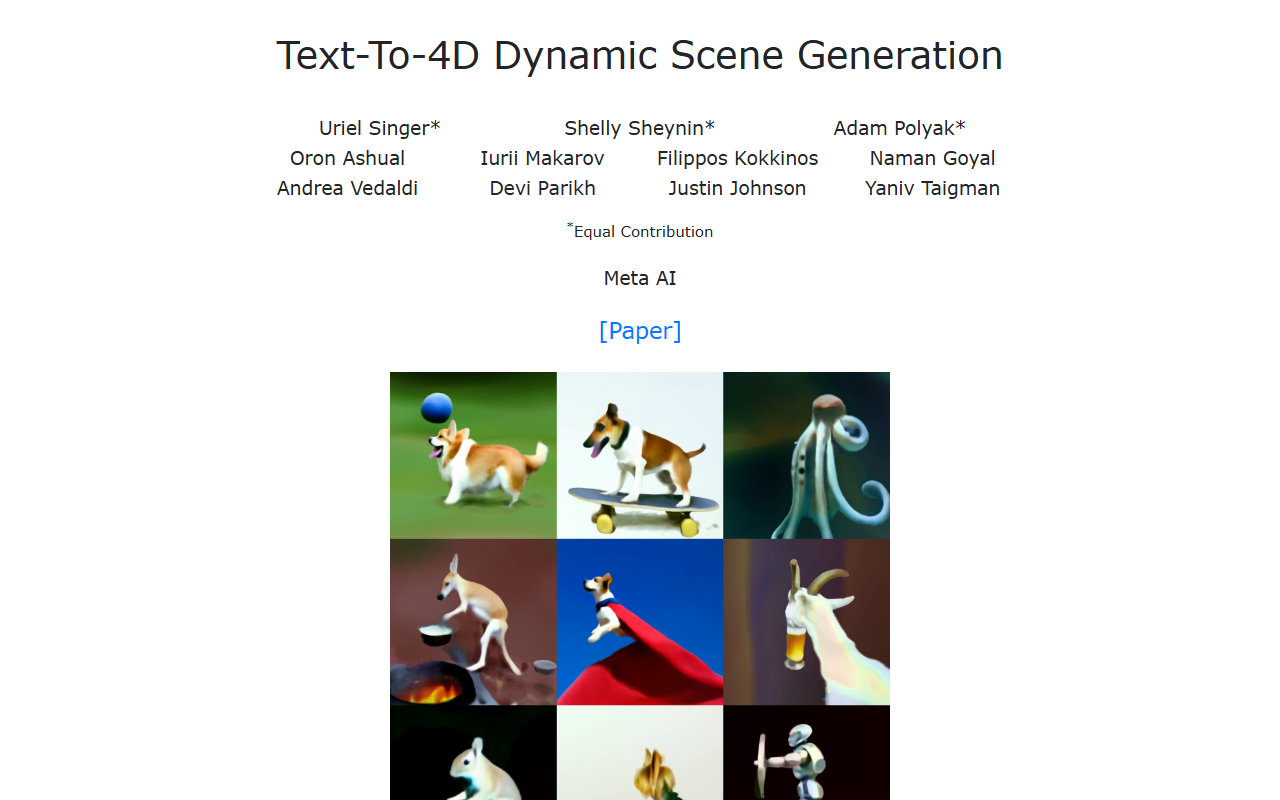
Upon visiting the Make-A-Video3D website, I immediately recognized it as a pure academic project landing page — no sign-up buttons, no API keys, no interactive demo. Instead, I was greeted by the familiar layout of a research paper showcase: a title splash, author list (all from Meta AI), a link to the paper, and a gallery of sample outputs. The page is minimalist and functional, focused entirely on explaining their method for Text-To-4D Dynamic Scene Generation. For a journalist used to testing commercial tools, this felt like stepping into a lab, not a storefront. But that’s exactly the point — MAV3D is a breakthrough in generative AI, not a ready-to-use SaaS.
What MAV3D Does and How It Works
Make-A-Video3D (MAV3D) solves a genuinely new problem: generating a dynamic, three-dimensional scene from a simple text description. Unlike prior models that produce static 3D objects or 2D videos, MAV3D outputs a 4D Neural Radiance Field (NeRF) – essentially a scene that changes over time (the fourth dimension) and can be viewed from any camera angle. The underlying engine combines a Text-to-Video (T2V) diffusion model with a 4D NeRF optimizer that enforces scene appearance, density, and motion consistency. Remarkably, the T2V model requires no 3D or 4D training data; it learns solely from text-image pairs and unlabeled videos.
From the sample gallery, I observed several text prompts like “a dog running through a field” being transformed into short video loops that you can orbit around. The generated motion is smooth and the geometry plausible — though clearly not photorealistic. The page also demonstrates an Image-to-4D feature where a single input image can drive a 4D generation. This dual capability (text and image input) adds flexibility, but again, no live interaction was available for me to test directly.
Strengths and Limitations: A Honest Assessment
Strengths: MAV3D is, by the authors’ own claim, the first method to generate dynamic 3D scenes from text. This is a monumental technical leap — comparable to how early text-to-image models like DALL·E opened a new frontier. The use of a 4D NeRF ensures both spatial and temporal consistency, something earlier static3D methods lack. The fact that it requires no 3D supervision is a huge advantage for scalability. Additionally, the potential applications are vast: game design, virtual production, architectural visualization, and interactive storytelling.
Limitations: The most obvious limitation is that MAV3D is not a consumer product. There is no demo, no API, and no code release (though the paper is available). The generated videos on the page are short and low-resolution (likely 256×256 or similar). As a research prototype, it runs on high-end GPUs and takes hours to optimize a single scene — nowhere near real-time. The website itself offers no way to try it; you can only observe pre-generated examples. Furthermore, the quality of motion and geometry still lags behind what a skilled 3D artist could produce manually. For commercial use, it’s years away.
In terms of market positioning, there are alternatives like Nvidia’s Neuralangelo (static 3D from video) or Google’s DreamFusion (text-to-3D), but none that handle dynamic scenes and camera control simultaneously. MAV3D is uniquely ambitious, but also uniquely inaccessible today.
Who Should (and Shouldn’t) Use MAV3D
Make-A-Video3D is best suited for: AI researchers specializing in 3D generation, computer graphics engineers exploring NeRF-based pipelines, and forward-thinking creative technologists who follow state-of-the-art generative models. If you are a developer looking to integrate text-to-4D into a product, you will have to wait for an official release or reimplement from the paper. For non-technical users or businesses needing ready-to-deploy tools, this is not the right choice — look at simpler text-to-video models like Runway Gen-2 or Pika Labs instead.
Pricing is not publicly listed on the website; the project is shared as open research with no commercial offering. However, Meta has a history of open-sourcing such work (e.g., Make-A-Video), so a future release is possible. Until then, MAV3D remains a fascinating glimpse into the future of generative 3D content.
Recommendation: If you are a researcher or an AI enthusiast hungry to understand the bleeding edge, read the paper and bookmark this site. If you need a working tool, be patient – or explore existing alternatives that trade off dynamism for availability.
Visit Make-A-Video3D at https://make-a-video3d.github.io/ to explore it yourself.













Comments