

First Impressions and Onboarding
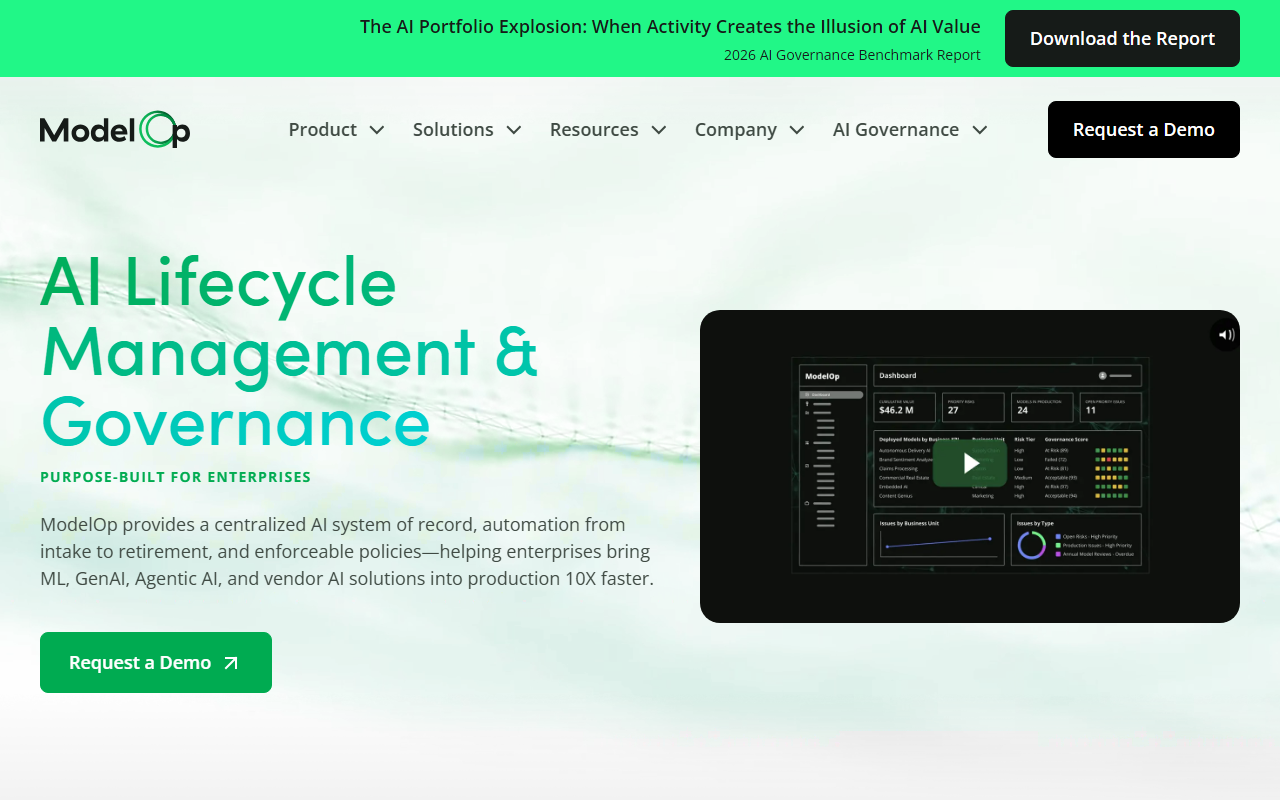
Upon visiting modelop.com, the site immediately establishes its enterprise focus. The headline — “The Control Tower for All Enterprise AI” — sets the tone, and a persistent “Request a Demo” call-to-action suggests this is not a self-service tool. I explored the product pages and found a clean, professional layout that segments features into four pillars: a single AI system of record, automation and orchestration, continuous control and insight, and standards-based extensible architecture. There’s no free tier or sandbox available; the only way to evaluate the platform is through a live demo or by downloading the 2026 AI Governance Benchmark Report (which I didn’t actually download, but the offer is prominent). I clicked the “Request a Demo” button and was taken to a form asking for company size, industry, and role — a typical enterprise sales funnel. One concrete workflow I observed from the case study: Prudential Financial used ModelOp to codify and automate their AI risk rating process, cutting a two-week manual review to less than one day. This immediately signals that ModelOp is built for heavily regulated institutions that need audit trails and speed.
Core Capabilities and Technical Depth
ModelOp is not a model training tool; it is an AI lifecycle management and governance platform. It centralizes inventory of all AI assets — internal ML models, GenAI applications, Agentic AI, and third-party vendor solutions — into a single system of record. The platform automates policy compliance against frameworks like NIST, EU AI Act, and ISO 42001 using pre-built templates. From a technical perspective, ModelOp offers REST-compliant microservices for extensibility, integrates with enterprise identity systems (e.g., SSO), and supports on-premises or cloud deployment without requiring data movement, which is critical for security and privacy. It also includes monitoring for bias, drift, and performance, plus automated generation of model cards and risk documentation. The architecture emphasizes enterprise-grade interoperability with existing MLOps, data platforms, and GRC tools. During my review, I noted that ModelOp claims to bring AI into production “10X faster” by enforcing enforceable policies and approval workflows. Unlike many competitors that focus solely on model monitoring or experiment tracking, ModelOp aims to be the central governance layer across the entire lifecycle from intake to retirement.
Pricing and Market Positioning
Pricing is not publicly listed on the website. ModelOp operates on a custom quote model typical of enterprise SaaS platforms. This is common for governance tools, as deployments vary widely in scale and regulatory complexity. In the market, ModelOp competes with IBM Watson OpenScale, DataRobot MLOps, and solutions from providers like SAS and Informatica. However, ModelOp differentiates itself by including both traditional ML and GenAI/Agentic AI under one governance umbrella, and by providing out-of-the-box templates for multiple regulatory frameworks. The target audience is clear: large enterprises in highly regulated industries such as financial services, healthcare, insurance, and government. The case study from Prudential Financial reinforces this. For small or mid-size teams, the platform may be overkill both in cost and complexity. Who should look elsewhere? Startups or teams experimenting with AI that don’t yet face strict compliance requirements — they would be better served by lighter-weight MLOps tools or even manual processes.
Strengths, Limitations, and Verdict
Genuine strengths: ModelOp excels at providing enterprise-wide visibility and enforceable governance automation. Its support for emerging AI types (GenAI, Agents) alongside traditional ML is forward-looking. The ability to map controls to NIST, EU AI Act, and ISO 42001 out of the box is a huge time-saver for compliance teams. The platform’s no-data-movement architecture ensures security in sensitive environments. Real limitations: ModelOp is not a tool for model training or experimentation — teams will need separate solutions for building and training models. The lack of transparent pricing and absence of a free tier makes it inaccessible for small-scale evaluation. Also, implementing ModelOp likely requires significant organizational change management and dedicated integration resources. Verdict: I recommend ModelOp for enterprise risk officers, AI governance committees, and C-suite leaders at regulated institutions who need a centralized system to audit, monitor, and enforce AI policies. If your organization is struggling with shadow AI or facing regulatory pressure, a demo with ModelOp is worth your time. For smaller teams or those focused purely on model development, explore other options first. Visit ModelOp at https://modelop.com/ to explore it yourself.













Comments