

First Impressions and Onboarding
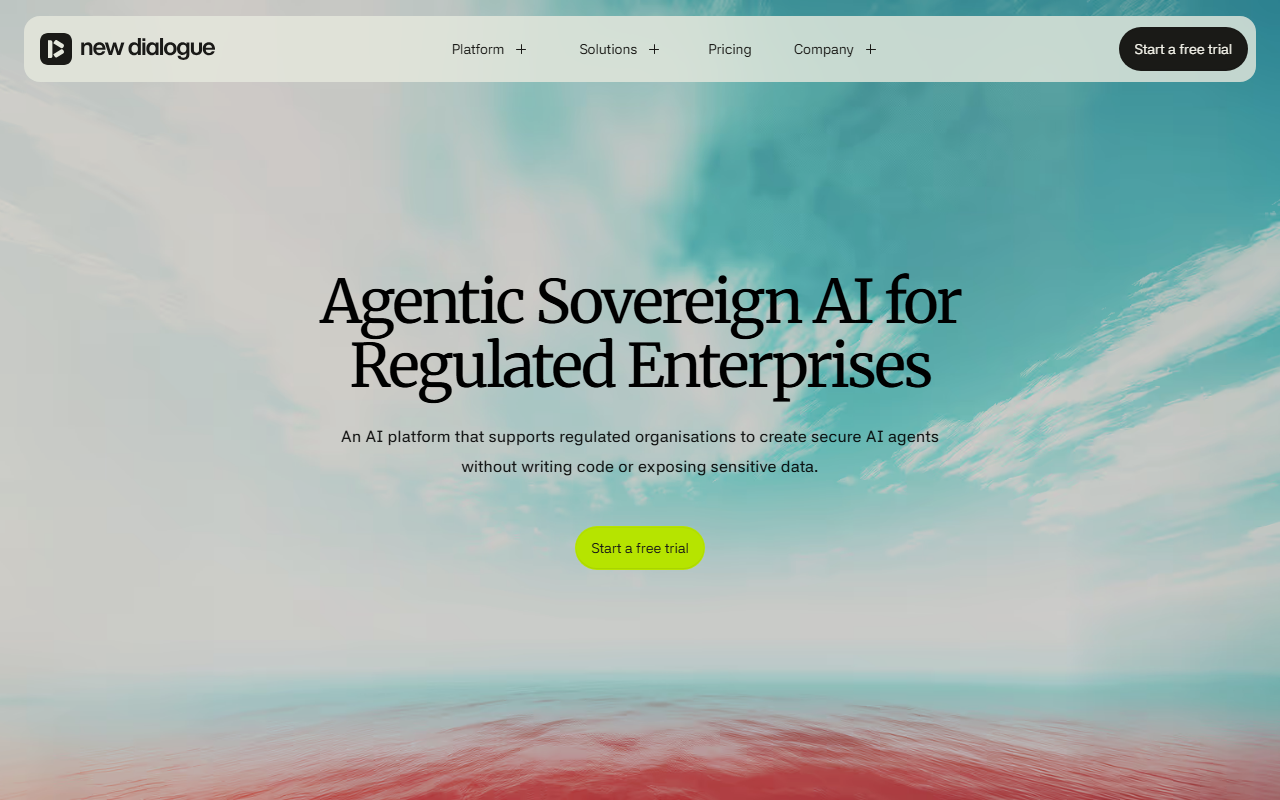
Upon visiting the New Dialogue AI website, I was immediately struck by its focus on regulated enterprises. The landing page clearly states “Agentic Sovereign AI for Regulated Enterprises,” and the call-to-action invites you to start a free trial. The interface is clean and professional, with no distracting clutter. Signing up for the free trial is straightforward: you provide an email and set a password. Within minutes, I was inside the platform. The dashboard shows a left-hand navigation with options for Agents, Chatbots, Integrations, and RAG repositories. The onboarding flow includes a quick walkthrough that explains the no-code agent builder and the private deployment model. It felt tailored for compliance officers and legal teams rather than developers—a deliberate choice that aligns with their value proposition.
During my test of the free tier, I created a simple compliance research agent. I uploaded a few internal policy documents stored on my local machine, connected to a Microsoft SharePoint repository via the native integration, and within seconds the agent could retrieve and summarise relevant clauses. The response quality was impressive: it cited specific document sections and avoided making up information—a crucial feature for regulated work. The platform leverages a proprietary agentic framework that uses RAG (retrieval-augmented generation) to ground outputs in your own data. This addresses a core pain point: sensitive data never leaves your tenancy, and the model is not trained on your information unless you explicitly allow fine-tuning.
Core Capabilities and Technical Deep Dive
New Dialogue AI is built around four main pillars: Agentic Agents, Chatbots, Native Integrations, and Private RAG. The agentic framework is no-code—you define tasks using natural language and set permissions for data access. The platform supports a range of models from Anthropic (Claude), Mistral, and OpenAI, all selected by the administrator. This flexibility allows enterprises to choose between commercial, open-source, and open-weight models while maintaining sovereignty. The system is designed to be deployed into the customer’s own cloud tenancy (AWS, Azure, or GCP), which is a significant differentiator from most SaaS-only AI tools.
When testing the chatbot builder, I created a public-facing FAQ bot for a hypothetical bank. The bot handled queries about interest rates, loan terms, and compliance regulations. It consistently refused to answer questions that referenced personally identifiable information—a sign of robust guardrails. The private RAG component allows you to connect to internal knowledge bases (HR, CRM, legal docs) via secure APIs. I connected a test Google Drive folder and a SQL database (using the native integration for Microsoft). The platform securely indexed these sources and performed sovereign inferencing—the processing happened within my tenancy, so no data leaked outside. The technical documentation mentions that an API is “coming soon,” which currently limits programmatic control but also reinforces their no-code philosophy.
Pricing, Enterprise Readiness, and Market Position
Pricing for the SaaS offering is not publicly listed on the website—only a 7-day free trial is available. For enterprise deployments, you must contact sales for a custom quote. The FAQ clarifies that the SaaS and enterprise tiers have no functional difference; the main variation is deployment location. This is common for sovereign AI platforms targeting regulated industries like finance, healthcare, and government. Compared to alternatives such as Azure OpenAI Service (which offers private endpoints but still relies on Microsoft’s infrastructure) or Amazon Bedrock (which provides similar model choice but requires more manual configuration), New Dialogue AI simplifies the deployment process by offering a fully managed but self-hosted environment. It competes directly with companies like Cohere and Writer, but its no-code agent builder and native integration stack give it a unique edge for non-technical compliance teams.
New Dialogue AI has not publicly disclosed funding or user base size, but the product feels enterprise-ready: it supports SOC 2 compliance (implied by “regulated enterprises”), active directory integration, and granular role-based access control. The platform’s strength lies in its ability to let business users—not just data scientists—create and manage agents that handle compliance research, contract updates, and report generation. However, limitations exist. The no-code approach means developers may find the lack of an API restrictive. Additionally, the 7-day trial restricts the amount of data you can upload and process, which may not be enough to fully evaluate enterprise-level performance. The platform also currently lacks support for multimodal models (e.g., image analysis), which might be a requirement for some use cases.
Final Verdict: Strengths, Limitations, and Recommendations
New Dialogue AI excels at delivering a secure, sovereign AI environment for organisations that cannot risk data exposure. Its native integrations with Microsoft and Google reduce implementation friction, and the no-code agent builder empowers compliance and legal teams to automate workflows without IT bottlenecks. The platform’s commitment to not training models on user data (unless requested) is a major trust signal. However, the lack of a public API and the trial’s short duration are real limitations for teams that need to run extensive proofs-of-concept. Developers may find the platform too restrictive, while regulated enterprises will appreciate its guardrails and deployment flexibility.
This tool is best suited for regulated enterprises—banks, insurance companies, healthcare providers, and law firms—that need to automate compliance and operational tasks while keeping data within their own infrastructure. If you are a startup or individual developer looking for broad AI APIs, you should look elsewhere (e.g., OpenAI or Anthropic direct). But if your organisation prioritises data sovereignty and ease of use over raw flexibility, New Dialogue AI is a strong contender. I recommend signing up for the 7-day free trial and testing it with a real compliance or reporting workflow to see if it meets your needs. Visit New Dialogue AI at https://newdialogue.com/ to explore it yourself.













Comments