

First Impressions and Onboarding
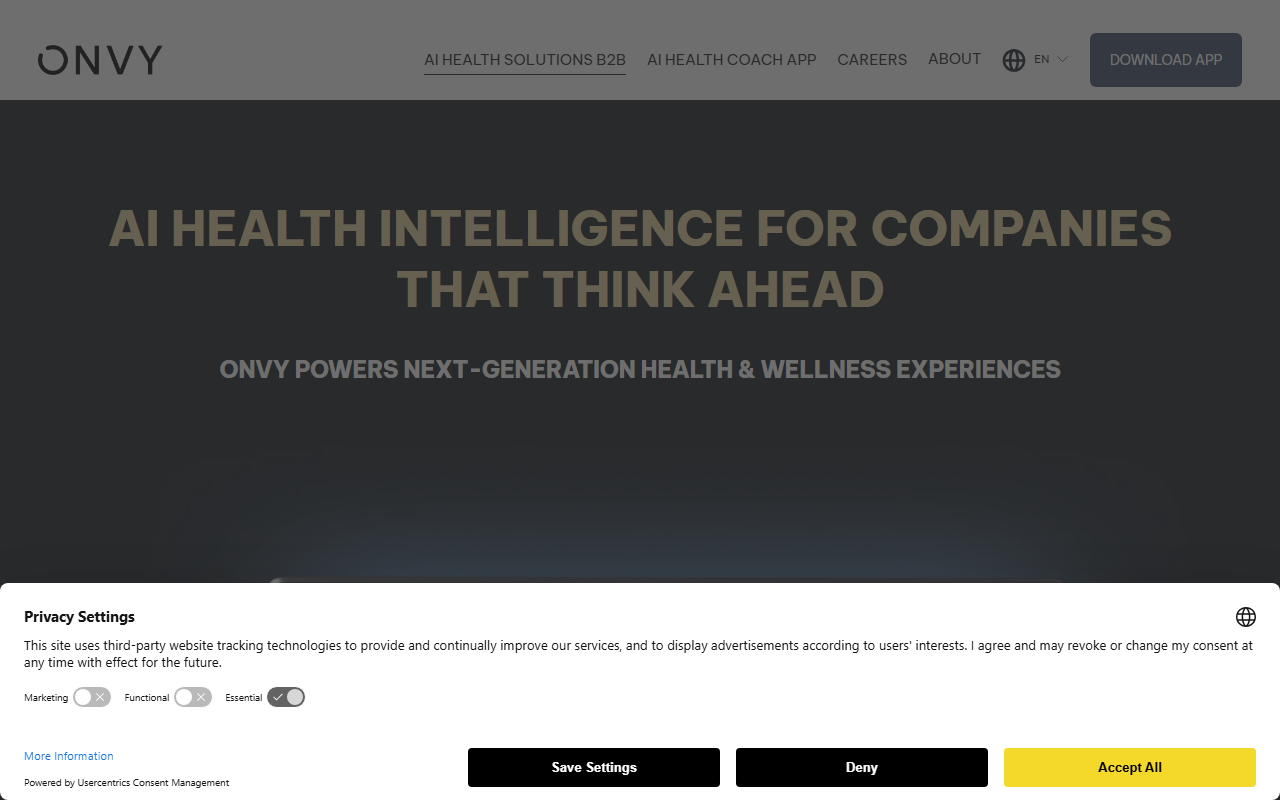
Upon visiting the ONVY website, I was greeted by a sleek, modern landing page that emphasizes enterprise-grade health intelligence. The homepage clearly states its value proposition: turning data from over 500 health sources into personalized wellness experiences. There’s no public free tier or demo; instead, a prominent “Book a Strategy Call” call-to-action drives visitors to a sales conversation. The layout is clean, with bold headers and bullet points that quickly convey the platform’s three core powers: data aggregation, AI health coaching, and business intelligence. I noticed a brief mention of licensing and API pricing tiers, but exact figures are not publicly listed—a common sign of a fully enterprise-focused product. The site also includes a modular section for custom health modules like smart nutrition and AI fitness coaching, which suggests flexibility for different business needs.
Core Functionality and Technology
ONVY positions itself as a “Health Intelligence Layer” that companies can plug into their existing ecosystems. The platform ingests data from wearables (Apple, Samsung, Oura, Garmin, Fitbit, Withings), health apps, CGMs, labs, and even environmental and behavioral data. This is all unified via a single API, with real-time and historical syncing, plus built-in GDPR, HIPAA, and EU AI Act compliance. The AI coaching engine converts raw data into adaptive nudges and personalized guidance across sleep, stress, nutrition, female health, recovery, and longevity. It also includes a “Personal Facts Engine” that learns from user interactions over time—a feature that makes recommendations smarter as usage grows. For businesses, the dashboard provides enterprise-grade visibility into metrics like engagement rates, health outcomes, and data sync status. An analytics engine uses machine learning to uncover patterns and correlations across biometric time series. ONVY also offers a “Collective Intelligence Layer” that aggregates anonymized population data for benchmarking and trend analysis. The community aspect—social support, gamification, and leaderboards—is designed to boost user retention, a critical metric for health apps.
Pricing and Market Positioning
ONVY’s pricing is not publicly listed in a simple table, but the website mentions three flexible business models: License & App (per user/month), Health API (per API call), and Enterprise (custom). This structure suggests a pay-as-you-scale approach. Compared to competitors like Welltok (which focuses on consumer health engagement) or Vida Health (which combines coaching and clinical care), ONVY leans heavily into data aggregation and AI personalization for B2B clients. It’s also more infrastructure-focused than platforms like Hinge Health or Kaia Health, which target specific musculoskeletal or chronic conditions. ONVY’s strength lies in its all-in-one approach—reducing the complexity of managing multiple APIs and building custom AI from scratch. However, the lack of transparent pricing is a limitation for smaller teams or startups that need quick cost estimation. Additionally, while the website mentions 500+ integrations and real-time syncing, there are no verified case studies or independent benchmarks on the site to validate performance claims. The platform seems best suited for enterprises with existing health products that need rapid personalization and analytics, not for individual consumers or small clinics.
Strengths, Limitations, and Verdict
ONVY’s genuine strengths include its comprehensive data unification (500+ sources, real-time, compliant), the built-in AI coaching engine that adapts over time, and the business intelligence dashboard that provides actionable population insights. The modular architecture (smart nutrition, fitness coaching, etc.) allows companies to deploy only what they need—a smart feature that reduces bloat. A notable limitation is the opacity around pricing and the need for a sales call to even get a ballpark figure. Additionally, there is no public sandbox or free tier to test the API’s speed or accuracy; you must engage directly with the sales team. For a product in the “AI Reading” category, it’s more about interpreting health data than traditional text analysis, but the AI engine does read and understand biometric signals. In the crowded digital health market, ONVY differentiates by being a backend intelligence layer rather than a consumer app. I would recommend this tool to health tech product teams, insurance companies, and wellness platforms that already have a user base but struggle with data silos and generic experiences. If you are an individual looking for personal health tracking, look elsewhere—ONVY is purely B2B. Overall, it’s a promising platform for enterprises ready to invest in AI-driven health personalization, but it lacks the transparency smaller players may need. Visit ONVY at https://onvy.health/ to explore it yourself.













Comments