

First Impressions and Platform Overview
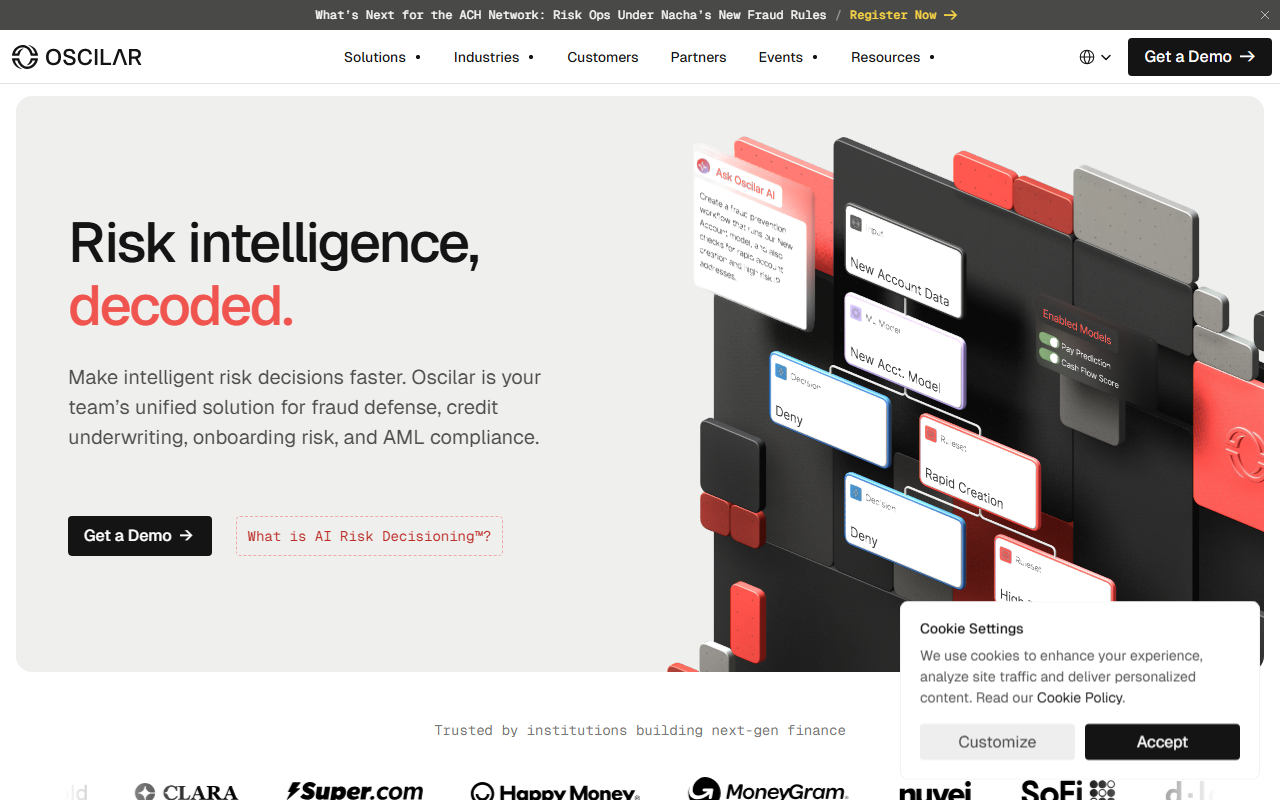
Upon visiting Oscilar's website, I was immediately struck by the focus on enterprise-grade financial risk. The homepage leads with a webinar on Nacha’s new ACH fraud rules, signaling that this platform is built for compliance-heavy institutions. The interface cleanly presents four core areas: Onboarding, Credit, Fraud, and Compliance. The tagline “Risk intelligence, decoded” hints at Oscilar’s ambition to simplify complex decisioning. As someone who has evaluated dozens of risk tools, I appreciate that the platform is positioned as an end-to-end solution rather than a point product. It clearly targets banks, fintechs, and payment companies that need to handle the full customer lifecycle—from account opening to transaction monitoring to AML checks.
Core Capabilities and Technical Architecture
Oscilar markets itself as “the only AI-native risk decisioning platform built from the ground up.” The architecture relies on what they call agentic AI—autonomous agents that chain data-fetching, scoring, and escalation steps. These agents communicate via natural language, which I found intriguing. For example, the Payment Fraud Agent dynamically updates transaction risk scores in real time, with major threshold modifications subject to governance approval. Other agents cover account takeover, first-party fraud, identity verification, dispute management, and scam detection. The platform claims to process over 30 billion decisions per year, with 120,000 requests per second and sub-100-millisecond latency. While I couldn't test these numbers myself, they suggest a highly scalable infrastructure suitable for high-volume financial workflows. The no-code workflow builder and rule optimization recommendations are also noteworthy, as they lower the barrier for risk analysts.
Use Cases and Real-World Impact
Oscilar’s website highlights three customer case studies: Nuvei cut manual underwriting time by 50%, SoFi increased processing speed by over 30%, and Clara boosted client onboarding times by 3x. These metrics are compelling, especially for a unified platform. I observed that the platform covers onboarding risk (consumer, business, and merchant), credit underwriting, fraud detection, and compliance. Each use case is backed by specific AI agents. For instance, the Credit Underwriting Collections Agent helps with decisioning and recovery. The human-in-the-loop design addresses regulatory concerns—a critical factor for financial institutions. Unlike competitors such as DataVisor or Forter that focus primarily on fraud, Oscilar attempts to cover the entire risk spectrum. This could reduce the need for multiple vendors, but it also means the platform may require deeper integration into existing core banking systems.
Pricing, Limitations, and Final Verdict
Pricing is not publicly listed on the website. This is typical for enterprise platforms, but it does limit initial evaluation. Oscilar is clearly designed for mid-to-large financial institutions with dedicated risk teams. Smaller startups may find the platform too heavy or costly. Another limitation is the lack of transparent model details—the site mentions AI and agentic AI, but not which underlying LLMs or machine learning models power the decisions. Banks requiring extreme model explainability may need to demand more documentation. That said, the strength lies in unification and agentic AI orchestration. For institutions struggling with siloed fraud, credit, and compliance systems, Oscilar offers a compelling single pane of glass. I recommend requesting a demo if your organization processes millions of transactions and needs to modernize risk operations. It's less suitable for small businesses or those looking for a lightweight API-only solution.
Visit Oscilar at https://oscilar.com/ to explore it yourself.











Comments