

First Impressions and Onboarding
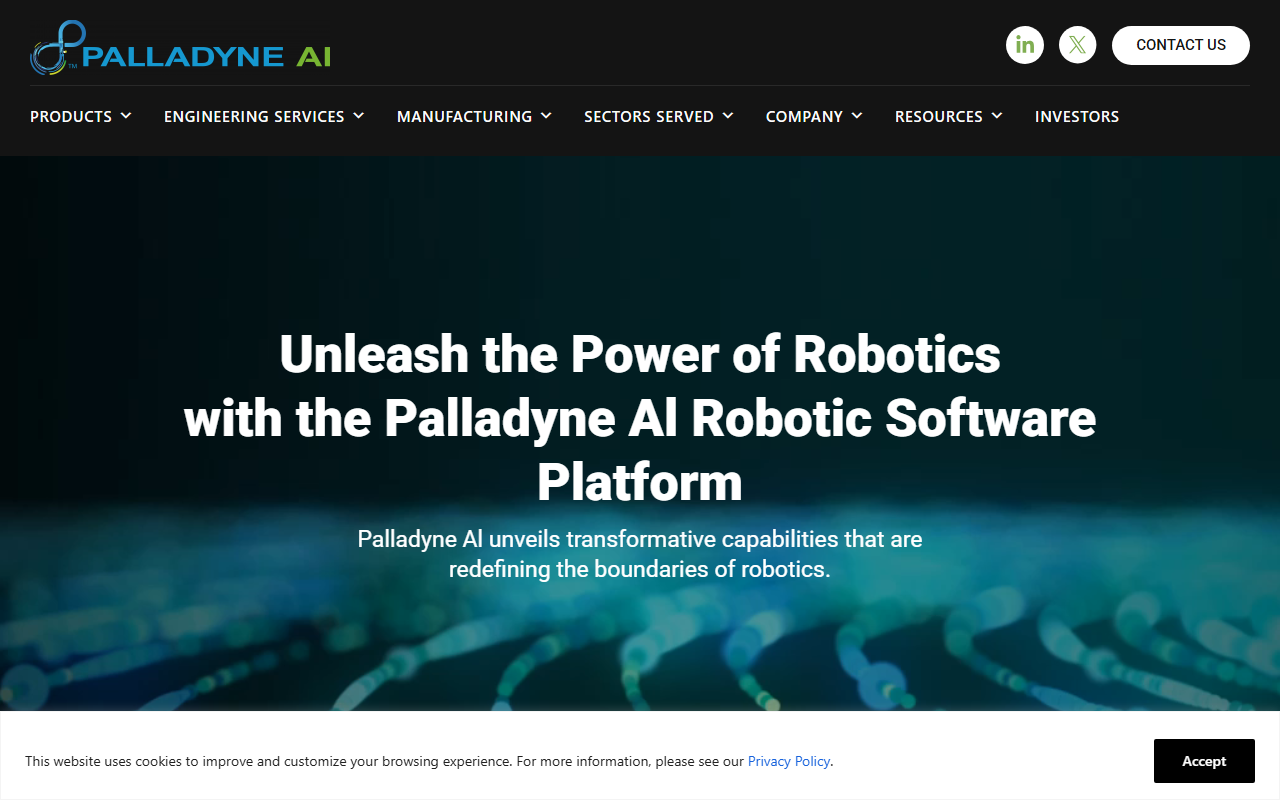
Upon visiting the Palladyne AI website, I was immediately struck by the company’s focus on defense and industrial robotics rather than the typical "Text AI" dev framework you might expect from the category. The landing page presents a clean, professional layout with a navigation menu that lists products like Palladyne™ IQ, Palladyne™ Pilot, and SwarmOS™, alongside hardware components such as Brain X2 and IntelliSwarm™. The messaging is bold — "America’s Cross-Domain Force Multiplier" — and clearly targets sectors like aerospace, defense, public safety, and manufacturing.
I navigated through the product links, but the site does not offer a direct interactive demo or a free tier to test the software. The onboarding experience is more informational than hands-on; you are encouraged to download whitepapers or contact the sales team. This makes sense given the enterprise and government nature of the product, but it means individual developers or small teams won’t get a quick sandbox environment. The website does feature a "Talk to Palladyne AI" call-to-action prominently, suggesting a consultative sales process.
Core Capabilities and Technical Depth
Palladyne AI describes itself as an "embodied AI" platform. From the content, the software enables robots and UAVs to perceive, reason, and act in real time at the edge — without relying on cloud connectivity. This is a clear differentiator: rather than a text-generation API or a typical machine learning framework, Palladyne provides a full-stack autonomy solution. The three core software products are Palladyne IQ, which appears to be the intelligence layer for single robots; Palladyne Pilot for guided autonomy; and SwarmOS for coordinating multiple drones or ground vehicles.
On the hardware side, the company offers components like the Brain X2 (likely an edge compute module) and IntelliSwarm (communication hardware). The website also lists UAS products like SwarmStrike and Gremlin-X, which are autonomous loitering munitions — a far cry from text AI. What is missing from the public site are specific technical details: supported programming languages, API documentation, or compatibility with ROS (Robot Operating System). The whitepaper titled "Speeding Robotics Automation with AI" is behind a download form, so I could not inspect it without submitting contact info. However, the brief mentions "edge-based intelligence" and "closed-loop frameworks" indicate industry-standard approaches.
Market Position and Pricing
Palladyne AI sits in a niche where few traditional "dev frameworks" compete. Closest alternatives might be companies like Forge.AI or Robotiq’s software, but Palladyne is more defense-oriented. Another competitor could be NVIDIA’s Isaac platform for robotics, but Palladyne emphasizes autonomous decision-making on edge hardware with no cloud dependency, which is particularly critical in contested or communication-denied environments. The company is publicly traded on NASDAQ (PDYN), which adds a layer of transparency and accountability.
Pricing is not publicly listed on the website. This is typical for enterprise-grade defense and industrial solutions. I suspect pricing is on a per-license or per-system basis, likely with large upfront costs and subscription components for software updates. The website does not mention any free tier, community edition, or open-source offerings. This tool is best suited for defense contractors, large-scale manufacturing firms, and public safety agencies that need robust, certified autonomy. Individual developers or small startups looking for a cheap robotics AI framework should look elsewhere.
Strengths, Limitations, and Verdict
One genuine strength is the real-time edge reasoning capability, which Palladyne apparently validates with actual hardware products like SwarmStrike. The company has a long legacy — described as "decades" in robotics — and an existing user base in defense sectors. The breadth of offerings from software to full manufacturing is rare. However, a real limitation is the lack of technical transparency for developers. Without an API, documentation, or a trial environment, it is hard to assess the tool’s true capabilities or integration complexity. Additionally, the website focuses heavily on marketing language rather than concrete code samples or comparative benchmarks.
Who should try this? If your organization builds or operates autonomous systems for defense, public safety, or large-scale industrial automation, and you have the budget for a proprietary solution, Palladyne AI is worth a contact. For everyone else — particularly AI developers looking for a text AI dev framework — this is not the right tool. The category label "Text AI > Dev Framework" is misleading; Palladyne is an embodied AI platform for robots and drones. In summary, Palladyne AI is a serious player in mission-critical autonomy but remains opaque for casual evaluation.
Visit Palladyne AI at https://palladyneai.com/ to explore it yourself.













Comments