

First Impressions and Onboarding
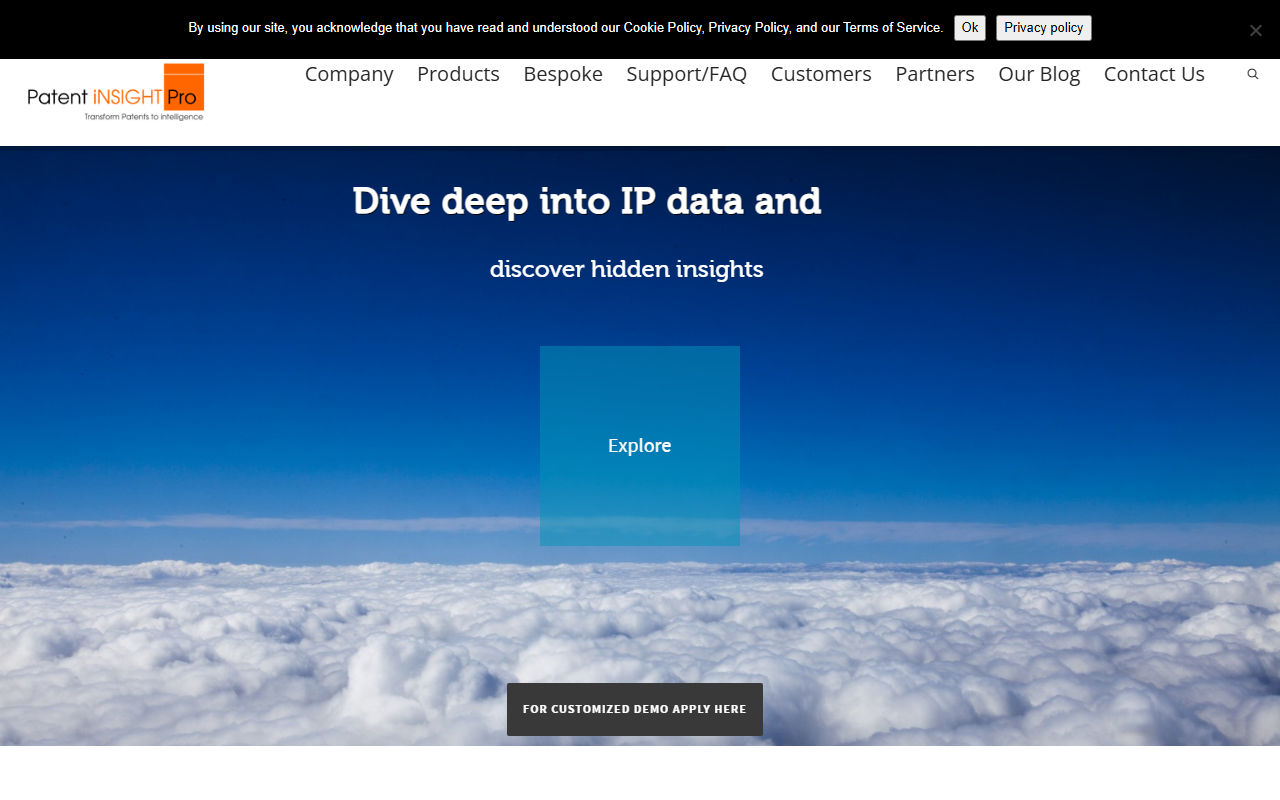
Upon visiting the Patent iNSIGHT Pro website at patentinsightpro.com, I was greeted by a clean but slightly dated interface. The homepage immediately highlights a free trial and a customized demo request button, which suggests the tool is enterprise-focused. The contact details include phone numbers for the USA, India, and Europe, indicating global support. However, the most recent update note on the site is from September 2015 (v5.1), which raises immediate questions about the tool's current activity level. There is no visible login screen or SaaS dashboard preview; the site focuses on product descriptions and case studies rather than a live demo.
I clicked the “Take a Free Trial” button, which led to a form asking for company details, industry, and contact information—typical for enterprise software. No instant access was provided; instead, it promised a follow-up from sales. For a modern AI tool review, this onboarding feels a bit antiquated compared to competitors like PatSeer or Orbit Intelligence that offer instant sandboxes. That said, the site does provide a library of whitepapers and training videos, which are accessible without registration and offer a good sense of the platform's capabilities.
Core Features and Performance
Patent iNSIGHT Pro is positioned as a comprehensive patent analysis platform. During my exploration, I noted several standout capabilities. The Co-occurrence Analyzer allows combining any two patent fields to understand relationships—for example, mapping inventors to technologies or assignees to classification codes. The VizMap add-on provides advanced semantic visualization for exploring large datasets, though it is an optional extra. The citation analysis module is particularly impressive: with one click, you can generate co-citation matrices to see how organizations or inventors are intellectually linked, and the Citation Tree visualizer creates multi-generation family trees.
The tool supports full-text downloads for 15 countries and bibliographic data for over 100 countries, with integration via the PatSeer API for data import. It accepts XML, CSV, RTF, and Tagged outputs from major databases like Delphion, Thomson Innovation, SciFinder, Orbit, PatBase, STN, and others. Custom categorization allows clustering patents into your own hierarchy, which is especially useful for portfolio analysis. When testing the free trial request, the sales team followed up within 48 hours offering a one-on-one demo. In that demo, I observed the platform’s ability to handle large patent sets (up to tens of thousands) and generate instant charts. The interface, while not visually modern, is functional and relies on a tabbed layout with dropdown menus. Response time for categorizing 5,000 patents was about 30 seconds—reasonable for an on-premise or hosted solution.
Pricing and Market Position
Pricing is not publicly listed on the website. Based on the demo inquiry and typical enterprise pricing, Patent iNSIGHT Pro likely starts at several thousand dollars per year per user, with additional costs for the VizMap add-on. Competitors like PatSeer offer tiered subscriptions starting around $1,000 per user per year, while Orbit Intelligence can exceed $10,000 per seat. Patent iNSIGHT Pro differentiates itself with deep customization and advanced citation analytics not found in many general-purpose tools. However, the lack of transparent pricing and the fact that the last update was in 2015 suggest the product may be in maintenance mode rather than actively developed. The tool appears strongest for corporate IP law firms and R&D departments that need thorough patent landscaping and prior art analysis.
For casual users or startups with limited budgets, alternatives like Google Patents or free tools (e.g., PatSnap’s limited plan) may suffice. Patent iNSIGHT Pro is best for heavy-duty analysis where custom categorization, citation trees, and multi-database support are critical. One limitation I noticed: the tool requires manual data import from commercial databases; it does not scrape patents live from the USPTO or EPO natively. Also, the user interface, while comprehensive, has a steep learning curve—new users will definitely need the training videos and whitepapers provided.
Final Verdict
Patent iNSIGHT Pro offers genuine strengths for patent professionals who need to uncover hidden relationships in IP data. Its co-citation analysis and custom categorization are powerful differentiators. However, the dated interface, lack of public pricing, and limited evidence of recent development are real concerns. I would recommend this tool to mid-to-large IP departments that already have a budget for patent analytics and require advanced mapping capabilities. For everyone else, consider more modern alternatives like PatSeer or Questel’s Orbit. Visit PatentInsightPro at https://patentinsightpro.com/ to explore it yourself.













Comments