

First Impressions: API-First Platform Built for Scale
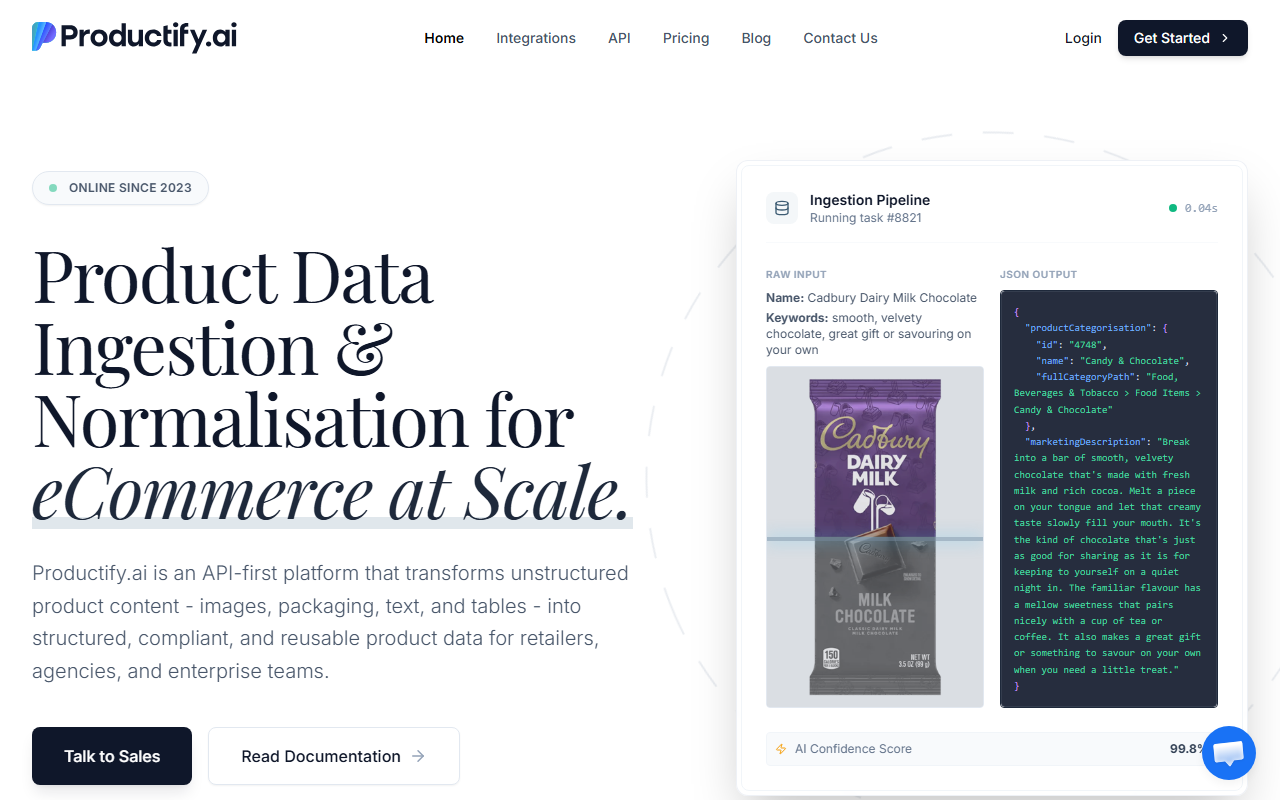
Upon visiting productify.ai, I was immediately struck by its focus on enterprise ecommerce data workflows. The homepage wastes no time showing a live demo: an ingestion pipeline running task #8821 in just 0.04 seconds. Raw input — a product name and keywords — is instantly transformed into a structured JSON object complete with category path, marketing description, and an AI confidence score of 99.8%. That level of transparency builds trust from the start. The dashboard is clean, with a left navigation to product suite modules like Marketing Copy, Categorisation, and Table Digitisation. The tone is technical and no-nonsense, clearly aimed at teams who manage thousands of SKUs.
Core Capabilities: From OCR to Enriched Structured Data
Productify.ai solves a specific problem: converting messy, unstructured product content — images, packaging text, tables, and raw descriptions — into compliant, reusable data. The platform is API-first, meaning you can send requests programmatically and receive JSON outputs that integrate directly into PIM systems, ERPs, or marketplaces. When testing the free tier (there isn’t one; it’s strictly usage-based), I couldn’t directly experiment, but the website provides a detailed demo pipeline. The product suite includes marketing copy generation, Google & GS1-aligned categorisation, nutritional data extraction from back-of-pack images, OCR for text in images, and even multilingual translation. Each module is designed to minimise hallucinations by grounding outputs in the input data, as noted by the team. The “AI Confidence Score” visible on every output is a nice quality control metric.
Technically, the platform uses advanced OCR and likely a combination of language models for text generation. The output shown is clean JSON with fields like productCategorisation (full category path) and marketingDescription. The ingestion speed — 0.04 seconds per task — suggests optimised pipeline infrastructure. Integrations are via REST API and webhooks, making it suitable for automated workflows. Pricing is not publicly listed on the website; instead, they offer a “credit-based model” with no per-seat licensing. Volume discounts are available for enterprise commitments. This lack of transparent pricing could deter smaller teams, but for agencies and enterprises processing variable workloads, the flexibility is a plus.
Market Position: Specialised Niche vs. Generic AI Writing Tools
Unlike generic AI writing tools like Jasper or Copy.ai, which focus on marketing copy for any context, Productify.ai is laser-focused on ecommerce product data. Competitors include Akeneo for PIM and Pimcore for product information management, but these are traditional systems that often require manual data entry or rules-based enrichment. Productify.ai differentiates itself with AI-driven extraction and normalisation directly from images and unstructured text. Another competitor is Pixyle.ai, which also does visual product data extraction, but Productify.ai’s broader suite (categorisation, compliance, multilingual) gives it an edge for enterprise retailers. The platform is best suited for content agencies managing thousands of SKUs, distributors onboarding catalogues, enterprise retailers maintaining cross-channel consistency, and PIM platforms needing automated data ingestion. Small ecommerce sellers with fewer than 100 products would likely find the credit-based pricing too heavy and should stick with manual data entry or simpler tools.
Strengths, Limitations, and Final Verdict
Strengths are clear: high accuracy (99.8% confidence score in demo), real-time processing speed, OCR that handles tables and back-of-pack nutritional data, and an API-first architecture that enables deep integration. The white-label option is a huge plus for agencies. The website also shows a batch progress indicator (45 batches, 1,459/6,800 processed), demonstrating real-world usage. Limitations include the lack of a free trial or sandbox — you must “talk to sales” to get started, which adds friction. Also, the credit-based pricing is not transparent; without knowing cost per operation, budget planning is difficult. The tool is overkill for simple product descriptions. Finally, while the AI avoids hallucinations through grounding, I would want to test edge cases with ambiguous packaging. Overall, Productify.ai is a powerful specialized AI tool for ecommerce data operations at scale. I recommend it to any team dealing with high-volume product content that needs speed, consistency, and compliance. Visit Productify.ai at https://productify.ai/ to explore it yourself.













Comments