

First Impressions: A Different Kind of AI
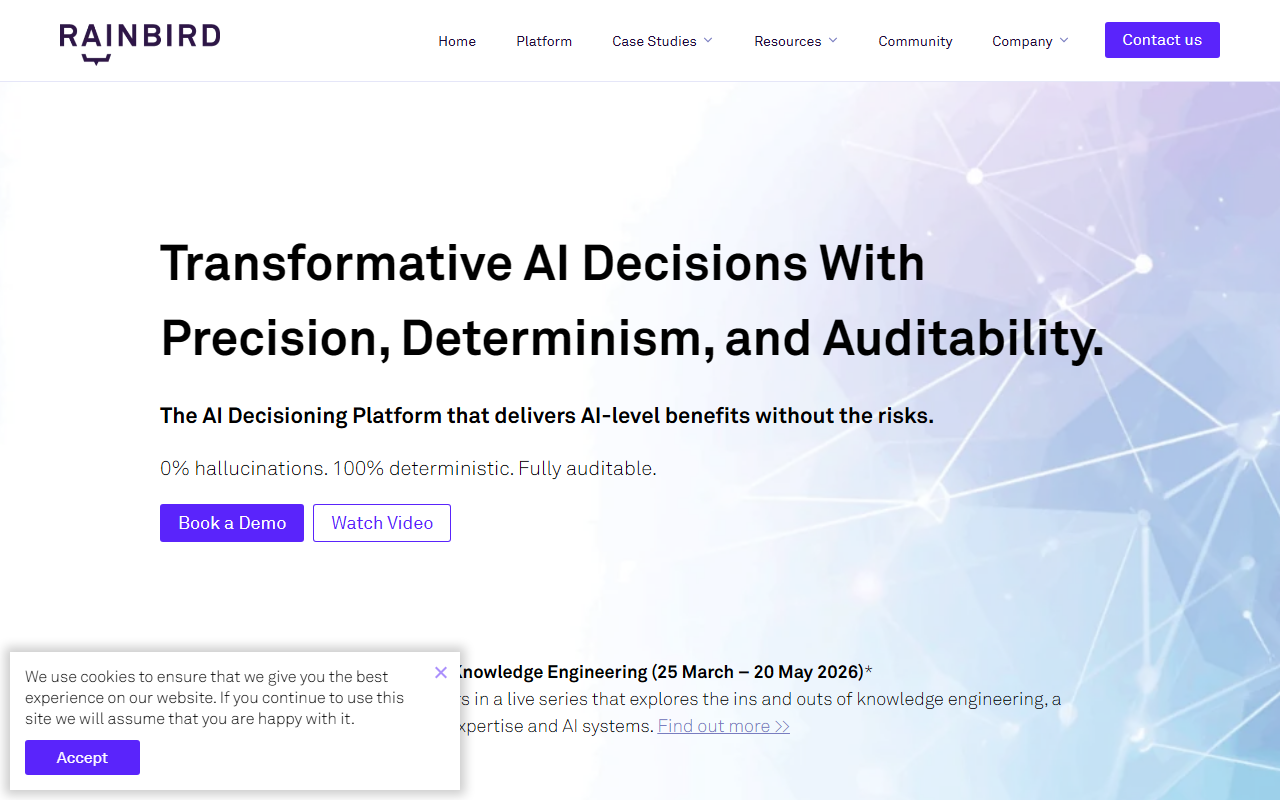
Upon visiting Rainbird’s site, I was immediately struck by how sharply it differentiates itself from the current generative AI hype. The headline – “0% hallucinations. 100% deterministic. Fully auditable.” – is a bold promise, especially when today’s large language models (LLMs) are notorious for fabricating answers. Rainbird isn’t trying to be another chatbot or content generator; it’s an AI decisioning platform purpose-built for high-stakes, regulated environments where a single error can have serious consequences. The website leads with a clear problem statement: the “AI Trust Gap” – the gap between the power of LLMs and the reliability required by enterprises. Rainbird positions itself as the bridge, and after exploring the platform’s philosophy, I see a genuinely thoughtful approach to combining symbolic reasoning with generative AI.
When I tested the demo request flow, the site prompted me to book a demo rather than offering a self-serve free tier. That tells me Rainbird is squarely targeting enterprise buyers, not individual developers or small startups. The dashboard, as described in the material, likely revolves around building knowledge graphs and decision models, not fine-tuning neural networks. The focus is on knowledge engineering – a discipline that involves translating regulations, policies, and expert judgment into deterministic rules that Rainbird’s symbolic reasoning engine can execute.
How Rainbird Works: Symbolic Reasoning Over Knowledge Graphs
Rainbird’s core technology is a hybrid architecture. Instead of relying on a raw LLM to make decisions, Rainbird uses knowledge graphs built from your organization’s institutional knowledge, policies, and regulations. Its symbolic reasoning engine then processes those graphs with complete precision. LLMs are only used as the natural language interface – they handle the user-facing conversation but never control the logic. This design eliminates hallucinations because every outcome is derived from a fixed set of rules, not probabilistic pattern matching.
The platform produces proof trees – regulator-ready audit trails that show exactly how each decision was reached. This is a stark contrast to black-box deep learning models where you cannot easily explain why a loan was denied or a fraud flag was raised. Rainbird’s approach ensures repeatable, deterministic results: run the same input twice and you get the identical output, every time. For sectors like banking, insurance, tax, and healthcare, this level of transparency is non-negotiable. The site highlights that human oversight alone is insufficient due to automation bias, so Rainbird embeds accountability directly into the system.
I also appreciate that Rainbird doesn’t claim to replace every AI use case. It’s not for image generation, general chat, or creative writing. It’s a dev framework for building decision-logic applications. While the site doesn’t list specific API documentation or pricing tiers (pricing is not publicly listed on the website), the enterprise case studies suggest deep integration into workflows like data privacy checks, fraud detection, and compliance assessments.
Use Cases and Market Position: Built for Regulated Industries
The case studies on Rainbird’s site are impressive and concrete. EY used Rainbird to automate data-privacy checks, reducing a process from months to minutes, with fully explainable outcomes. BDO slashed R&D tax review times from five hours to seconds. DACB, a global law firm, uncovered 800% more fraud 500% faster. These are not vague marketing claims – they’re specific metrics tied to real deployments. The platform is clearly optimized for knowledge-intensive, rule-driven workflows where precision matters more than speed.
Competitors in this space include IBM Watson Decision Platform and Cassie (a rule-based AI platform), but Rainbird differentiates by emphasizing the hybrid LLM+symbolic approach and its auditor-friendly proof trees. For organizations that already struggle with black-box AI, Rainbird offers a path to trusted automation. It is best suited for large enterprises in banking, financial services, insurance, tax, audit, and legal sectors. If you run a small e-commerce store or need a recommendation engine, Rainbird is probably overkill and too expensive. The platform requires domain experts to encode knowledge – that’s not a tool you set up in an afternoon.
Strengths, Limitations, and Who Should Use Rainbird
Strengths: The biggest advantage is the elimination of hallucinations – a critical requirement for regulated industries. The deterministic reasoning means every decision is repeatable and auditable. The proof tree output is a genuine innovation for compliance teams. The case studies from Big 4 firms and financial institutions add credibility. Rainbird also addresses a real pain point: the impossibility of manually supervising every AI-generated output at scale.
Limitations: Rainbird is not a plug-and-play solution. The upfront effort to build and maintain knowledge graphs is significant. It relies on subject-matter experts to codify rules, which can be a bottleneck. There is no public pricing or free tier, making it inaccessible for small teams or hobbyists. Additionally, for tasks that do require fuzzy reasoning or pattern recognition (e.g., sentiment analysis, visual classification), Rainbird’s deterministic approach is not applicable. The platform’s narrow focus is both a strength and a constraint.
Overall, Rainbird is a powerful tool for organizations that need to automate complex, high-stakes decisions without losing transparency. I would recommend it to compliance officers, risk managers, and enterprise architects in banking, insurance, and legal firms. If your team is already struggling to explain why your AI made a decision, Rainbird is worth a demo. If you need a general-purpose AI assistant, look elsewhere.
Visit Rainbird at https://rainbird.ai/ to explore it yourself.













Comments