

First Impressions and Onboarding
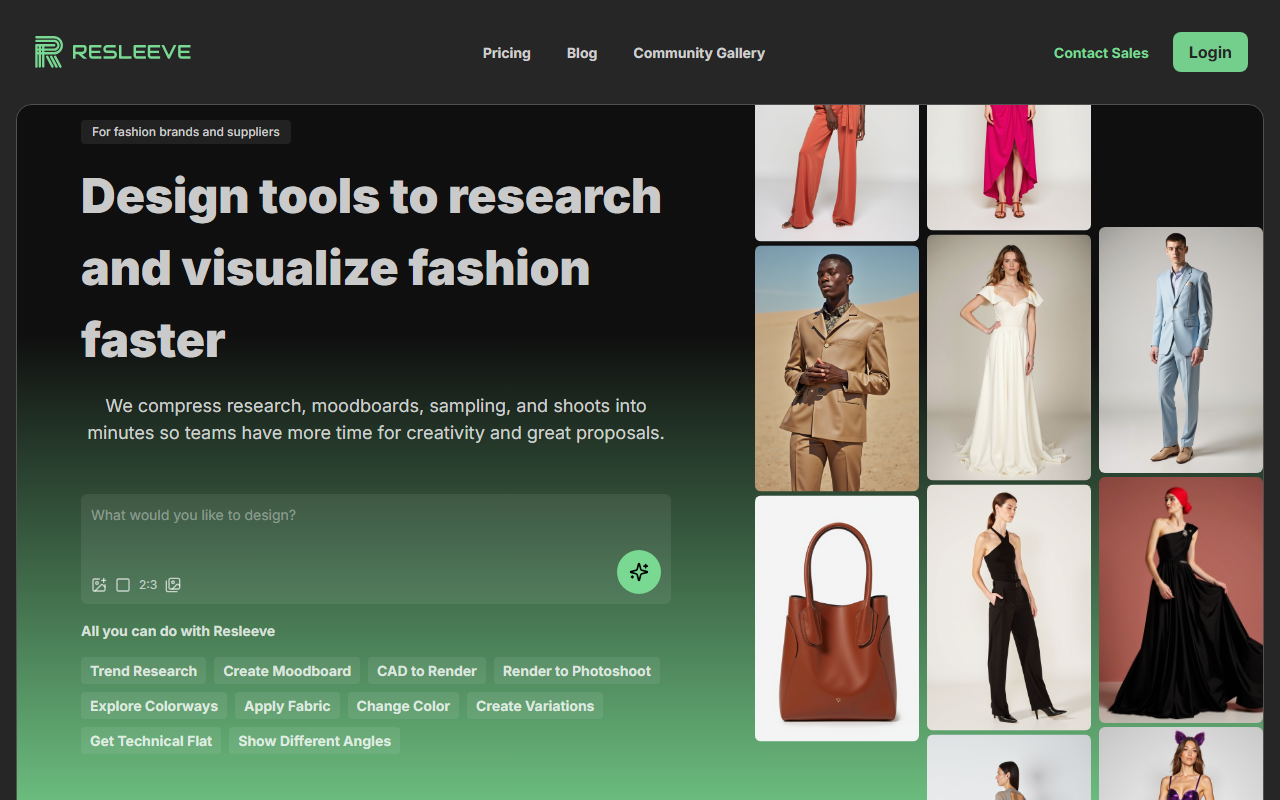
Upon visiting Resleeve’s website, the first thing I noticed is its polished, brand-focused aesthetic. The homepage immediately pitches itself as an “AI Content Production Studio for Fashion & Brands,” with a clear split between a done-for-you full-service option and a self-service tool. The layout is clean, with a horizontal navigation bar and a bold call-to-action to “Get Quote” or “Login.” I clicked through to the self-service login page—it requires an account, so I could not test the platform directly without signing up. However, the website provides enough screenshots and a case study (NORDIC Atelier) to give a sense of the workflow. The onboarding flow appears to be straightforward: you either submit a brief for the full-service team or log in to use the same tools yourself.
The Full-Service vs Self-Service Approach
Resleeve offers two distinct paths, which is a smart positioning. The full-service option is essentially a creative agency powered by AI: you send a brief (a sentence or mood board), and in 24 hours they return a production plan. Content is generated, retouched, and even turned into motion in days. The self-service tier gives you the same underlying tools—trend research, moodboards, lookbook generation, photoshoots—but you operate them yourself. This is a strong differentiator. Unlike many AI image tools that are purely self-serve (e.g., Midjourney, DALL-E), Resleeve acknowledges that many brands still want a human touch. The testimonial from Marcus Lindqvist (Head of Brand at a home interiors company) reinforces this: they budgeted $80k for a seasonal shoot and got the full catalog refresh in ten days for a fraction of that cost. That’s a concrete, believable claim. For small to mid-size fashion brands that need high-quality on-model or lifestyle imagery without the overhead of a traditional shoot, this hybrid model is compelling.
Technical Capabilities and Output Quality
Resleeve’s platform is tailored specifically for fashion and related industries (home, beauty, automotive, jewelry, food, eyewear). The website lists seven output types: campaign editorials, lookbooks, product detail pages (flat lays, on-model, lifestyle), mood boards, social content, e-commerce catalog imagery at scale, and fabric/texture visualization. That is a comprehensive list that covers most brand content needs. During my review, I looked for clues about the underlying AI model. The site does not explicitly name the model (e.g., Stable Diffusion, DALL-E 3), but given the focus on consistent brand identity and multiple variants, it likely uses a fine-tuned or custom pipeline. The self-service tools promise “everything needed for your whole creative workflow,” which suggests features like prompt-based generation, inpainting, style transfer, and batch export. One limitation I observed: there is no clear API or integration documentation on the public site. For a tech-forward brand, that could be a dealbreaker. Also, the sample assets shown (e.g., the NORDIC Atelier lookbook) appear high-quality but are heavily stylized; I would want to test on my own product photos to see how well it handles specific brand colors and logos.
Pricing and Market Position
Pricing is not publicly listed on the website. You must request a quote. This is typical for enterprise-oriented creative tools, but it can frustrate small businesses that want instant transparency. Based on the testimonial, the cost savings are significant—$80k traditional shoot vs. an undisclosed but lower Resleeve cost. They likely charge per asset or per project for full-service, and a monthly subscription for self-service. Alternatives include ZMO.ai (AI fashion model generation) and Midjourney (general AI image generation with fashion prompts), but neither offers a full-service production studio. Resleeve’s sweet spot appears to be established DTC and fashion brands that shoot frequent catalog updates and social content. Who should look elsewhere? Very small brands or individual creators with minimal budgets may find the quote-only model off-putting, and the tool may be overkill for simple logo or pattern generation.
Strengths: Fast turnaround (days vs months), hybrid human-AI workflow, industry-specific outputs, credible case study. Limitations: No public pricing, no API details, self-service tool requires login to evaluate fully, and limited transparency on AI model technology. Overall, I recommend Resleeve for fashion and home decor brands that need a steady stream of professional product imagery and are open to a partnership model. The full-service option especially could reduce time to market for seasonal collections. Visit Resleeve at https://resleeve.ai/ to explore it yourself.













Comments