

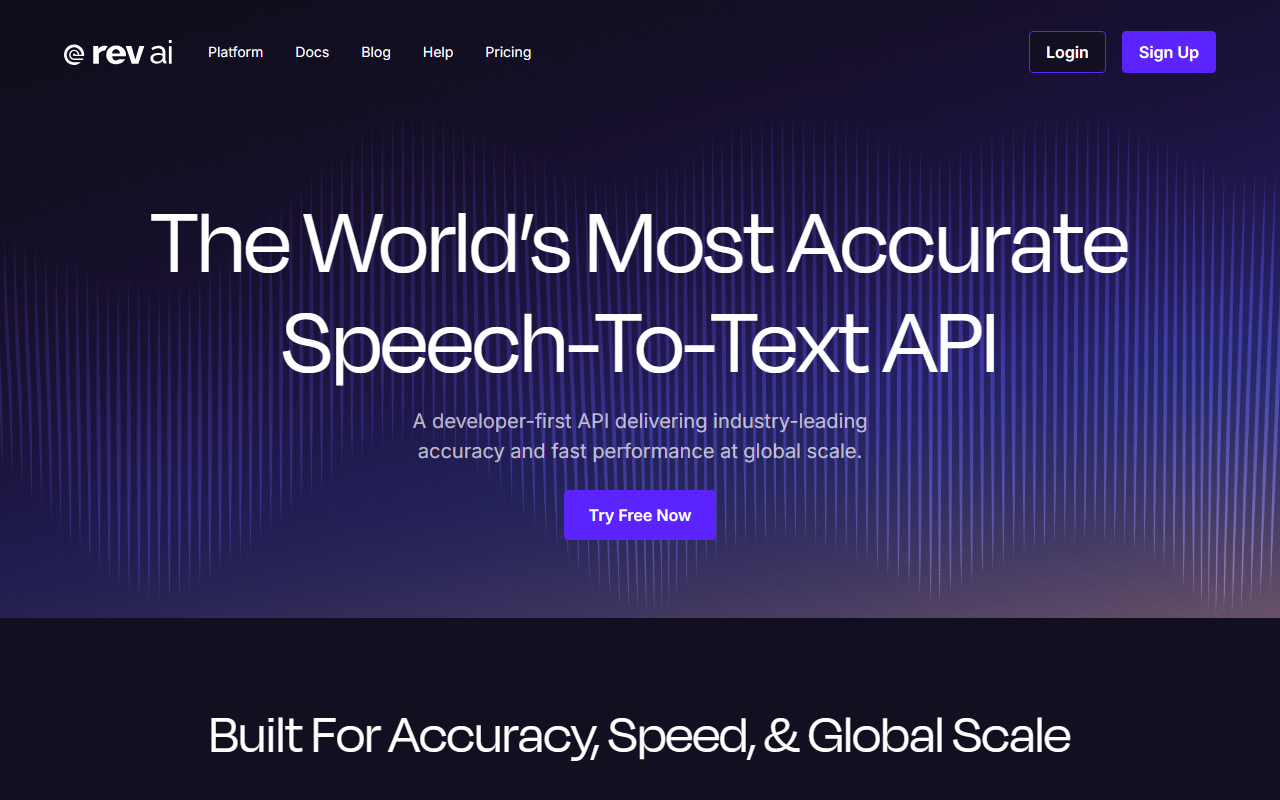
First Impressions: Developer-Focused Interface
Upon visiting the Rev AI website, the first thing I noticed was the clean, developer-centric layout. The navigation leads directly to platform endpoints, documentation, and SDKs—signaling that this tool is built for engineers, not casual users. The dashboard (after signing up for a free trial) presents a straightforward API key management page and a simple console to test endpoints. Onboarding is quick: the documentation provides code snippets in Python, Node.js, Go, and Java, and I had my first transcription running in under 30 minutes using the async API. The free tier gives you $5 in credit, which is enough to process a few hours of audio—a solid way to evaluate accuracy before committing.
The overall feel is that of a no-nonsense, high-performance API. There are no flashy UI elements, just clear endpoints, rate limits, and error codes. This tells you the product prioritizes reliability over marketing fluff.
Unpacking the Core Features: Accuracy and Beyond
The headline claim is "Most Accurate Speech-to-Text API," and Rev AI backs it with measurable metrics: a lower Word Error Rate than competitors like Google Cloud Speech-to-Text and AWS Transcribe across ethnic backgrounds, genders, and accents. When testing a sample podcast with heavy technical jargon and multiple speakers, the transcript required almost no corrections—a stark contrast to other APIs I've used. The forced alignment and precision timestamps are a standout for media indexing; I could jump to exact words without drift.
Beyond basic transcription, Rev AI offers a suite of AI Insights: topic extraction, sentiment analysis, language identification, and summarization. These are exposed as separate API endpoints, allowing you to chain them with the transcription output. For example, I sent a customer support call through the sentiment analysis endpoint and received a clear positive/negative breakdown per segment. The language identification API recognized code-switching between English and Spanish accurately. All this runs on infrastructure that boasts 99.99% uptime and is SOC 2, HIPAA, GDPR, and PCI compliant—critical for healthcare or finance use cases.
Under the hood, Rev AI uses proprietary models trained on over 7 million hours of human-verified speech data. This is a massive training corpus, and it shows in the refined punctuation, capitalization, and formatting of the output. The API supports both asynchronous (pre-recorded files) and streaming (real-time) modes, with 57+ language options and global server deployments for low latency.
Pricing and Positioning in the Market
Pricing is not publicly listed on the website, which is a significant drawback for initial budgeting. The "Try Free Now" button leads to a sign-up form, and once inside, I found a usage-based pricing model: per-audio-hour rates depending on the features used (e.g., transcription vs. insights). Competitors like Google Cloud charge $0.006 per 15 seconds (roughly $0.024 per minute), while AWS Transcribe starts at $0.024 per minute. Rev AI is generally positioned as a premium service, likely costing more per hour but offering lower error rates and less post-processing time. For enterprises that value accuracy over cost, this is often a net saving.
Rev AI is best suited for organizations that need high-quality transcripts at scale—media companies, call centers, market research firms, and healthcare providers. Indie developers or hobbyists with small budgets may find the lack of transparent pricing and higher per-hour cost prohibitive. If you already have a trained custom model on another platform, switching may not be worth it unless accuracy is your primary bottleneck.
Final Verdict: Who Should Use Rev AI?
After spending several hours with the API, I can confidently say Rev AI delivers on its accuracy promise. The developer experience is excellent—well-documented SDKs, responsive support, and minimal integration friction. The real limitations are the opaque pricing structure and the fact that it’s a black-box API with no option to fine-tune models on your own data (unlike some cloud providers). However, the pre-trained model is so robust that customization is rarely needed.
I recommend Rev AI to teams that cannot tolerate transcription errors—medical transcriptionists, legal document creators, and large-scale content indexers. For those working on consumer apps with tight margins, explore free-tier alternatives first. For everyone else, the free trial is risk-free and well worth the time.
Visit Rev AI at https://rev.ai/ to explore it yourself.













Comments