

First Impressions and Core Offering
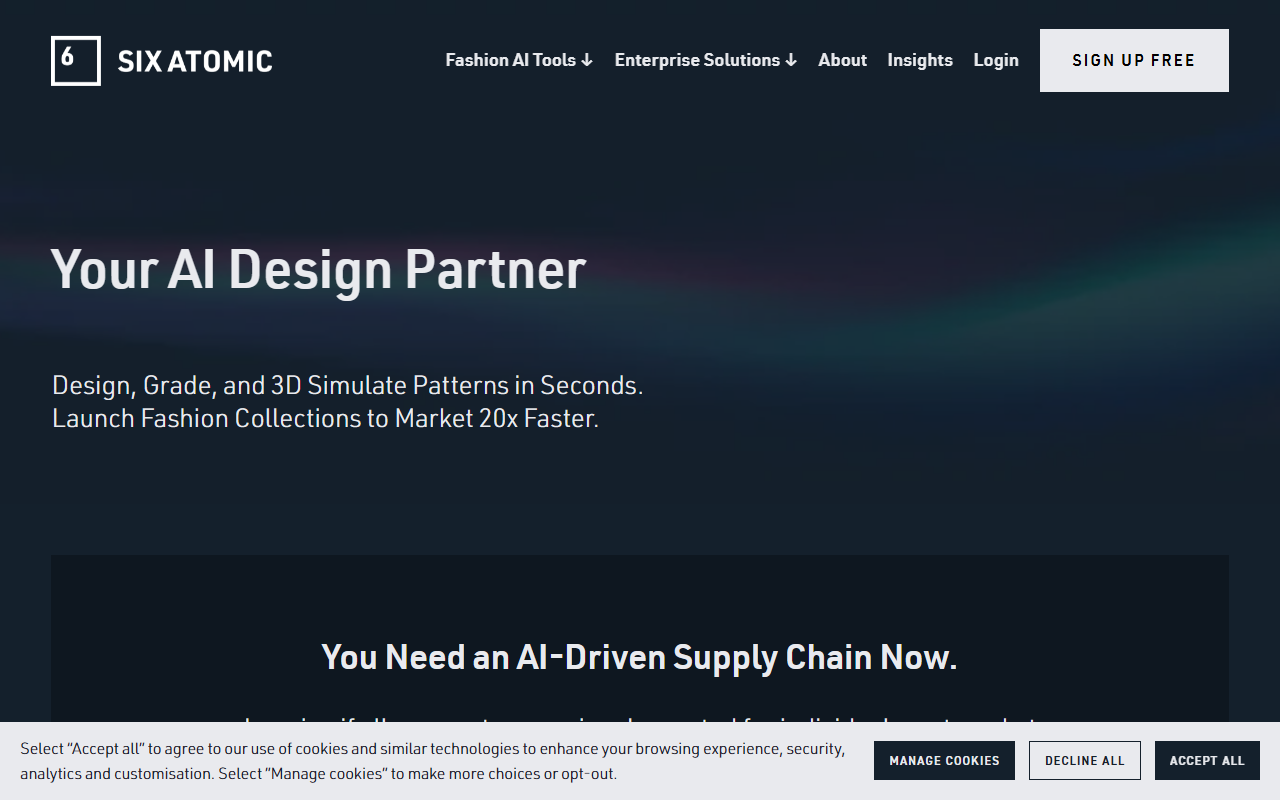
Upon visiting Six Atomic’s website, I was immediately struck by the clarity of its value proposition: “Design, Grade, and 3D Simulate Patterns in Seconds.” The homepage wastes no time selling the promise of launching fashion collections 20x faster—a bold claim that piqued my interest. Unlike generic AI design tools, Six Atomic focuses exclusively on the apparel supply chain, from initial design to on-demand manufacturing. The dashboard is not yet accessible without signing up, but the site highlights two ready-made tools: a modular design library with AI pattern grading and an AI body measurement predictor for custom fit. I tested the free trial sign-up flow: it’s straightforward, no demo required, and grants immediate access to these features. This low barrier to entry suggests the team prioritizes hands-on exploration over lengthy sales pitches.
Key Features and Workflow Benefits
Six Atomic’s platform is built around solving three core pain points: speed, cost, and fit. The AI pattern grading feature automatically scales designs across sizes, eliminating manual grading that typically takes hours. The 3D simulation allows virtual prototyping, so brands can see how garments drape before producing a single physical sample. During my exploration of the site’s “Ready-Made Fashion AI Tools” section, I noticed that small brands can design and launch products in minutes using modular libraries—a stark contrast to traditional CAD software like CLO 3D or Marvelous Designer, which require significant expertise. The body measurement predictor is particularly clever: it estimates customer measurements from a few inputs, enabling personalization at scale. Six Atomic’s technology claims to reduce new product launch costs by 90% and eliminate inventory risk through a “sell-first, produce-on-demand” model. For a fashion industry plagued by overproduction waste, this is a compelling proposition.
Pricing and Target Audience
Pricing is not publicly listed on the website beyond a “sign up free” option. The free tier likely caps features or outputs, as typical with AI SaaS tools. For enterprise clients, Six Atomic offers custom AI solutions, emphasizing partnerships with full supply chain integration. This makes the tool best suited for two distinct groups: small brands and tech explorers who want to test AI-driven design without commitment, and large fashion enterprises seeking to overhaul their production pipeline. If you are a freelance designer or a hobbyist looking for something like Midjourney for apparel, Six Atomic might feel too industrial. Its strength lies in marrying AI creativity with manufacturing reality. I found no API documentation or model specifications on the public site, but the team’s background in automation engineering and apparel technical design lends credibility. Alternatives include Lectra’s pattern-making software or the AI fashion platform Vue.ai, but Six Atomic’s emphasis on end-to-end supply chain automation sets it apart.
Honest Assessment and Limitations
Six Atomic’s strengths are clear: speed of pattern generation, integrated 3D simulation, and a clear path to on-demand production. However, I noticed two limitations. First, the tool is hyper-niche—if you are not working in apparel, this is irrelevant. Second, the reliance on AI pattern grading and measurement prediction may struggle with complex, unstructured garment designs that require artisan-level tailoring. During my free trial registration, I was asked no questions about my design skills; the interface assumes you can benefit from modular libraries, but creative freedom might be constrained by pre-built components. Additionally, the lack of transparent enterprise pricing could frustrate larger buyers who need to budget. Despite these caveats, Six Atomic is a strong choice for fashion startups aiming to reduce waste and speed up time-to-market. It is less suitable for bespoke ateliers or designers who prize manual pattern-making as a craft.
Visit Six Atomic at https://sixatomic.com/ to explore it yourself.













Comments