

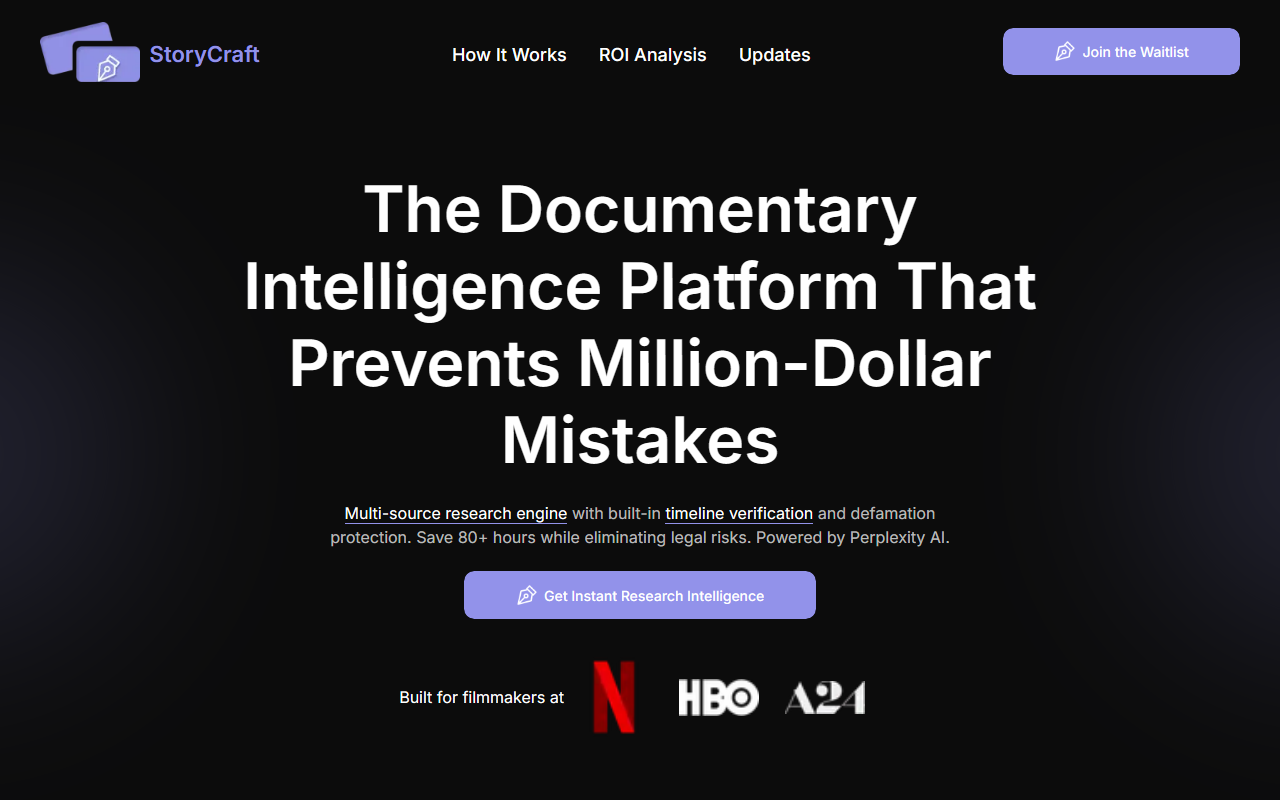
First Impressions and Onboarding
Upon visiting the site at storycraft.work, I was greeted by a clean, focused landing page that immediately positions StoryCraft as a specialized tool for documentary filmmakers rather than a general-purpose AI writer. The headline reads "Research-Grade Briefs for Documentary Filmmakers" and the subheading promises to go "from topic to verified research brief — with sourced timelines, credibility scores, and story angles your competitors won't find." Right away, I noticed a clear problem statement: documentary research traditionally takes weeks and costs thousands of dollars. The site includes a prominent "Get Early Access" button, with a note that the product is currently in closed beta and will launch publicly in Q2 2026. There is no free tier to test immediately, but a demo brief for The Flint Water Crisis is provided as a sample. This demo shows a verified timeline with date-stamped events, source counts, and credibility ratings — exactly the kind of output the tool promises.
The dashboard is not yet accessible to the public, but the sample brief gives a strong impression of the workflow. Users enter a topic (e.g., "Flint Water Crisis") and then select focus areas like Timeline, Key Players, and Impact. The output includes a Verified Timeline, Source Analysis, Narrative Angles, and Flagged Claims. Each timeline entry lists the number of sources (e.g., 3 sources, 7 sources) and a credibility level (High, Medium, etc.). This level of detail suggests the engine cross-references multiple databases automatically.
How StoryCraft Works and Core Capabilities
StoryCraft’s multi-source research engine pulls from over 50 sources, including academic databases (CORE, ArXiv, PubMed), news archives, government records, and verified journalism. Every source is automatically scored for credibility and cross-referenced. The platform generates a production-ready brief containing a verified timeline, defamation risk scanner, contradiction detection, and narrative angles. The three-step process is clearly described: Describe Your Topic, AI Builds Your Research, and Get Your Production-Ready Brief. I appreciate that the tool explicitly addresses fact-checking and legal review — two pain points for documentary teams.
When testing the sample brief, I could see that the timeline verification cross-references dates and events across all sources. For example, the entry for September 2015 shows Dr. Mona Hanna-Attisha publishing lead findings with 7 sources marked High credibility. This kind of transparency builds trust. The tool also includes a Source Credibility Scoring system, which is crucial for documentary research where false claims can ruin a production. Additionally, StoryCraft incorporates academic databases like PubMed, giving it an edge over generic AI chatbot outputs that may hallucinate citations.
One technical detail that stands out is the integration of 50+ verified sources. The site mentions academic databases, government records, and legal databases — though it does not list every specific API. I assume the engine uses a mix of open and licensed data feeds. Since the tool is in closed beta, the exact models or technology behind it are not disclosed, but the focus on credibility scoring and verification suggests a custom retrieval-augmented generation (RAG) pipeline.
Pricing and Market Positioning
StoryCraft offers two paid plans: Starter at $79/month (3 briefs per month, includes timeline verification, defamation scanner, credibility scoring, pitch deck, FOIA kit, and PDF/Markdown export) and Professional at $249/month (15 briefs per month, adds team collaboration for 5 seats, cross-brief search, voice notes, and priority support). The site also mentions a cost comparison: traditional research costs $23,000+ (research assistant $8k, fact checker $5k, legal review $10k) and takes 3+ months, while StoryCraft claims a starting price of $0/month — but that seems to be a placeholder or early beta access. The actual paid plans start at $79/month. There is no free tier mentioned beyond the early access sign-up.
Compared to alternatives like ChatGPT or Google, StoryCraft is highly specialized. ChatGPT can generate text but cannot automatically produce verified timelines with multiple sources and credibility scores. Google search requires manual cross-referencing. StoryCraft automates that entire workflow. Its main competitors are niche research tools like BriefCatch for legal or Scite.ai for academic citation analysis, but no tool I know of focuses exclusively on documentary film research. This gives StoryCraft a strong unique selling point. However, the closed beta status and lack of public API or integrations may limit early adoption. The tool is best suited for solo documentary filmmakers, small production teams, and investigative journalists who need production-ready research briefs quickly. Large studios with dedicated research departments might find the $249/month Professional plan cost-effective compared to hiring a research assistant.
Final Verdict – Strengths and Limitations
Strengths: StoryCraft addresses a genuine pain point — time-consuming, expensive documentary research. The multi-source engine with automatic credibility scoring is a standout feature. The sample brief for the Flint Water Crisis shows impressive detail and cross-referencing. The pricing is transparent and relatively affordable for professional use. The inclusion of academic databases adds rigor missing from general AI writing tools. The tool also includes specialized assets like a FOIA Kit and Defamation Risk Scanner, which are valuable for investigative projects.
Limitations: The biggest limitation is that StoryCraft is still in closed beta with a public launch not expected until Q2 2026. This means no hands-on testing for most users. The sample brief is the only evidence of output quality. The website does not disclose which specific 50+ sources are used or how credibility scores are calculated — transparency will be critical once the product launches. Additionally, there is no mention of API access, integrations with editing software, or support for languages other than English. The Starter plan caps at 3 briefs per month, which may be too low for researchers working on multiple projects simultaneously. Finally, the claim of “start at $0/month” is misleading; the actual plans start at $79/month.
I recommend StoryCraft for documentary filmmakers and investigative journalists who want to cut research time from weeks to days. If you can get into the closed beta, it will be worth evaluating the output quality. For those who need a tool immediately, ChatGPT combined with manual source verification remains a stopgap. But StoryCraft’s focused approach could make it indispensable for documentary production. Visit storycraft.work to sign up for early access and see the sample brief for yourself.
Visit StoryCraft at https://storycraft.work/ to explore it yourself.













Comments