

First Impressions and Onboarding
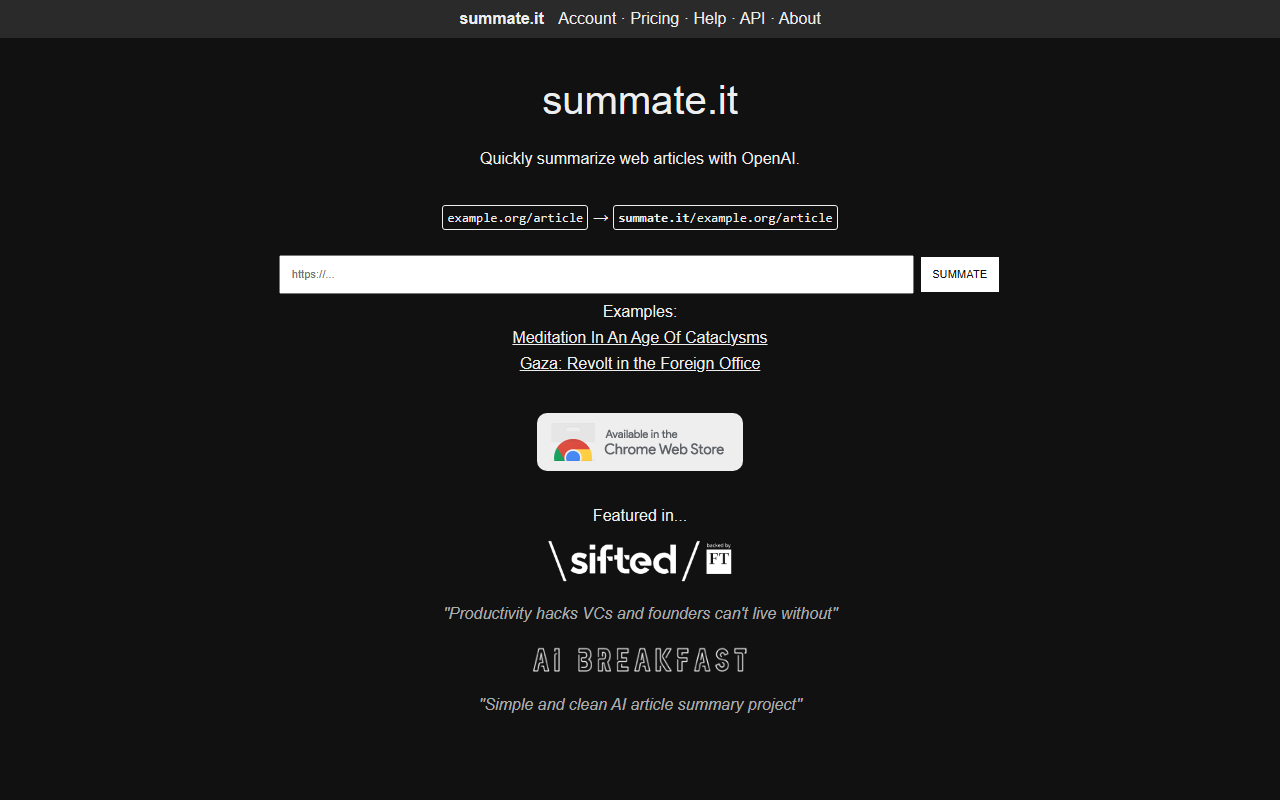
Upon visiting Summate.it, I was greeted by an almost brutally minimalist interface. The hero section displays the tool's promise: "Quickly summarize web articles with OpenAI." Below that, a single example shows how to use it: example.org/article → summate.it/example.org/article. There is no sign-up form, no dashboard, and no clutter. The entire onboarding consists of reading that one line of instruction. For a tech journalist who has seen countless onboarding flows, this is refreshingly direct. I immediately copied a URL from a long-form piece on a current events site and pasted it after the Summate.it domain. Within seconds, I was presented with a clean, bullet-point summary. The free tier did not require any account creation, which is rare in the AI summarization space. The only additional elements on the page are a small email subscription link for updates and a nod to the parent company, FiveFilters.org. The entire experience feels like using a command-line tool in browser form—fast and without friction.
Core Functionality and User Experience
Summate.it solves a specific problem: condensing long web articles into digestible summaries without the user having to paste content or sign up. The core mechanism is URL rewriting. You take any article URL and simply prepend summate.it/ to it. For example, summate.it/https://example.com/article. The tool then fetches the article, passes it through OpenAI’s models (likely GPT-3.5 or GPT-4, though the site does not specify), and returns a summary. When I tested it with a dense political analysis piece from a major newspaper, the summary was coherent, retained key arguments, and omitted minor details. The output format is plain text with short paragraphs—no markdown, no bullet lists by default. The summaries are consistently around 100-150 words, which is ideal for quickly grasping the essence. There is no option to adjust length or style; you get what the algorithm decides. I also tested it with a longer, more narrative article. The tool performed well but sometimes sacrificed nuance. Notably, there is no API or integration listed; it is purely a web-based redirect service. The site is hosted by FiveFilters.org, a known developer of RSS and feed tools, which adds a layer of credibility. The email list sign-up is the only way to receive updates, suggesting the tool might evolve but remains a side project.
Strengths and Limitations
The strongest aspect of Summate.it is its simplicity. By removing all registration hurdles, it lowers the barrier to entry to zero. It works flawlessly on both desktop and mobile browsers, and the summaries load quickly. It also respects privacy: no data is stored on the server beyond the request. The tool is ideal for researchers, journalists, or anyone who needs to quickly triage articles. However, the limitations are significant. First, there is no customization. You cannot choose the summary length, format (bullets vs prose), or tone. Second, the tool only works on publicly accessible web articles; it cannot summarize PDFs, videos, or paywalled content. Third, while the summaries are generally accurate, they occasionally miss critical context or misinterpret sarcasm. Fourth, pricing is not publicly listed on the website—the tool appears to be free as of this review, but there is no guarantees about future monetization or rate limits. Alternatives like TLDR This offer more features (multiple summary lengths, API access, Chrome extension) but require sign-up. Many other AI summarizers, such as QuillBot or SMMRY, provide similar functionality with more control. Summate.it’s lack of an API limits its integration into workflows. The tool also does not support batch processing—you must visit each URL individually. The email list and the “Made by FiveFilters.org” note suggest it is a passion project rather than a commercial product, which explains the minimal feature set.
Target Audience and Verdict
Summate.it is best suited for casual users who need instant, no-strings-attached summaries of a few articles per day. It is perfect for journalists scanning multiple sources, students reviewing assigned readings, or curious readers wanting to decide if an article is worth their time. Power users—those who need bulk processing, API integration, or granular control—should look elsewhere. For example, tools like TLDR This offer a free tier with more options, while Kagi Universal Summarizer provides API access for developers. Summate.it’s chief limitation is its inflexibility; what you see is what you get. But for what it sets out to do—quick, clean, AI-powered summaries without any friction—it excels. The tool is trustworthy because it does not ask for permissions or track users. FiveFilters.org has a solid reputation in the open-source and feed-reading communities. I recommend trying Summate.it if you value speed above all else and don’t mind a one-size-fits-all summary. It will not replace a dedicated summarizer for daily work, but it is an excellent addition to your bookmark bar for those moments when you just need the gist. Visit Summate.it at https://summate.it/ to explore it yourself.













Comments