

First Impressions and Onboarding
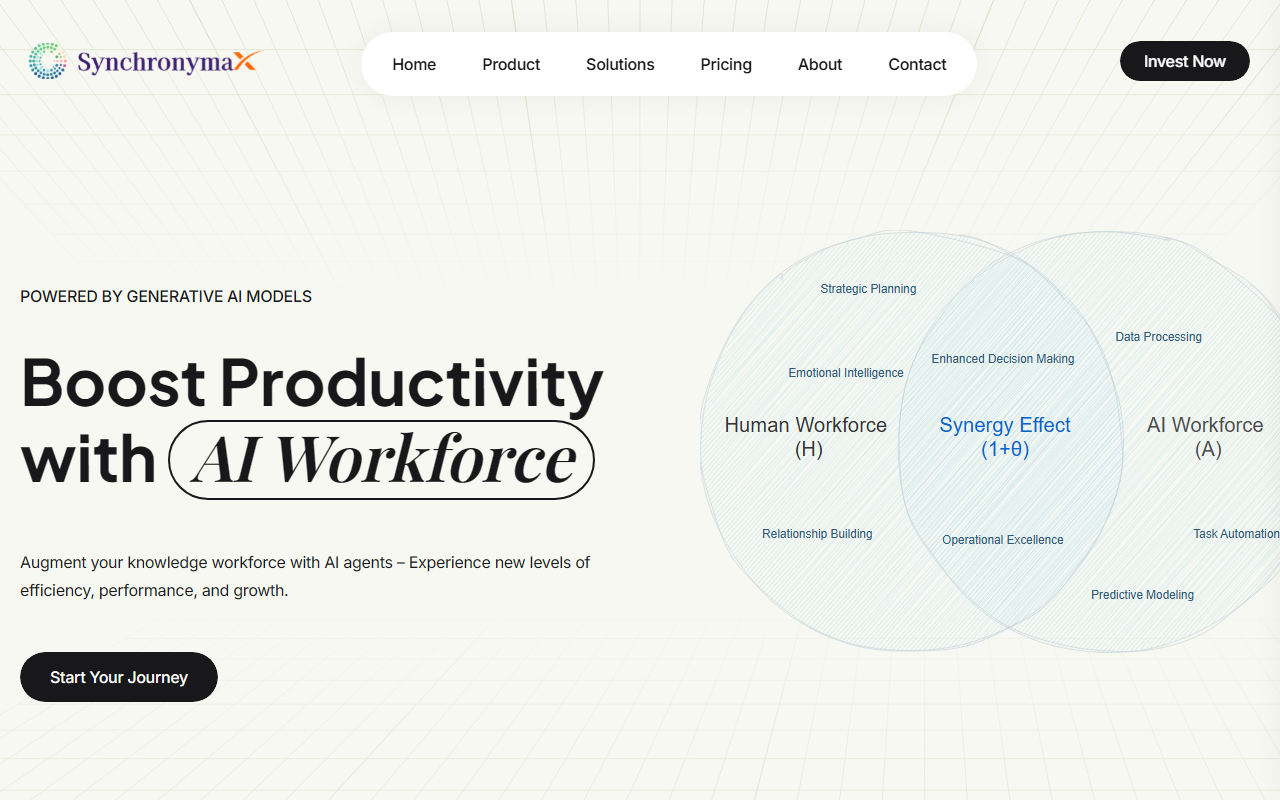
Upon visiting the Synchronymax website, I was greeted by a clean, modern interface with a clear value proposition: “Boost Productivity with AI Workforce.” The homepage highlights key statistics—efficiency gains, revenue growth, and reduced operation costs are listed as percentages without specific numbers, which felt like a missed opportunity. I clicked the “Start Your Journey” call to action, which led to an email capture form. The free tier is mentioned in pricing but not actually available for testing—only paid plans are listed. The FAQ section is thorough, covering integration via APIs and workflow automation, security (GDPR, HIPAA), and customization. I appreciated the transparency about supported industries: healthcare, finance, retail, and more.
When I tried to interact with an AI agent, I found no public demo or sandbox. This limits the hands-on experience, but the site explains that agents are accessible after subscription. The dashboard is not visible without logging in, but from screenshots on the “About Us” page, the interface resembles a chat-based tool with side panels for agent selection and history.
Core Technology and Capabilities
Synchronymax is powered by generative AI models (specific model names are not disclosed). The platform is designed to solve workforce challenges by augmenting human skills with AI agents. It offers three primary integration methods: direct integration for real-time decision support, API integration to enhance existing software, and full workflow automation for tasks like claims processing and inventory management. The FAQ suggests the platform supports ERP, CRM, and database connections, making it suitable for enterprise environments.
The agent library is industry-specific—I observed mentions of agents for healthcare, finance, and manufacturing. However, no exhaustive list is provided on the website. The agents bridge skill gaps, especially in markets like the US and Japan facing talent shortages. From a technical standpoint, Synchronymax appears to rely on large language models but does not advertise specific model architectures or version numbers. The platform likely uses a combination of retrieval-augmented generation (RAG) and fine-tuned models for domain tasks. Security is emphasized, with compliance to HIPAA and GDPR listed, which is critical for healthcare and financial users.
Pricing and Plans
Pricing is clearly displayed: Professional at $200/year (saves 20% vs. monthly), Team at $300/year per user, and Enterprise at $500/year per user. The Professional plan includes a wide range of AI agents for individual use, a real-time chat interface, unlimited queries with 30MB data per query, and standard email support. The Team plan adds industry-specific agents, unlimited shared queries, and customizable workflow automation. Enterprise offers full agent design capabilities and 24/7 support. Notably, there is no free trial mentioned—only a “Get Started” button that leads to payment. Unlike competitors like OpenAI’s GPT or Microsoft Copilot, Synchronymax focuses on pre-built, industry-specific agents rather than a general assistant.
I found the pricing reasonable for small teams or professionals, but the lack of a trial makes it hard to evaluate value. The yearly billing discount is attractive. For large enterprises, custom pricing is available, but no estimates are given beyond $500/user/year. This positions Synchronymax as a mid-range AI workforce tool, more accessible than custom-built solutions but pricier than some consumer AI tools.
Strengths, Limitations, and Final Verdict
Strengths: Synchronymax addresses a real problem—talent shortages in developed economies. Its multi-channel integration and workflow automation features are well-documented. The FAQ shows attention to security and compliance, which builds trust for regulated industries. The founding team (Rajesh Rai and Sankar Seramani) are named, adding credibility. The pricing is straightforward and annual plans offer savings.
Limitations: The biggest drawback is the lack of a visible demo or free trial. Without testing actual AI agents, I cannot verify performance claims. The website uses vague statistics (like 0% efficiency gain—clearly placeholder numbers) and does not show case studies or user testimonials. The model technology is undisclosed, raising questions about customization depth. For power users who prefer open platforms like LangChain or open-source LLMs, Synchronymax may feel like a black box.
Who should try Synchronymax? Professionals in healthcare, finance, or manufacturing looking for an out-of-the-box AI workforce solution with compliance and pre-built agents. Small to medium organizations wanting to automate routine tasks without heavy technical overhead. Enterprises may find the $500/user/year compelling if the agents truly match their workflows.
Who should look elsewhere? Developers seeking API-only tools or those needing deep model control. Also, users on a tight budget—individuals can get equivalent capabilities from free tools like ChatGPT for generic tasks, but not for industry-specific workflows.
Overall, Synchronymax shows promise, but I need to see it in action before fully endorsing it. Visit Synchronymax at https://synchronymax.com/ to explore it yourself.












Comments