

First Impressions and Platform Overview
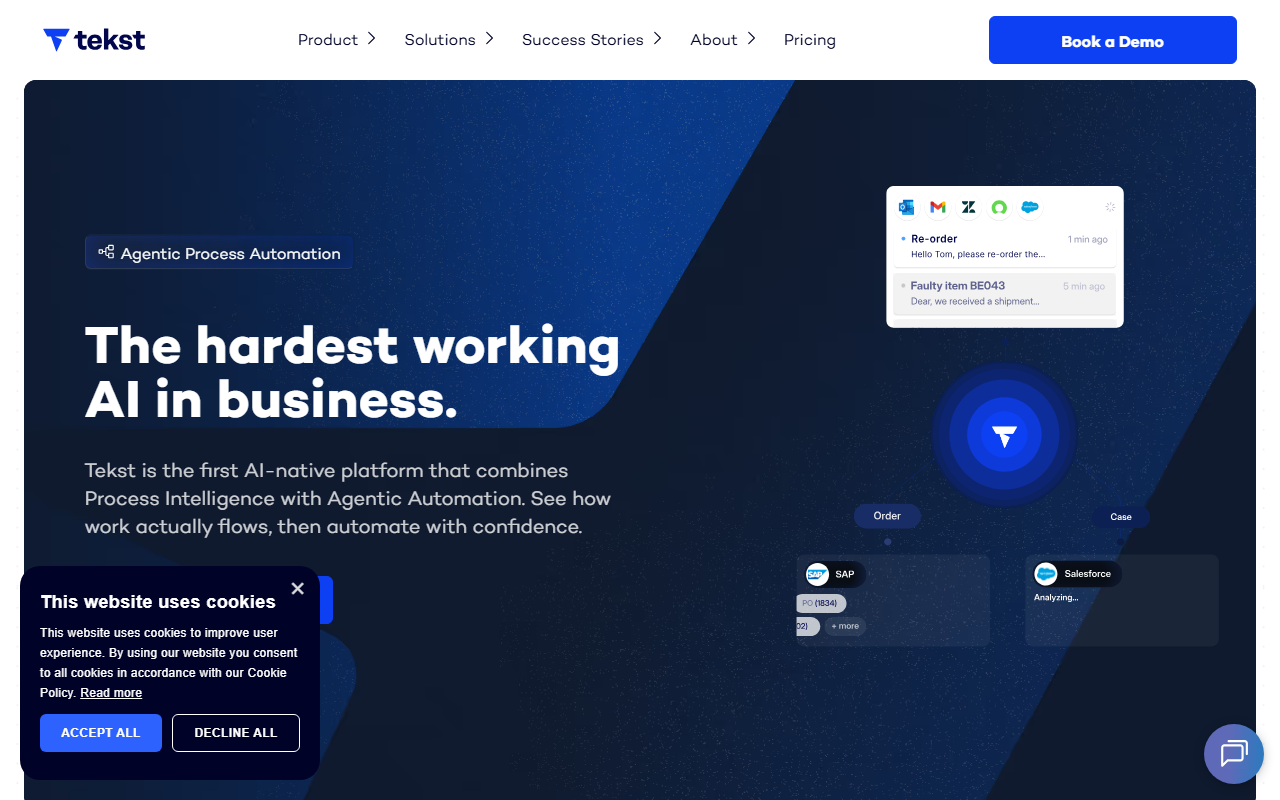
Upon visiting the Tekst.ai website, the first thing I notice is its focus on enterprise-level automation. The landing page immediately pitches “Agentic Process Automation,” promising to turn unstructured communication into actionable process intelligence. The dashboard—viewed through screenshots and demo offers—shows a clean, functional interface geared toward operations specialists. The onboarding flow appears to rely on a demo call rather than self-service trial, which matches the target audience of large organizations.
During my exploration of the free tier (which is not publicly available—only a demo is offered), I observed that Tekst emphasizes integration with existing enterprise tools. The website highlights connections to Outlook, Salesforce, SAP, and other CRM/ERP systems. The platform claims to “map how work actually flows” by ingesting emails, documents, and system data. This is not a generic chatbot; it is a specialized automation layer for high-volume operational workflows.
Key Features and Technical Depth
Tekst’s core technology revolves around process intelligence and custom-trained AI models. The platform builds a “context graph” that maps decisions, dependencies, and end-to-end workflow logic. This allows AI agents to execute tasks such as email routing, case classification, document processing (quote-to-cash, accounts payable), and shared inbox management. A standout statistic from the website is a 90% email routing accuracy achieved for Securex (a partner handling 3.2 million emails annually). Another customer reported 200% faster first response time after implementing Tekst.
The technical architecture integrates in three phases: first, connecting inboxes, CRM, ERP, and documents to capture operational interactions; second, deploying AI agents that update systems and handle exceptions; third, continuous optimization where the system learns from every interaction. Tekst claims to deliver ROI in weeks, not months, and emphasizes enterprise-grade security with full data ownership. The AI model is custom-trained on each company’s data and language(s), which is a significant differentiator from one-size-fits-all automation tools.
Pricing, Market Positioning, and Limitations
Pricing is not publicly listed on the website. The only call-to-action is to book a demo or call, which suggests a consultative, enterprise sales model. This is typical for platforms targeting large organizations with complex existing systems. Compared to competitors like UiPath (general robotic process automation) or IBM Watson Orchestrate, Tekst positions itself as more narrowly focused on communication-based workflows—email, case management, and document processing—rather than broad desktop automation. It is also distinct from simpler shared inbox tools like Front or Hiver because it adds process intelligence and multi-system automation.
Strengths include its seamless integration without requiring system overhauls, the ability to handle multiple languages, and the promise of continuous optimization. However, there are real limitations. First, the platform requires significant initial setup and partnership with Tekst’s team—there is no self-service option. Second, it is clearly designed for enterprises with high volumes; small businesses or teams with simpler workflows may find it overkill. Third, the lack of transparent pricing makes it hard to evaluate cost-effectiveness without a demo. The dependency on existing CRM/ERP systems also means companies with less digitized operations may struggle to extract full value.
Final Verdict: Who Should Use Tekst?
Tekst is best suited for large enterprises—especially those in industries like insurance, logistics, HR/payroll, and customer support—that handle millions of emails, cases, or documents annually. If your team spends hours stitching processes across Outlook, Salesforce, and SAP, Tekst’s agentic automation could dramatically reduce manual effort. The verified success stories from companies like Securex and Milcobel lend credibility. Look elsewhere if you are a small team needing a simple auto-responder or a no-code RPA tool; Tekst’s focus on process intelligence and complex integrations is tailored for scale.
To explore Tekst, you must request a demo—there is no free tier. But for enterprises drowning in unstructured communication, the potential ROI appears substantial. Visit Tekst at https://tekst.ai/ to explore it yourself.










Comments