

First Impressions: A Dashboard Built for Depth
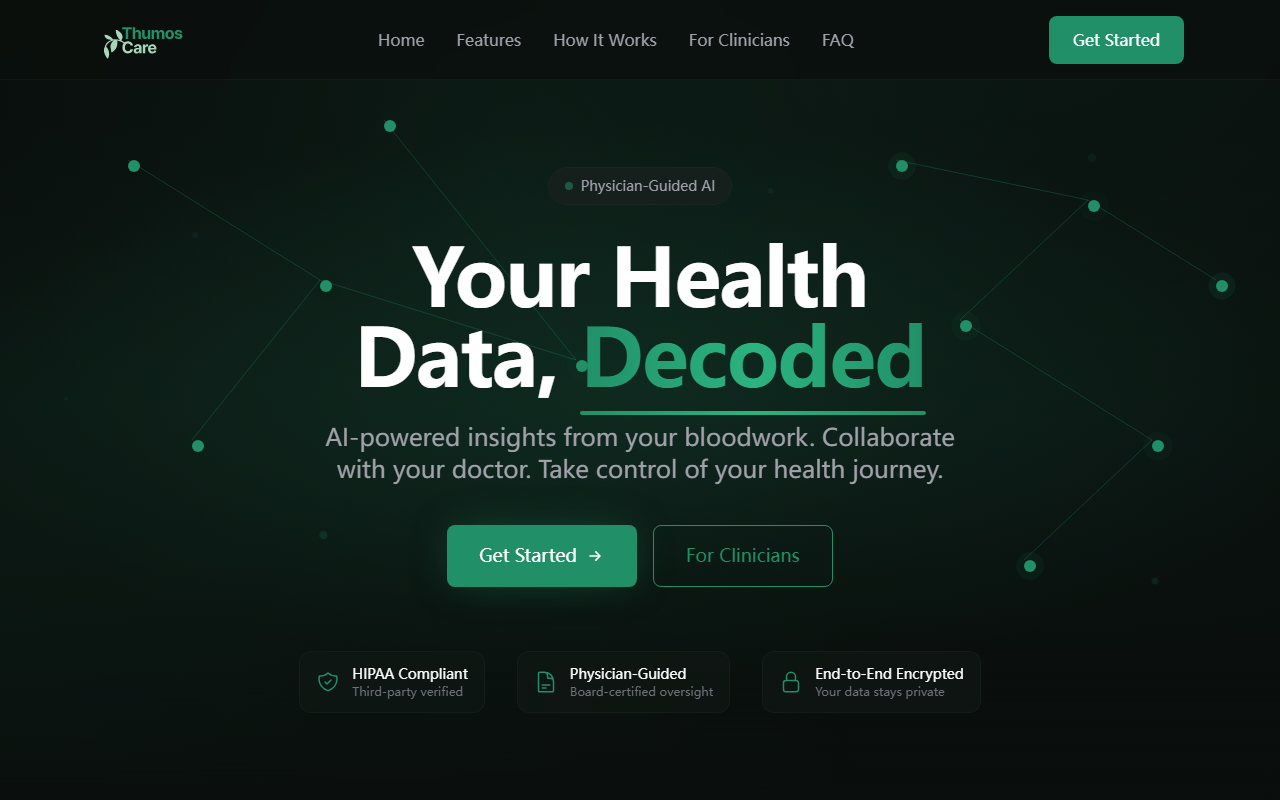
Upon visiting Thumos Care, I was struck by the clean, clinical interface. The landing page immediately sets expectations: this is not a generic wellness app. It promises physician-guided, HIPAA-compliant analysis of your lab results. The dashboard, once you create a free account, presents a clear “Add your first lab” prompt. I tested the free tier by uploading a sample blood test PDF. The extraction was nearly instantaneous, automatically mapping biomarkers like LDL, HbA1c, and TSH into system-specific cards—cardiovascular, metabolic, hormonal, immune, and more. Each card shows a status indicator (green, yellow, red) based on a knowledge graph with 130K+ biomedical relationships. That level of granularity is rare in consumer-facing AI tools; it feels more like a specialist consult than a chatbot.
How It Works: From Lab Upload to System-Wide Analysis
The workflow is straightforward: you complete a comprehensive intake covering medical history, lifestyle, supplements, and symptoms. Then you upload lab results as PDF, Excel, or manual entry. The platform extracts and organizes data, then cross-references it against that medical knowledge graph. I found the trend-tracking feature particularly useful—historical charts for every measurement, with lifestyle logs overlaid. You can chat via text or voice with a health advisor that remembers your entire profile. I asked, “What does my slightly elevated CRP mean given my recent shoulder injury?” The response cited clinical guidelines and noted the connection between inflammation and recovery. The recommendations section organizes action items by category—supplements, lifestyle, diet, follow-up testing—prioritized by urgency and linked to the affected body system. Unlike many symptom checkers, Thumos Care avoids scare tactics; it focuses on actionable, evidence-backed steps.
The Clinical Search: A Powerful Differentiator for Providers
For healthcare providers, Thumos Care offers a flagship feature: evidence-based clinical search. You can search across PubMed, Cochrane, and guidelines from USPSTF, AHA/ACC, ADA, CDC, NICE, and ESC using natural language or voice dictation. Answers come with inline citations, collapsible abstracts, DOIs, citation counts, and recommendation grades. I attached a mock patient profile—a 55-year-old with borderline hypertension—and asked about statin therapy. The AI returned a synthesized answer referencing USPSTF Grade B recommendations, with links to original studies. You can generate patient-friendly handouts directly from the search. The clinician setup wizard lets you set your risk tolerance and evidence threshold, so recommendations match your practice style. This is a serious tool for physicians who want to stay current without wading through dozens of research papers.
Pricing, Privacy, and the Bottom Line
Pricing is not publicly listed on the website beyond “Free to start, no credit card required.” The free tier appears to include unlimited lab uploads and the core analysis features. Thumos Care claims HIPAA compliance, third-party verification, and end-to-end encryption. For clinicians, patient management dashboard and clinical search are available with a free start. Compared to alternatives like InsideTracker (focused on athletic optimization) or Quest's lab interpretation, Thumos Care offers a broader system view and deeper medical evidence integration. Its main limitation: the platform is heavily dependent on data entry depth. If you skip the intake, the analysis becomes generic. Also, the AI advisor is not a substitute for a real doctor—it synthesizes evidence but cannot diagnose. Best suited for proactive patients who want to understand their lab results in full context and for clinicians seeking a time-saving evidence search. Look elsewhere if you want a quick, gamified health score.
Visit Thumos Care at https://thumoscare.com/ to explore it yourself.













Comments