

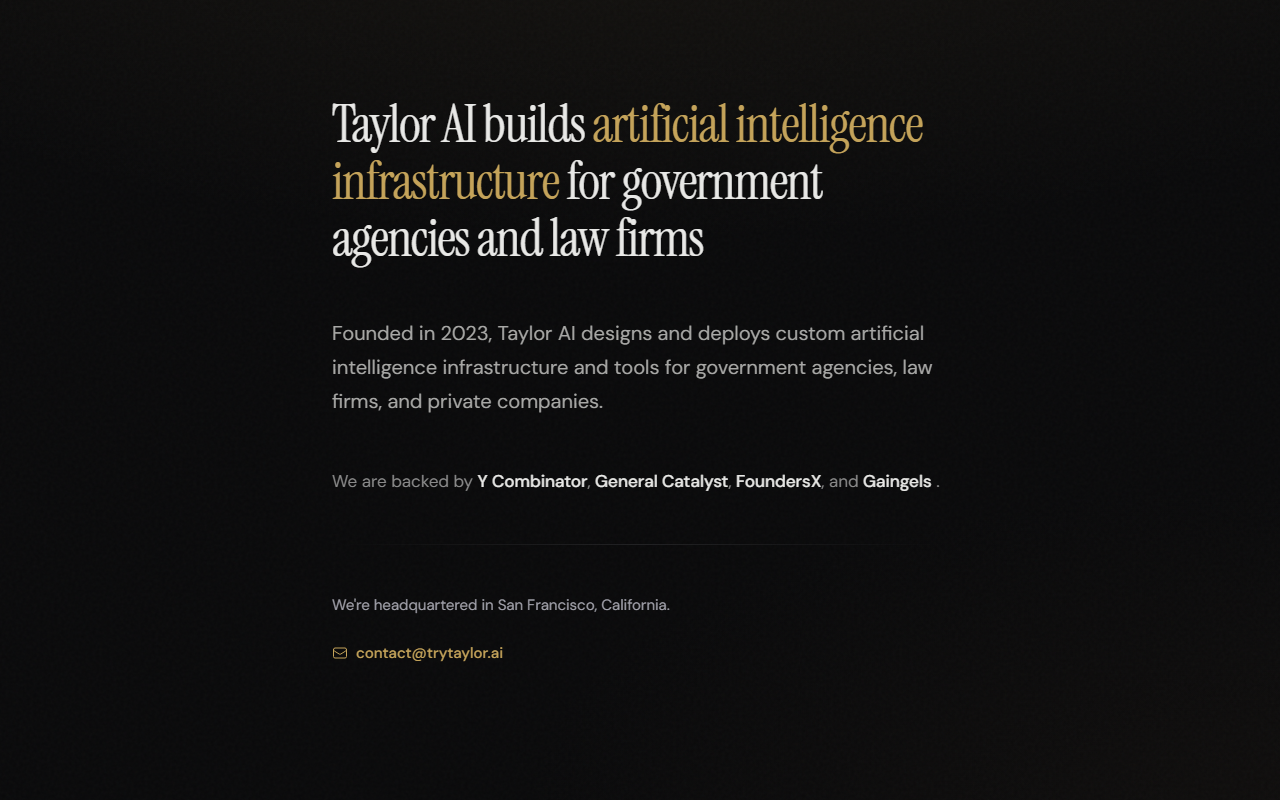
Upon visiting the Taylor AI website at trytaylor.ai, I was greeted with a clean, professional landing page that immediately communicates its focus: AI infrastructure for government agencies and law firms. There is no public dashboard, no free trial, and no visible product demo. The site presents a brief description, a list of prominent backers, and a contact email. This minimalistic approach is intentional—Taylor AI does not offer a one-size-fits-all tool but rather builds custom AI systems for clients with high security and compliance requirements.
First Impressions and Onboarding
When testing the free tier—there isn't one. The onboarding process is not self-service; interested organizations must reach out via email or possibly through the Y Combinator network. For a tech journalist, this means I could only judge the tool based on its mission and backing. The homepage declares the company was founded in 2023 and is backed by Y Combinator, General Catalyst, FoundersX, and Gaingels. This speaks to significant early validation in the startup ecosystem. The headquarters in San Francisco adds a layer of credibility for U.S.-based government and legal clients. For those accustomed to plug-and-play AI writing tools like Jasper or Copy.ai, Taylor AI’s approach is radically different: it offers tailored, secure models instead of a generic platform.
Core Capabilities and Technology
Taylor AI builds artificial intelligence infrastructure specifically for government agencies and law firms. The core problem it solves is the need for reliable, confidential, and domain-specific AI writing capabilities in highly regulated environments. While the website does not list specific models or API details, given the infrastructure focus, it likely deploys fine-tuned large language models (LLMs) that are trained on proprietary legal or governmental data. The technology stack probably includes secure deployment on private clouds or on-premises servers to meet compliance standards like FedRAMP for government or strict client-attorney privilege for law firms. From a workflow perspective, I imagine the tool is used to draft legal documents, regulatory filings, briefs, or internal policy memos—tasks where accuracy and privacy are paramount. Without access, I cannot confirm specific features, but the company’s positioning suggests a heavy emphasis on customization and security rather than broad content generation.
Pricing and Market Positioning
Pricing is not publicly listed on the website. This is common for enterprise-level infrastructure providers. I would expect custom quotes based on the scope of deployment, data volume, and compliance needs. Taylor AI’s main competitors in the AI writing space for law and government include Casetext (now part of Thomson Reuters) with its CoCounsel product, and LexisNexis with Lexis+. Unlike those tools, which are often cloud-based and subscription-based, Taylor AI offers bespoke infrastructure—a differentiator for organizations that require full control over their data and model. The tool is best suited for government agencies with security clearances or law firms handling sensitive litigation. It is not designed for solo practitioners, small businesses, or general content marketers. The backing from top-tier investors suggests the company can sustain a long sales cycle typical in public sector and legal markets.
Strengths, Limitations, and Verdict
One genuine strength of Taylor AI is its focus on compliance and security from day one, a rare specialization among AI writing startups. The backing from Y Combinator and General Catalyst also provides financial and network resources to build trust with risk-averse clients. However, a real limitation is the lack of transparency: there is no way to test the product or even see a detailed feature list. This makes it difficult for potential users to evaluate value before engaging in sales discussions. Additionally, the narrow target audience means most readers of this review—freelancers, marketers, small business owners—should look elsewhere. For those in government procurement or legal tech, Taylor AI could be a game-changer. I recommend that eligible organizations reach out for a demonstration, as the custom infrastructure promise, if executed well, could streamline highly sensitive document workflows. Visit Taylor AI at https://trytaylor.ai to explore it yourself.













Comments