

First impressions and onboarding
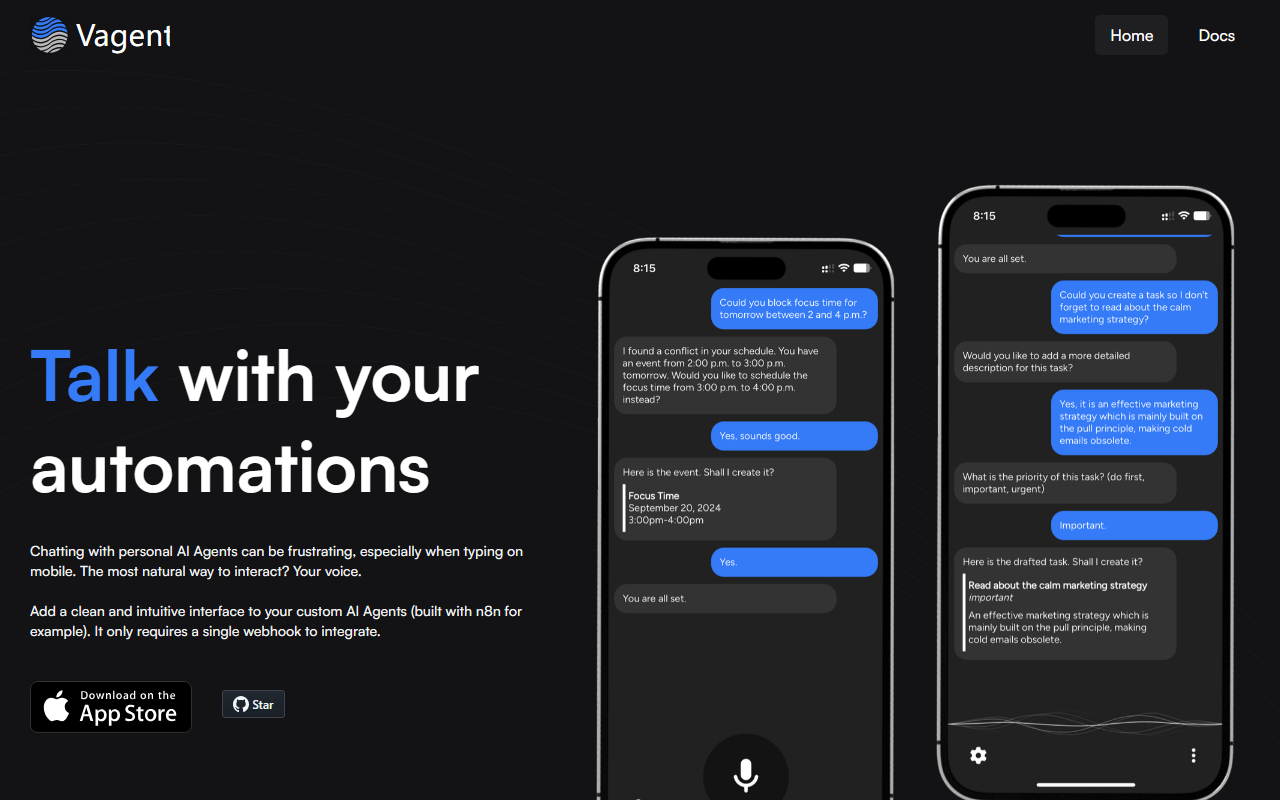
Upon visiting vagent.io, I was greeted by a clean, minimal landing page that immediately pitches the core value: “Talk with your automations.” The hero section includes a brief demo video (labelled “Watch in Action”) and a GitHub-like star button. Scrolling down reveals a feature grid and a clear call-to-action to start with an n8n workflow template or build your own backend. The site itself is fast and uncluttered — no registration wall, no pop-ups. I clicked the documentation link and found detailed setup instructions for connecting Vagent via a webhook endpoint. The onboarding flow is refreshingly straightforward: you either import a pre-built n8n workflow or configure your own backend to send/receive messages over a webhook URL provided by Vagent. For a developer framework, this low-friction entry is a smart move.
Core features and technical underpinnings
Vagent is essentially a voice front-end for custom AI agents. It solves the problem of interacting with agents on mobile — typing is slow, so voice is more natural. Under the hood, Vagent uses OpenAI’s Speech API for both voice input (transcription) and output (text-to-speech). This means the speech quality is excellent, and languages are automatically detected across 60+ locales. The integration point is a single webhook: your agent sends a JSON payload to Vagent’s endpoint, and Vagent returns audio and text responses. What caught my attention is the separation of speech and text: you can have spoken output be different from the markdown-rendered text on screen. This is a thoughtful detail for UX designers who want succinct voice replies and more detailed written output. Sessions are tied to a unique ID stored locally on your device — no data is collected by Vagent, which is a strong privacy stance. The webhook is authenticated, and you can reset the session anytime. I tested the free tier (the only tier visible) and spun up the n8n template. The Main Agent calls Sub-Agents as tools, and actions are shown as drafts before execution, requiring confirmation. This “trust but review” pattern prevents accidental automations.
Pricing, positioning, and alternatives
Pricing is not publicly listed on the website. The site only mentions no registration and no data collection — strongly implying that the basic usage is free, but there may be limits or future tiers for higher usage. I found no pricing page or API credits information. In the developer frameworks space, Vagent competes with tools like Voiceflow (which offers a visual builder for voice apps) and Botpress (a broader chatbot platform). Unlike Voiceflow, Vagent is not a full voice app builder — it’s a lightweight integration layer for existing agents. It’s best suited for developers who already have an n8n workflow or custom backend and want to add a voice interface without building a custom UI. If you’re building a complete voice assistant from scratch, Voiceflow might be more appropriate. Vagent’s strength lies in its simplicity: one webhook, zero front-end work. The project appears to be early-stage (no major funding announcements), but it’s open-sourced or at least publicly available with a star on GitHub.
Strengths, limitations, and final verdict
The biggest strength is the sheer simplicity of integration. If you can configure a webhook, you can have a voice-enabled agent in minutes. The no-registration, data-local approach builds trust. The support for 60+ languages and high-quality OpenAI speech is impressive for a tool with no upfront cost. However, there are real limitations. The tool is entirely dependent on OpenAI’s API — if you have concerns about cost or latency, that’s a factor. There’s no built-in NLP processing or agent logic; Vagent is purely a voice I/O layer. You must supply and run your own agent backend. Additionally, the lack of pricing transparency could be a hurdle for teams planning production use. Overall, Vagent is an excellent fit for developers and tinkerers who want to quickly prototype voice interactions for their n8n automations or custom agents. It is not a full voice assistant platform, but for what it does — adding voice chat to custom AI agents — it does it elegantly.
Visit Vagent at https://vagent.io/ to explore it yourself.













Comments