

First Impressions and Onboarding
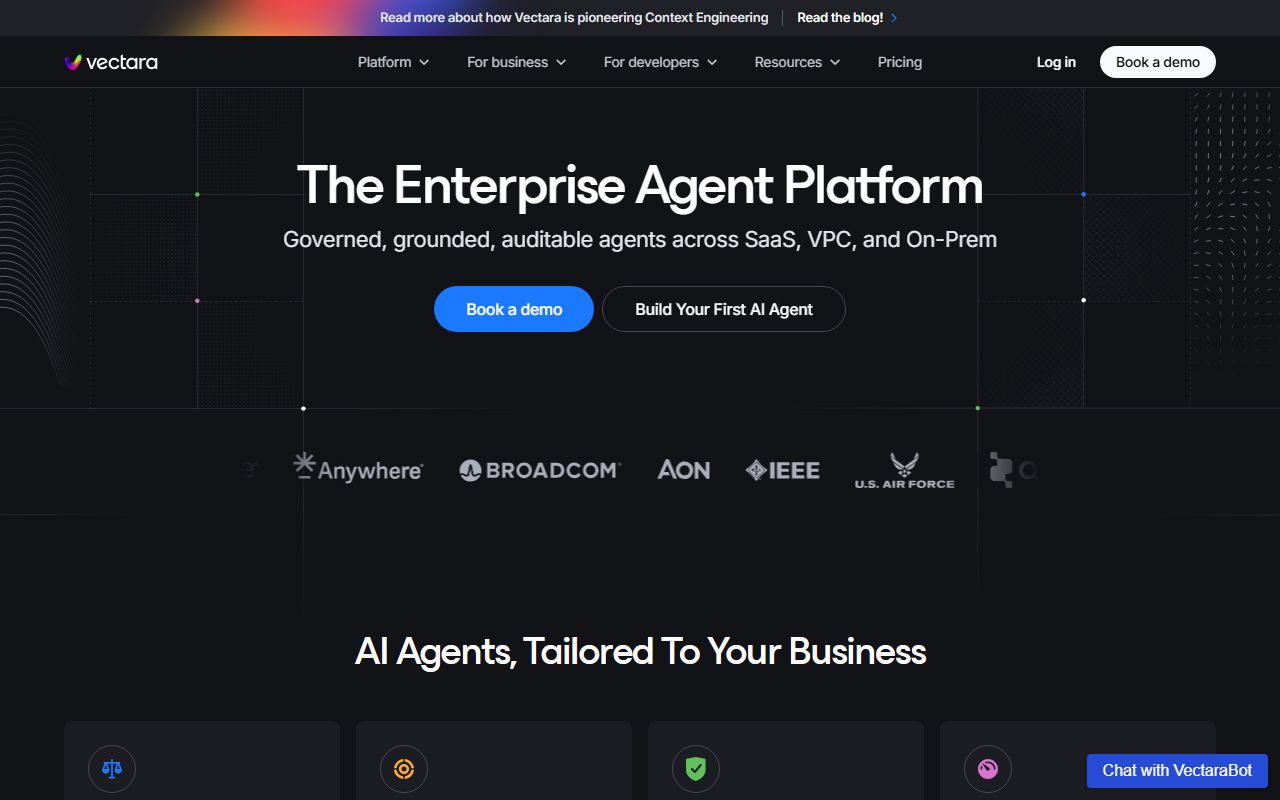
Upon visiting Vectara’s website at vectara.com, the enterprise focus is immediate. The headline “The Enterprise Agentic Platform” dominates the page, flanked by navigation links to “Log in” and “Book a demo.” A prominent call-to-action reads “Build Your First AI Agent,” but clicking reveals a demo request rather than a self-serve playground. I also noticed a blog entry titled “Read more about how Vectara is pioneering Context Engineering,” indicating a strong thought-leadership angle. The landing page is clean and professional, with sections explaining governed, grounded, and auditable agents. There is no visible pricing or free tier; the path to onboarding clearly goes through a sales conversation. This makes Vectara less accessible for casual experimentation but appropriate for serious enterprise deployments.
Core Technology and Capabilities
Vectara solves the fundamental challenge of deploying safe, compliant, and factually consistent AI agents at enterprise scale. The platform’s central innovation is “Context Engineering,” a methodology that ensures retrieval is grounded in the most relevant data, supporting multimodal inputs including text, tables, and images. Technically, Vectara is model-agnostic and supports Bring Your Own Model (BYOM), allowing integration with GPT, Claude, or open-source LLMs. It is delivered as a fully hosted service across SaaS, customer-managed VPC, and on-premises environments—a rare level of flexibility for enterprise IT. The platform also features policy-led enforcement that not only detects hallucinations but actively corrects them at runtime, with always-on audit trails for compliance. This governance-first approach sets Vectara apart from developer frameworks like LangChain or AutoGPT, which typically require users to build their own guardrails. Additionally, Vectara provides an API for integration and claims effortless scaling from a handful of agents to hundreds of applications without re-engineering.
Use Cases and Practical Observations
Testing the conceptual workflow, I imagined building an agent for semiconductor failure analysis, as highlighted in a video demo on the site. The system would ingest chip design documents and test













Comments