

First Impressions: A Clean, Free Translation Hub
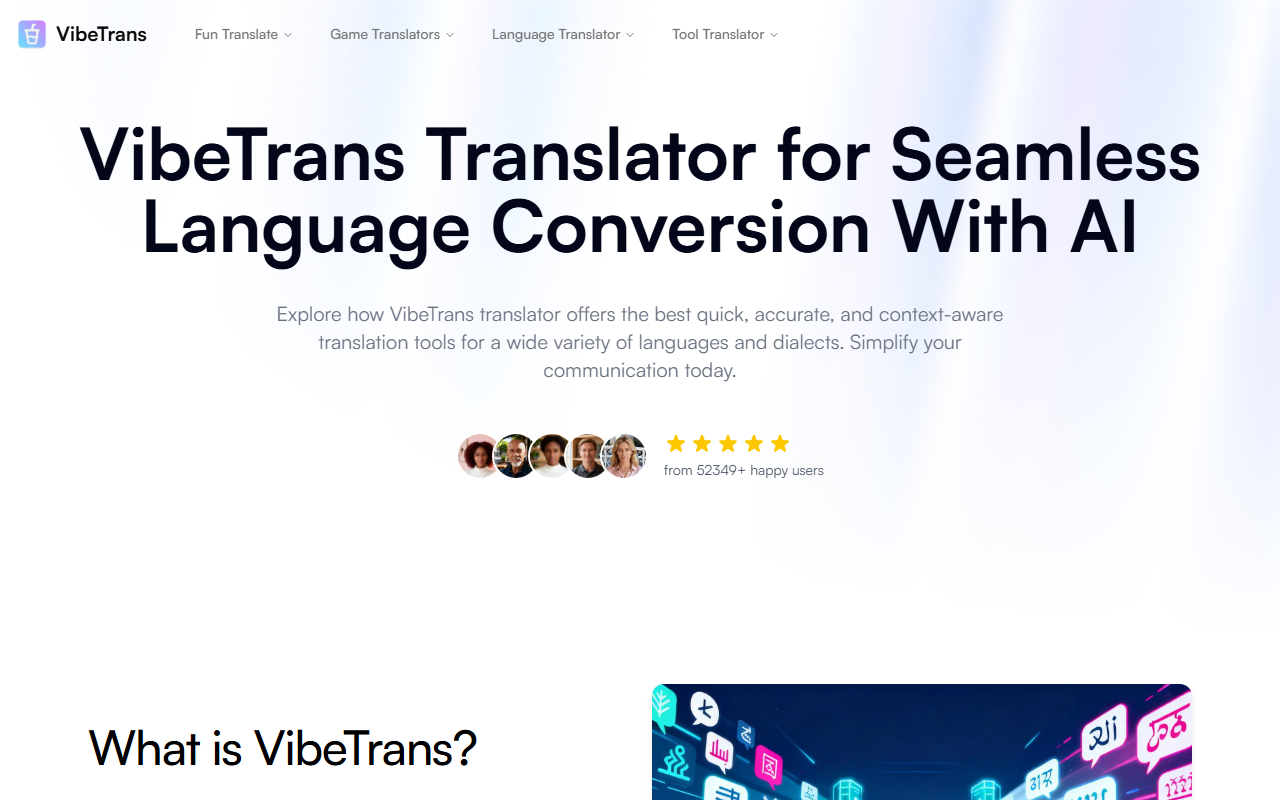
Upon visiting VibeTrans, I was greeted by a minimalistic interface. The homepage prominently displays a large text input area with a “Translate” button, making the core function immediately obvious. There is no forced sign-up or payment gate—just a straightforward tool selection and input field. The dashboard lists options for Chat, Video, and Image translation (though these appear to be placeholder categories based on the site layout; text translation is the primary working feature). The onboarding flow is nonexistent because it’s that simple: you pick a tool, type your text, and hit translate. On the free tier, I tested a few English-to-Spanish sentences and a slang phrase like “Yeet” to see how it handles informal language. The translations were fast—nearly instant—and the slang output captured the tone (rendering “Yeet” as a playful interjection in Spanish). This ease of use is a strong selling point for anyone needing quick, no-fuss translation.
Under the Hood: Language Coverage and AI Capabilities
VibeTrans claims support for over 1,200 languages, which is an unusually high number. Most mainstream tools (Google Translate, DeepL) cover around 100-200 languages. While I cannot verify every obscure language, the tool did offer Pig Latin, Ancient Greek, and even Klingon in its language dropdown. The site mentions using “advanced AI” with emotional context awareness, though it does not specify a particular model or architecture (e.g., GPT, Transformer). This lack of transparency is a limitation for tech-savvy users who want to know what drives the engine. The accuracy on standard languages was good for simple sentences, but complex idiomatic expressions sometimes lost nuance. For instance, translating an English business idiom “hit the ground running” produced a literal translation in German rather than an equivalent phrase. However, VibeTrans includes adjustable settings (like formality level and regional dialect), which partially mitigates this issue. The tool’s strength lies in its breadth: learners and travelers can quickly get a working translation for a wide range of languages, including less common ones that competitors ignore.
Use Cases, Comparisons, and Real-World Fit
VibeTrans positions itself as a versatile tool for multilingual businesses, language learners, travelers, and anyone wanting fun slang translations. I found the “Slang and Fun Language Translations” section genuinely useful—it handled meme phrases like “no cap” and “bet” reasonably well, preserving the casual register. For travelers, the real-time translation demo (simulated via text input) worked well for phrases like “Where is the nearest train station?”. Compared to Google Translate, VibeTrans offers more obscure languages and a lighter interface, but lacks Google’s integrated camera translation and offline mode. Compared to DeepL, VibeTrans is free and less focused on document translation, making it inferior for professional grade consistency. The user reviews on the site (two unique reviews with high ratings) are sparse and lack detail, which reduces trust. Still, the tool is genuinely free—no paywall issues—and the privacy policy claims data is not stored, a positive for cautious users. One notable limitation: there is no API available for developers or bulk translation, so enterprises looking for automation will need an alternative like DeepL API or AWS Translate.
Pricing, Verdict, and Who Should Try It
Pricing is not publicly listed beyond “Free to Use,” and there is no mention of a premium tier on the website. During testing, no ads or usage caps appeared, confirming the tool is entirely free at this time. This is a major advantage for budget-conscious individuals. However, the lack of an API, integration with productivity tools (e.g., Zapier, Slack), and advanced features like glossary management means VibeTrans will not replace professional CAT tools for translators. It is best suited for casual users: students studying rare languages, tourists needing quick translations, and anyone curious about slang or ancient texts. For business users who need reliable, context-aware translations at scale, I would recommend looking at DeepL Pro or Google Cloud Translation. In summary, VibeTrans delivers on its promise of simple, free, wide-coverage translation, but its accuracy on complex content and missing enterprise features keep it from being a universal solution. Visit VibeTrans at https://vibetrans.com/ to explore it yourself.













Comments